Featured series

Campus & Community
A historian for the ages
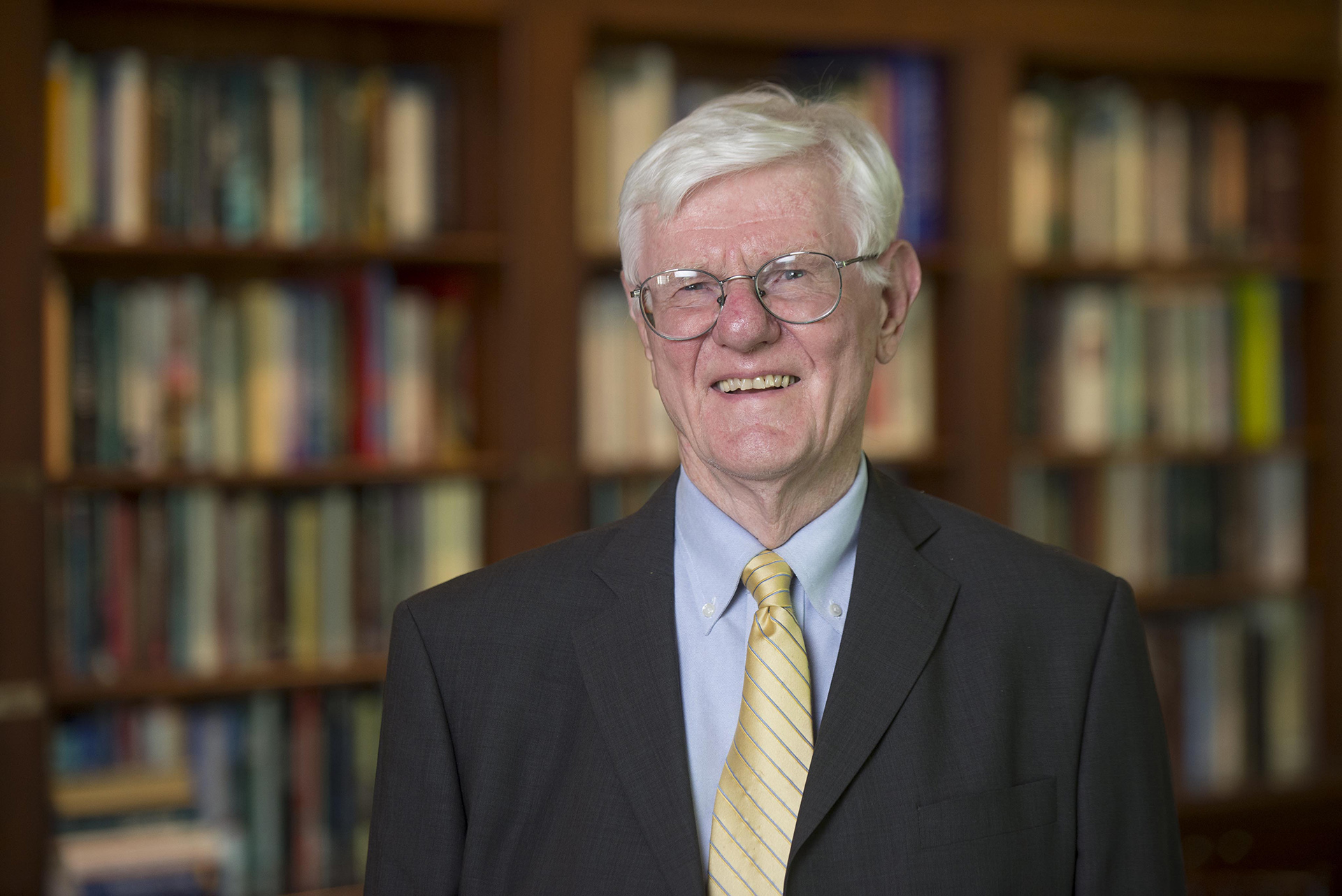
Photo by Tony Rinaldo
It was OK to disagree with Gordon Wood, but you couldn’t ignore him
Gordon Wood didn’t just tell readers about the Revolution. Like no other historian, he helped them feel it.
“What Gordon did was to capture the liveliness — the electricity — of these opening debates in 1775 and 1776, when Americans were about to write new constitutions of government, and they were going to be able to apply their aspirations and inspirations in this process,” said Jack Rakove, Ph.D. ’75, a Stanford historian.
Wood, a Brown University professor emeritus who received his Ph.D. in history from Harvard in 1964, died June 7 at age 92 after being hit by a car in Providence, R.I. His achievements won’t soon be surpassed, according to fellow scholars and former students.
“His work on the Revolution and the founding period has shaped the way we teach it, and no one knew the founding or the characters involved better than he did,” said Robert Allison, Ph.D. ’92, a Suffolk University historian who also teaches at Harvard Extension School. “Wood’s first book is still the place to start to understand how states formed new governments after independence.”
That book, “The Creation of the American Republic,” published in 1969, won the Bancroft Prize and was praised as a landmark in the study of the Revolution. He would dig deeper into the birth of the nation in the nine books that followed, one of which, “The Radicalism of the American Revolution” (1991), won a Pulitzer Prize. In 2011, he was awarded the National Humanities Medal by President Obama for “scholarship that provides insight into the founding of the nation.”
Wood’s research was pathbreaking, said Annette Gordon-Reed, Carl M. Loeb University Professor at Harvard.
“More than any other modern historian, his work set a standard that has been accepted and argued with from the moment his first book, ‘The Creation of the American Republic,’ appeared,” she said.
The standard was defined in part by Wood’s talent as a writer, according to Boston College Law Professor Mary Bilder, J.D. ’90, Ph.D. ’2000.
“‘Creation’ was no popular trade press volume,” she said. “It was detailed, dense, intellectually challenging, heavy with footnotes, filled with nuanced transformations. But Wood’s writing enthralled the reader. He made the history of constitutions puzzling and fascinating. With one book, Wood helped many of us fall in love with constitutional history.”
Rakove, who is editing a Wood essay collection set to be published next year, remembered a scholar who stood out for his sophistication and intellectual ambition. “Other historians in the early 20th century had looked at these issues, but they approached it in a straightforward and unimaginative way,” he said.
“From his first book to his last, his was the interpretation everyone else had to address.”
Bruce H. Mann
Wood was not a humorless academic. He found it amusing when his name was mentioned in a barroom scene in the film “Good Will Hunting,” earning him what he called “his two seconds of fame.” In a 2015 interview with the Los Angeles Review of Books, he said, “More kids know about that than any of the books I have written.”
The books were sometimes controversial. Wood was criticized by younger historians for not including issues of race and gender in his study of the founding era. Yet even scholars who disagreed with him had no choice but to engage with his work, said Bruce H. Mann, Carl F. Schipper Jr. Professor of Law at Harvard Law School.
“From his first book to his last, his was the interpretation everyone else had to address,” said Mann. “He relished debate. Although criticized for not giving non-elite voices their due, throughout his career he vigorously and brilliantly advanced the argument for the transformative power of ideas in the creation of the American republic.”
Mann, who was Wood’s student at Brown, recalled his lectures with a mix of warmth and awe.
“He was a stunning lecturer,” he said. “I remember sitting transfixed, and then excited, by what I was hearing. Whether or not they became historians themselves, his students learned lessons about history that none of us forgot.”
In a 2021 interview at the Museum of the American Revolution, Wood spoke of the importance of teaching history with all its imperfections and triumphs, and his optimism for the future of the country.
“Our story is worth telling,” he said. “It’s an extraordinary saga, filled with irony. Most of it is ironic except when it’s tragic. I don’t think we can hold our nation together if we are not proud of our country. But you have to accept all of the sins, all of the faults as well as the achievements.”