
 Featured series


Tag: lasers
-
Science & Tech
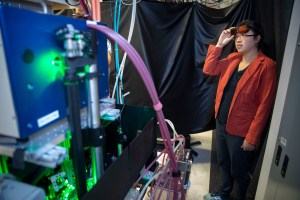
Mystery of the missing molecules
When scientists moved from manipulating atoms to messing with molecules, molecules started to disappear from view. Professor Kang-Kuen Ni has figured out why.
-
Science & Tech
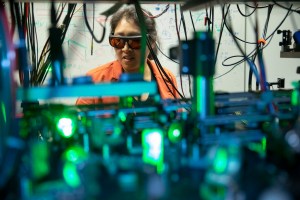
Catching lightning in a bottle
Harvard researchers have performed the coldest reaction in the known universe by capturing a chemical reaction in its most critical and elusive act.
-
Science & Tech
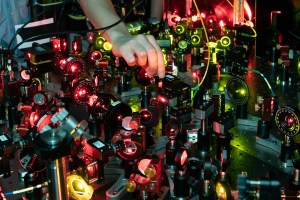
Tiny tweezers
Using precisely focused lasers that act as “optical tweezers,” Harvard scientists have been able to capture and control individual ultracold molecules – the eventual building-blocks of a quantum computer – and study the collisions between them in more detail than ever before.
-
Science & Tech
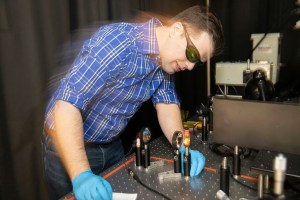
Seeing things in a different light
Harvard researchers are using a chemical process known as triplet fusion upconversion to transform near-infrared photons into high-energy photons. The high-energy photons could be used in a huge range of applications, including a new type of precisely targeted chemotherapy, in which low-energy infrared lasers that penetrate deep into the body could be used to transform…
-
Science & Tech
Researchers create quantum calculator
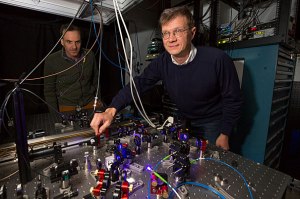
Researchers have developed a special type of quantum computer, known as a quantum simulator, that is programmed by capturing super-cooled rubidium atoms with lasers and arranging them in a specific order, then allowing quantum mechanics to do the necessary calculations.
-
Health
Lasering in on tumors
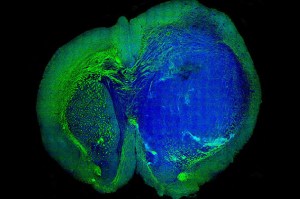
In the battle against brain cancer, doctors now have a new weapon: an imaging technology that will make brain surgery dramatically more accurate by allowing surgeons to distinguish between brain tissue and tumors, and at a microscopic level.
-
Health
Controlling behavior, remotely
Researchers have been able to take control of tiny, transparent worms by manipulating neurons in their brains, using precisely targeted pulses of laser light.

-
Science & Tech
SEAS brings good things to light
By nestling quantum dots in an insulating egg-crate structure, researchers at the Harvard School of Engineering and Applied Sciences have demonstrated a robust new architecture for quantum-dot light-emitting devices (QD-LEDs).

-
Science & Tech
Researchers demonstrate highly directional terahertz laser rays
A collaborative team of scientists at Harvard and the University of Leeds have demonstrated a new terahertz (THz) semiconductor laser that emits beams with a much smaller divergence than conventional THz laser sources. The advance, published in NatureMaterials, opens the door to a wide range of applications in terahertz science and technology. Harvard has filed…
-
Science & Tech
Scientists demonstrate highly directional semiconductor lasers
Applied scientists at Harvard collaborating with researchers at Hamamatsu Photonics in Hamamatsu City, Japan, have demonstrated, for the first time, highly directional semiconductor lasers with a much smaller beam divergence than conventional ones. The innovation opens the door to a wide range of applications in photonics and communications. Harvard University has also filed a broad…
-
Science & Tech
Creating semiconductor lasers
Lasers are often considered to be highly directional light sources: their beams are able to propagate over long distances without substantial spreading. This, however, is not always the case. Semiconductor lasers, the most commonly used among all lasers, suffer from a large beam divergence. Such divergence is governed by the principle of diffraction, which predicts…
-
Science & Tech
Laser precision added to search for new Earths
Harvard scientists have unveiled a new laser-measuring device that they say will provide a critical advance in the resolution of current planet-finding techniques, making the discovery of Earth-sized planets possible. The discovery of planets outside of our solar system, called “exoplanets,” is one of the hottest fields in astronomy and holds great promise to increase…
-
Science & Tech
Compact, wavelength-on-demand Quantum Cascade Laser chip created
Engineers at Harvard’s School of Engineering and Applied Sciences have demonstrated a highly versatile, compact and portable Quantum Cascade Laser sensor for the fast detection of a large number of chemicals, ranging from infinitesimal traces of gases to liquids, by broad tuning of the emission wavelength. The potential range of applications is huge, including homeland…
-
Campus & Community
Body art for the faint of heart
Ever wish you could get rid of that tattoo of barbed wire around your wrist, or the forearm-length dragon you once thought of as so stylish or macho? It’s not easy. You can go through a long, expensive series of laser treatments, and still not get it completely erased. You can have it sanded off,…
-
Campus & Community
Harvard scientists develop ‘plug and play’ laser
Engineers and applied physicists have demonstrated the feasibility of a new type of plug-in laser that could lay the groundwork for wide-ranging security applications. Their Raman injection laser, described in the most recent issue of the journal Nature, combines the advantages of nonlinear optical devices and semiconductor injection lasers with a compact “plug and play”…
-
Campus & Community
Lasers produce slow, cold antiatoms
A new way to make colder atoms of antimatter has been found. It could help bring scientists closer to understanding why we, and everything else, are made out of matter instead of antimatter.
-
Science & Tech
New use found for black silicon
In 1999, Harvard researchers used laser pulses to etch the surface of silicon, the most common substance used in electronic devices. By accident, they created a material that efficiently traps light. Called black silicon, it holds amazing potential for efficiently converting sunlight to electricity, for communicating by light, and for monitoring the environment for evidence…
-
Health
New treatment effective against psoriasis
Psoriasis is a skin disease that disfigures people’s bodies with scaly red plaques. Thirteen patients had portions of their psoriasis patches irradiated with intense beams of ultraviolet laser light at Massachusetts General Hospital. Other parts of the plaques were left untreated for comparison. After only five treatments, one patient’s redness, scales, and discomfort disappeared from…
-
Science & Tech
Black silicon: A new way to trap light
Eric Mazur, Harvard College Professor and Gordon McKay Professor of Applied Physics, and his students were studying what kinds of new chemistry can occur when lasers shine on metals, like platinum. One day, they decided to put a chip of gray silicon into a vacuum chamber, add some halogen gas, and scan it with ultrashort,…