
 Featured series

Tag: Harvard Medical School
-
Science & Tech
Stimulus funds provide welcome research boost
In remarks last month at the National Institutes of Health (NIH) in Bethesda, Md., President Barack Obama said not only do we need stimulus money to create thousands of jobs in the sciences and technology, but also to get the progress of the nation’s research back on track. “We can only imagine the new discoveries…
-
Campus & Community
Body’s Own Antioxidant May Slow Parkinson’s Decline, Study Says
Today’s study “suggests a new approach in slowing down the rate of the disease,” said Schwarzschild, an associate professor of neurology at Harvard Medical School, in an Oct. 9 telephone interview. “People live with Parkinson’s disease for decades. We want to make those decades much more manageable and keep people much more mobile….”
-
Health
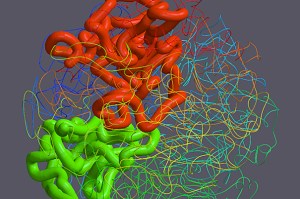
A look inside
Scientists have deciphered the three-dimensional structure of the human genome, paving the way for new insights into genomic function and expanding our understanding of how cellular DNA folds at scales that dwarf the double helix.
-
Health
Three Harvard teams to receive $9 million each in federal funding for stem cell research
Three teams of Harvard Stem Cell Institute (HSCI) researchers are slated to receive $27 million over seven years in National Heart Lung and Blood Institute (NHLBI) grants for the development of stem-cell based tools and treatments to understand and treat cardiovascular and blood disorders. The NHLBI Progenitor Cell Biology Consortium will consist of nine research…
-
Health
Harvard team reports major step forward in cell reprogramming
A team of Harvard Stem Cell Institute (HSCI) researchers has made a major advance toward producing induced pluripotent stem cells, or iPS cells, that are safe enough to use in treating diseases in patients. “This demonstrates that we’re halfway home, and remarkably we got halfway home with just one chemical,” said Kevin Eggan, an HSCI…
-
Nation & World
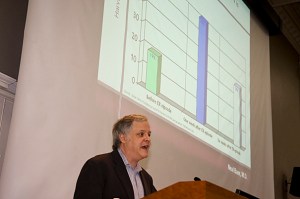
Educational merits of TV
A lecture series at the Harvard Graduate School of Education explores the benefits of learning through entertainment. This most recent lecture featured Neal Baer, Ed.M.’79, A.M. ’82, M.D. ’96, executive producer of “Law & Order: Special Victims Unit,” a network television crime drama.
-
Campus & Community
U.S. study shows mammograms save lives
“The most effective method for women to avoid death from breast cancer is to have regular mammographic screening,” Dr. Blake Cady of Cambridge Hospital Breast Center and Harvard Medical School in Massachusetts told reporters in a telephone briefing…
-
Health
Jack Szostak 2009 Nobel Laureate in Physiology or Medicine
Jack Szostak, a genetics professor at Harvard Medical School and Harvard-affiliated Massachusetts General Hospital (MGH), has won the 2009 Nobel Prize in physiology or medicine for pioneering work in the discovery of telomerase, an enzyme that protects chromosomes from degrading. The work not only revealed a key cellular function, it also illuminated processes involved in…
-
Health
Not having health insurance is expensive
New findings from researchers at Harvard Medical School (HMS) demonstrate that individuals who were either continuously or intermittently uninsured between the ages of 51 and 64 cost Medicare more than those who had continuous insurance coverage in the years prior to Medicare eligibility. On average, those who were previously uninsured cost Medicare an additional $1,000…
-
Campus & Community
‘Immortality Enzyme’ Wins Three Americans Nobel Prize
Three American scientists, including Jack W. Szostak, genetics professor at Harvard Medical School and Massachusetts General Hospital, shared the Nobel Prize in medicine for research linked to telomerase, an “immortality enzyme” that allows cells to divide continuously without dying and could play a role in the uncontrolled spread of cancer cells.
-
Campus & Community
Nobel Prize in Medicine shared by Harvard Medical School professor
Jack W. Szostak, a professor of genetics at Harvard Medical School, is one of three winners of the Nobel Prize in Physiology or Medicine this year, with Elizabeth Blackburn of the University of California, San Francisco, and Carol W. Greider of Johns Hopkins University School of Medicine….
-
Campus & Community
Telomerase work wins Szostak Nobel Prize in medicine
Jack W. Szostak, a genetics professor at Harvard Medical School and Harvard-affiliated Massachusetts General Hospital (MGH), has won the 2009 Nobel Prize in physiology or medicine for work on cellular structures called telomeres, which protect chromosomes from degradation.

-
Science & Tech
Donald Ingber awarded the 2009 BMES Pritzker Distinguished Lectureship for outstanding achievements, originality and leadership
Donald Ingber, M.D., Ph.D., founding director of the Wyss Institute for Biologically Inspired Engineering at Harvard University, has been awarded the Biomedical Engineering Society’s prestigious Pritzker Distinguished Lectureship for 2009. The lectureship recognizes outstanding achievements, a high level of originality and leadership in the science and practice of biomedical engineering. Presentation of the award, a…
-
Campus & Community
Leon Eisenberg, pioneering child psychiatrist, dies at 87
Leon Eisenberg, the Maude and Lillian Presley Professor of Social Medicine Emeritus at Harvard Medical School (HMS), died on Sept. 15 at the age of 87.
-
Campus & Community
Quest for a Long Life Gains Scientific Respect
In mice, sirtuin activators are effective against lung and colon cancer, melanoma, lymphoma, Type 2 diabetes, cardiovascular disease and Alzheimer’s disease, said David Sinclair, a Harvard Medical School researcher and co-founder of Sirtris. The drugs reduce inflammation, and if they have the same effects in people, could help combat many diseases that have an inflammatory…
-
Science & Tech
Huybers and Mahadevan named MacArthur Foundation Fellows
Two Harvard faculty members who study present and past ice sheets and the science behind familiar objects and everyday events have been named recipients of prestigious MacArthur Foundation “genius” grants. This year’s awards, announced today by the John D. and Catherine T. MacArthur Foundation, go to Assistant Professor of Earth and Planetary Sciences Peter Huybers…
-
Health
New study finds 45,000 deaths annually linked to lack of health coverage
Nearly 45,000 annual deaths are associated with lack of health insurance, according to a new study published online today by the American Journal of Public Health. That figure is about two and a half times higher than an estimate from the Institute of Medicine (IOM) in 2002. The study, conducted at Harvard Medical School and…
-
Health
Drug for MS reactivates virus causing deadly brain disease
The virus responsible for progressive multifocal leukoencephalopathy (PML), a rare brain disease that typically affects AIDS patients and other individuals with compromised immune systems, has been found to be reactivated in multiple sclerosis patients being treated with natalizumab (Tysabri). The findings by Harvard researchers at Beth Israel Deaconess Medical Center (BIDMC) and collaborators at Johns…
-
Campus & Community
Memorial service for Dean Tosteson
A memorial service will for Daniel Tosteson will be held at the Memorial Church, Harvard Yard, on Sept. 30 at 3 p.m.
-
Health
Neural response to electrical currents isn’t localized, as previously believed
For more than a century, scientists have been using electrical stimulation to explore and treat the human brain. The technique has helped identify regions responsible for specific neural functions and has been used to treat a variety of conditions from Parkinson’s disease to depression. Yet no one has been able to see what actually happens…
-
Health
Low-carb diets linked to atherosclerosis and impaired blood vessel growth
Even as low-carbohydrate/high-protein diets have proven successful at helping individuals rapidly lose weight, little is known about the diets’ long-term effects on vascular health. Now, a study led by team of Harvard researchers at Beth Israel Deaconess Medical Center (BIDMC) provides some of the first data on this subject, demonstrating that mice placed on a…
-
Health
Study finds promise in combined transplant/vaccine therapy for high-risk leukemia
Two of the most powerful approaches to cancer treatment — a stem cell transplant and an immune system-stimulating vaccine — appear to reinforce each other in patients with an aggressive, hard-to-control form of leukemia, Harvard scientists at Dana-Farber Cancer Institute (DFCI) have found. The researchers report that patients with high-risk acute myeloid leukemia (AML) or…
-
Health
New metabolic safeguards against tumor cells revealed
Cells don’t like to be alone. In the early stages of tumor formation, a cell might be pushed out of its normal home environment due to excessive growth. But a cell normally responds to this homeless state by dismantling its nucleus, packing up its DNA, and offering itself to be eaten by immune system cells.…
-
Health
Study supports DNA repair-blocker research in cancer therapy
Scientists at Dana-Farber Cancer Institute have uncovered the mechanism behind a promising new approach to cancer treatment: damaging cancer cells’ DNA with potent drugs while simultaneously preventing the cells from repairing themselves. The findings, reported in the Aug. 14 edition of Molecular Cell, help explain the promising results being seen in clinical trials of compounds…
-
Health
NIH renews Harvard Center for AIDS Research grant for another five years
The National Institutes of Health has renewed for five years – and $18.1 million – the funding for the Harvard University Center for AIDS Research (Harvard CFAR). Harvard is one of only 20 NIH CFAR sites in the U.S. and first received the designation in 2004. The award, under the umbrella of the Harvard Initiative…
-
Health
Kauffman Foundation awards researcher entrepreneurial fellowship
Praveen Kumar Vemula, a postdoctoral researcher in the Karp Lab at Brigham and Women’s Hospital, is one of 13 researchers to receive the Kauffman Foundation Entrepreneurial Postdoctoral Fellowship Award. Vemula was selected in part for his entrepreneurial vision to take lab research to market and for his recent breakthrough research with Jeffrey Karp, instructor in…
-
Health
Postdiagnosis aspirin use reduces risk of dying from colorectal cancer
Regular use of aspirin after colorectal cancer diagnosis may reduce the risk of cancer death, report Harvard researchers at Massachusetts General Hospital (MGH), Dana-Farber Cancer Institute (DFCI) and Brigham and Women’s Hospital. In today’s edition of the Journal of the American Medical Association, the study’s authors also find that the aspirin-associated survival advantage was seen…
-
Health
New steps forward in cell reprogramming
Harvard Stem Cell Institute (HSCI) researchers at Massachusetts General Hospital (MGH) have substantially improved the odds of successfully reprogramming differentiated cells into induced pluripotent stem cells (iPS) by blocking the activity of the gene that instructs the cells to stop dividing. Konrad Hochedlinger and colleagues at the MGH Center for Regenerative Medicine also found that…
-
Health
Scientists create energy-burning brown fat in mice
Harvard researchers at Dana-Farber Cancer Institute have shown that they can engineer mouse and human cells to produce brown fat, a natural energy-burning type of fat that counteracts obesity. If such a strategy can be developed for use in people, the scientists say, it might open a novel approach to treating obesity and diabetes. A…
-
Health
MGH researchers develop potentially safer general anesthetic
News release — Mass. General team develops potentially safer general anesthetic A team of Harvard Medical School (HMS) researchers at Massachusetts General Hospital (MGH) has developed a new general anesthetic that may be safer for critically ill patients. In the August issue of Anesthesiology, they describe preclinical studies of the drug called MOC-etomidate – a…