
 Featured series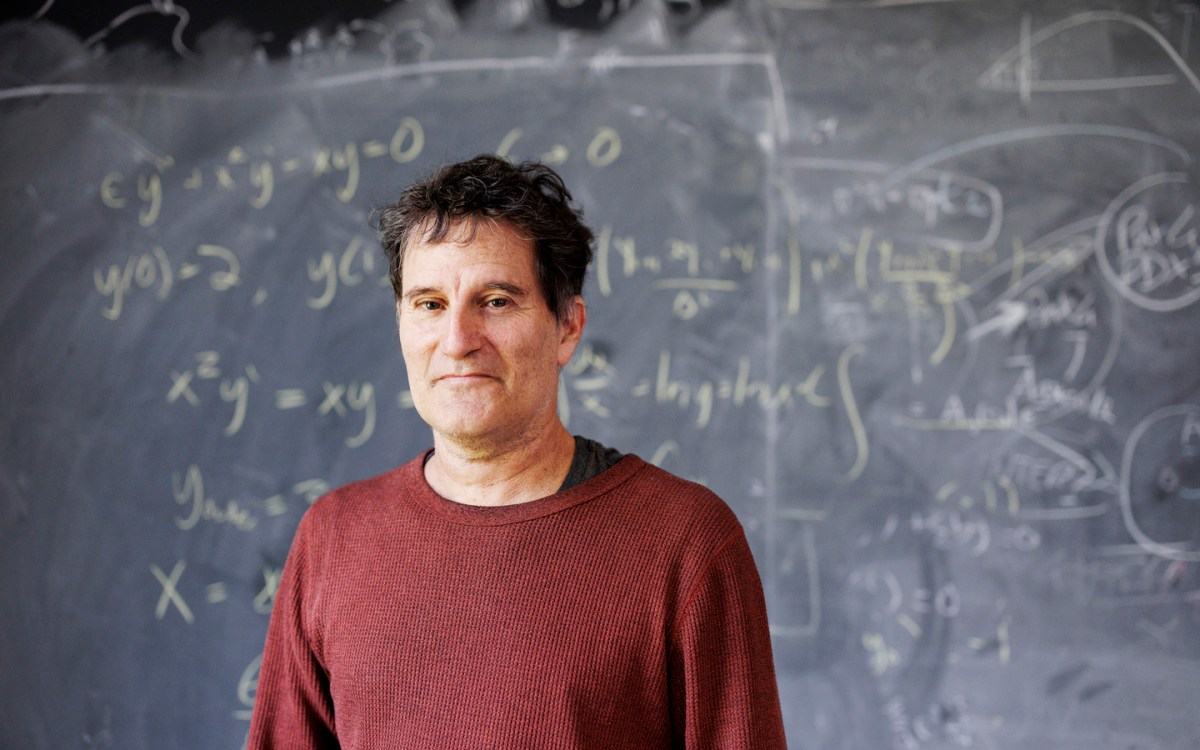

Tag: Faculty of Arts and Sciences
-
Science & Tech
Super-Earths may be three times more common than Jupiters
Astronomers have discovered a new “super-Earth” orbiting a red dwarf star located about 9,000 light-years away. This newfound world weighs about 13 times the mass of the Earth and is probably a mixture of rock and ice, with a diameter several times that of Earth. It orbits its star at about the distance of the…
-
Campus & Community
Countway reveals ‘buried’ treasures
There is something about the physical manifestations of history that communicate both intellectual heft and inspirational authority. Which is why Longwood’s Francis A. Countway Library of Medicine — the largest academic medical library in the nation — has launched a new campaign to ensure that the artifacts in its vast collection are brought to light,…
-
Campus & Community
Yau travels down the road less taken
Horng-Tzer Yau’s affinity for mathematics was obvious in high school, where, in his native Taiwan, he began studying advanced calculus and college algebra. He developed an interest in physics at the same time and was intrigued by relativity and quantum mechanics. At the National Taiwan University, Yau’s focus remained on mathematics. It was in Princeton…
-
Health
The ‘widow effect’ is real
In findings that highlight how health effects can reverberate through a social network, a researcher at HMS and his colleague report that the serious illness of an elderly spouse increases the risk of death of a husband or wife. In fact, a few illnesses in a spouse, such as dementia, may pose more of a…
-
Campus & Community
Study says ‘widower effect’ is real
A spouse’s illness can not only be bad for your health, it can kill you, according to a new study of couples over age 65 that highlights the importance of social networks to a person’s health. The study, by researchers at Harvard Medical School and the University of Pennsylvania, shows that the impact of a…
-
Campus & Community
Music Dept.’s beloved Elliot Forbes, 88
Elliot Forbes, the Fanny Peabody Professor of Music Emeritus, died Jan. 10 at his home in Cambridge, Mass. He was 88. A member of an old Boston family with numerous Harvard connections, Forbes was the son of Fogg Museum Director Edward Waldo Forbes and the great-grandson of poet and essayist Ralph Waldo Emerson.
-
Campus & Community
Gift from Jordans advances FAS, health research
The Faculty of Arts and Sciences (FAS) and disease-fighting researchers across Harvard are the recipients of Jerry and Darlene Jordan’s recent $10 million gift to the University. The gift is just the latest expression of the Jordans’ generosity: Over the years, Jerry ’61, M.B.A. ’67, and Darlene Jordan have funded financial aid, athletics, and other…
-
Campus & Community
Skocpol joins Radcliffe as senior adviser
Theda Skocpol, dean of the Graduate School of Arts and Sciences (GSAS), has accepted a three-year term as a Radcliffe Institute for Advanced Study senior adviser in the social sciences, effective Jan. 1.
-
Campus & Community
Sidanius named professor of African American Studies
James H. Sidanius, a psychologist best known for establishing and refining an influential theory of social dominance along lines of gender, age, race, and class, has been named professor of psychology and of African and African American Studies in Harvard University’s Faculty of Arts and Sciences, effective Jan. 1.
-
Campus & Community
Memorial services
Memorial services for David Westfall, William W. Howells, and Marion R. Briefer
-
Science & Tech
Neutron star swaps lead to short gamma-ray bursts
Gamma-ray bursts are the most powerful explosions in the universe, emitting huge amounts of high-energy radiation. For decades their origin was a mystery. Scientists now believe they understand the processes that produce gamma-ray bursts. However, a new study by Jonathan Grindlay of the Harvard- Smithsonian Center for Astrophysics (CfA) and his colleagues, Simon Portegies Zwart…
-
Science & Tech
Two exiled stars are leaving our galaxy forever
TV reality show contestants aren’t the only ones under threat of exile. Astronomers using the MMT Observatory in Arizona have discovered two stars exiled from the Milky Way galaxy. Those stars are racing out of the Galaxy at speeds of more than 1 million miles per hour – so fast that they will never return.…
-
Health
Long-term memory controlled by molecular pathway at synapses
Even for a fruit fly, learning and memory are important adaptive tools that facilitate survival in the environment. A fly can learn to avoid what may do it harm, such as a flyswatter, or in the laboratory, an electric shock that happens when it smells a certain odor. Now Harvard University biologists have identified a…
-
Science & Tech
Cosmic jet looks like giant tornado in space
While examining a region where new stars are forming with NASA’s Spitzer Space Telescope, astronomers found a surprise – an object that looks like a giant tornado in space. The apparent tornado is shaped by a cosmic jet packing a powerful punch as it plows through clouds of interstellar gas and dust. They released an…
-
Health
Synthetic molecule blocks exit from cell organelle
The ubiquitous, small GTPases are a family of signal transduction molecules that play crucial roles in numerous biological processes, including cell motility and division. Though scientists have eyed these proteins as potential therapeutic targets for years, inhibitors of GTPases have proven exceedingly difficult to develop; currently there are only a handful in existence. But in…
-
Health
RNAi solution knocks down herpes infection
Ever since RNA interference hit the scene a few years ago as a way to selectively turn off gene expression, researchers have been investigating whether these small but powerful bits of RNA can be used as therapies. The problem has been delivery – how to get the RNA into the cell where it can silence…
-
Campus & Community
‘Armored’ bubbles can exist in stable nonspherical shapes
Researchers at Harvard University have demonstrated that gas bubbles can exist in stable non-spherical shapes without the application of external force. The micron- to millimeter-scale peapod-, doughnut-, and sausage-shaped bubbles, created by coating ordinary gas bubbles with a tightly packed layer of tiny particles and then fusing them, are described on the Web site of…
-
Science & Tech
Ancient humans brought bottle gourds to Americas from Asia
Thick-skinned bottle gourds widely used as containers by prehistoric peoples were likely brought to the Americas some 10,000 years ago by individuals who arrived from Asia, according to a new genetic comparison of modern bottle gourds with gourds found at archaeological sites in the Western Hemisphere. The finding solves a longstanding archaeological enigma by explaining…
-
Science & Tech
Making the world’s smallest gadgets even smaller
You may not have noticed, but the smallest revolution in world history is under way. Laboratories and factories have begun to make medical sensors and computer-chip components smaller than a single blood cell or the periods on this page. Charles Lieber, Hyman Professor of Chemistry, has been making such diminishingly small things for years. He…
-
Campus & Community
Using physics to understand biology
Anita Goel is using the tools of physics to examine one of the most basic processes of biology, the way genetic information is extracted from DNA molecules and how this process is influenced by the environment. Goel, an associate of the Physics Department, is hoping her unique approach will lead to both a new understanding…
-
Science & Tech
A star that looks like a planet
Astronomers using NASA’s Spitzer Space Telescope have discovered a remarkably small brown dwarf surrounded by a dusty disk. The brown dwarf contains only about eight times the mass of Jupiter, making it one of the smallest known brown dwarfs. It is even smaller than several planets around other stars, leading to the question of whether…
-
Health
Warning labels on high-risk drugs inconsistently heeded by doctors
In a survey of approximately 930,000 ambulatory care patients, researchers from the Department of Ambulatory Care and Prevention (of Harvard Medical School and Harvard Pilgrim Health Care) and colleagues found that 42 percent received prescriptions for drugs with Black Box Warnings (BBW), the Food and Drug Administration’s strongest label for high-risk medication. Additionally, physicians’ compliance…
-
Campus & Community
Sexual attraction a matter of scent
An unexpected finding may settle an ongoing scientific debate by providing evidence that key reproductive behaviors in mice arise predominantly, if not exclusively, from olfactory input instead of input from the vomeronasal, visual, or auditory senses.
-
Science & Tech
Einstein’s rings in space
In a 1936 paper, Albert Einstein described how the gravitational field from a massive object can warp space and thereby deflect light. In special cases, the light from a distant object can be so distorted that it creates a complete ring known as an “Einstein ring.” The distortion maps the distribution of matter creating the…
-
Campus & Community
Beckert tracks cotton trail
Sven Beckert, a professor of history with an expertise in 19th century America, is hoping to understand the roots of the global economic ties that bind the world today by looking at one of the first truly global products: cotton. “Once upon a time, it was the most important agricultural product, the most important export,…
-
Campus & Community
Cancer link to ‘protein promiscuity’ being studied
When found at abnormally high concentrations, two proteins implicated in many human cancers have the potential to spur indiscriminate biochemical signaling inside cells, chemists at Harvard University have found. Their finding may expand scientists’ current understanding of oncogenesis – that cancer arises when an oncoprotein becomes overactive, ramping up the biochemical pathways that it normally…
-
Campus & Community
Neuroscientist Buckner named professor of psychology
Randy L. Buckner, a neuroscientist noted for his innovative use of new imaging techniques to map human memory formation and retrieval, has been named professor of psychology in Harvard University’s Faculty of Arts and Sciences, effective Oct. 1. Buckner is also affiliated with Harvard’s newly formed Center for Brain Science. Buckner, 35, comes to Harvard…
-
Science & Tech
A harvest of dozens of new stars
A new infrared image of the reflection nebula NGC 1333, located about 1,000 light-years from Earth in the constellation Perseus, reveals dozens of stars like the Sun but much younger. “These newborns are less than a million years old – babies by astronomical standards,” said Rob Gutermuth of the Harvard- Smithsonian Center for Astrophysics (CfA).…