Featured series
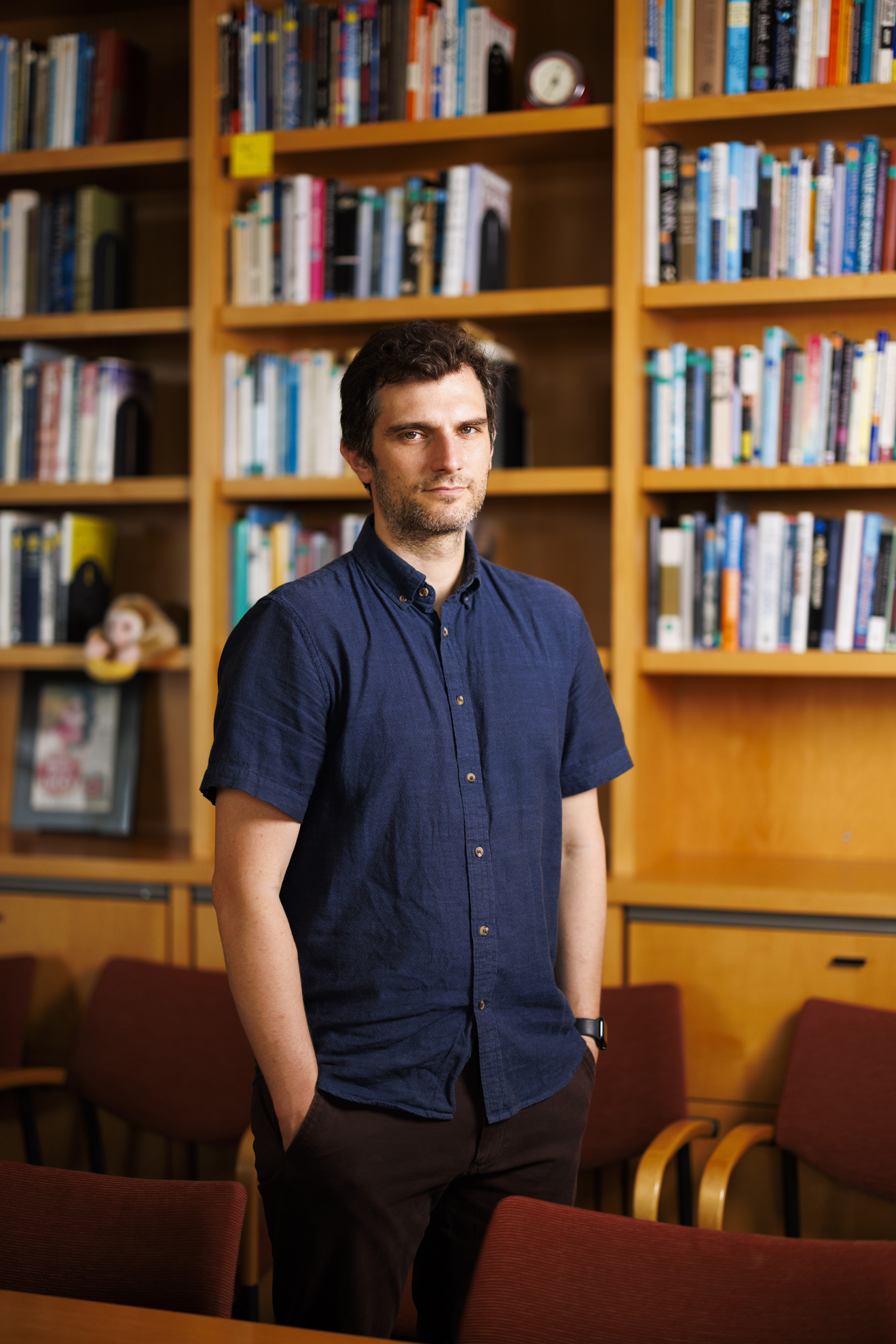
Joshua Conrad Jackson.
Veasey Conway/Harvard Staff Photographer
Science & Tech
Does vitriol make you feel special?
Beyond the algorithm, online negativity takes on a life of its own. Here’s why.
It doesn’t take a scientist to figure out that social media can trend toward the negative. But it might take one to figure out why.
In a new paper in PNAS, incoming professor of psychology Joshua Conrad Jackson and colleagues show that attention-seeking algorithms aren’t the only driver of online negativity. Another culprit is what psychologists call differentiation, the innate drive to stand out from one’s peers.
“Negative information is just much more diverse than positive information,” Jackson said. For example, he added, “If you’re talking about ‘The Odyssey,’ this new Christopher Nolan film, the top comment in a thread might be ‘I liked it’ — but then what else is there to say? If you want to stand out and say something new, you have to talk about something you disliked about the film.”
Jackson and his colleagues analyzed more than 2 billion comments from 2,150 Reddit communities and found that both threads and communities became more negative over time, and that semantic differentiation drove that trend — that is, negative comments were more semantically unique from what had already been said. They then replicated their observational findings with an experiment that showed that social media users who were primed to be unique posted more negative comments than users who were primed to conform.
We talked to Jackson about takeaways from the paper and potential implications for other forms of media. The interview has been edited for clarity and length.
Gazette: Why did you want to test the idea that differentiation might be contributing to negativity on social media?
Jackson: We started our paper with Godwin’s Law, which is the idea that the longer a conversation continues on social media, the probability of someone being compared to Hitler or Nazis approaches one. Harvard economists actually tested Godwin’s Law, and found that it’s not true.
But I don’t think it was meant to be literally true: I think it was meant to capture this intuition that dialogue on social media is more negative than it needs to be.
Of course, feed-ranking algorithms are a big part of the story: These are the algorithms that pick up on divisive content that gets people’s attention, keeps people engaged, and makes them angry so that they post their own divisive content, creating a vicious cycle and generating ad revenue in the process. This paper was kind of a side quest. We wanted to know if conversations would turn negative even in the absence of those algorithms.
What did you find in your analysis?
We found that the entire website of Reddit has become more negative over time. Moreover, the longer a given community exists, the more negative it becomes — and the longer a comment thread continues, the more negative the thread becomes. This is the first time someone has shown that, so that’s a finding in and of itself.
“Moreover, the longer a given community exists, the more negative it becomes — and the longer a comment thread continues, the more negative the thread becomes.”
But then we wanted to understand whether our hypothesis is correct — that this is happening because of differentiation. If so, you’d expect to see that the longer people comment, they’re more likely to make comments more distinct from the most modal comment. You’d find that the more positive a conversation starts, the more negative it will become — because if the thread starts really positive, the positive comments are all taken at the beginning and you have to go negative. And you’d also expect that the larger a community, the more negative it would get, because the information ecosystem is more crowded. And all that proved to be the case.
Are people consciously choosing to be negative to stand out, or is it more implicit than that?
Some research has shown that it can be a conscious choice, and people do it because that’s what they see get rewarded. We’re adding this idea that it’s not just a conscious choice: There’s a more indirect route that this can happen, and that’s what we get at in our experiment.
We find that when we incentivize people to stand out, people get more negative over time. We didn’t incentivize them to be negative; yet they become more negative as a side effect of trying to say something unique.
So are we doomed to live in a perpetually more negative social media landscape?
One thing we try to stress in the paper is that it’s not like these communities fall off a cliff of toxicity. In that way, I think the stereotype of social media is worse than the reality. In our paper, we limit our analysis to the first 50 comments in a thread. But we did run other analyses of these rare threads that go into the thousands of comments. You start to see this interesting oscillation where now you can stand out by being more positive again.
“You start to see this interesting oscillation where now you can stand out by being more positive again.”
This study pertains only to Reddit posts, but surely Reddit isn’t the only place where this trend is salient.
The shift toward negativity could theoretically creep into any conversation where you need to stay focused on a particular topic, but there is a risk of running out of things to say.
Cable news channels with a 24-hour news cycle are a good candidate, because anchors and correspondents are often covering stories for long periods of time with little new information. Under these conditions, there is a risk that discourse turns more negative because there are just more negative things to say.
In contrast, everyday conversations allow us to change topics frequently and avoid this negativity trap. Trying to differentiate oneself isn’t inherently bad. Decades of research suggest that it is a natural human motive. However, our study shows that this motive can promote negativity when conversation must stay on a single topic.
Finally, unrelatedly, you just joined the Faculty of Arts and Sciences in July. What’s on tap for you in your first semester this fall?
I’m very excited. I’ve been a professor at the business school at the University of Chicago for the past three years, but I’m a cultural psychologist by training, so it’s great to be back in a psychology department.
This fall I’ll be teaching a class called “From Bows to Bots: How Humans Invent Technology and How It Reinvents Us,” which deals with how the mind has kept up with new technological innovations over human history. We’ll ask how humans could create stone tools or bows and arrows that other animals couldn’t. We’ll go all the way through state formation to AI and social media algorithms, asking how the mind was able to generate these new inventions, and how these technologies have in turn reshaped the mind.