
 Featured series


Tag: Electrical Engineering
-
Campus & Community
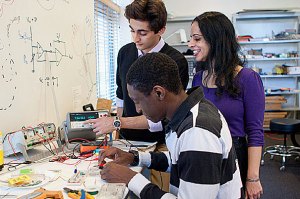
Fueling a creative spark
Hands-on engineering challenges fuel Daniela Villafuerte to solve problems and help build a better world.

-
Campus & Community
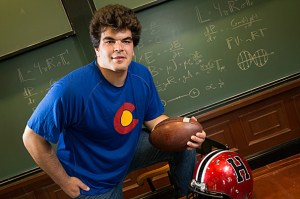
Where football meets astrophysics
Michael Mancinelli ’15 found that at Harvard he could anchor an offensive line and immerse himself in electrical engineering at the same time.
-
Science & Tech
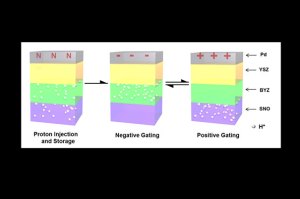
Have silicon switches met their match?
Silicon has few serious competitors as the material of choice in the electronics industry. Now, Harvard researchers have engineered a quantum material called a correlated oxide to perform comparably with the best silicon switches.
-
Science & Tech
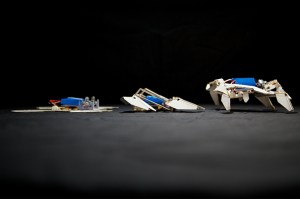
Robot folds up, walks away
A team of engineers used little more than paper and a classic children’s toy to build a robot that assembles itself into a complex shape in four minutes, and crawls away without human intervention.
-
Science & Tech
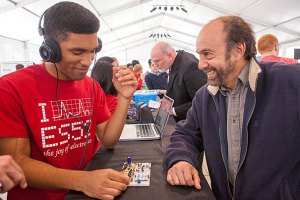
When engineering meets art
Music blared, LEDs blinked, and jaws dropped Tuesday at the SEAS Design and Project Fair, a celebration of creative problem-solving by students at the School of Engineering and Applied Sciences…
-
Science & Tech
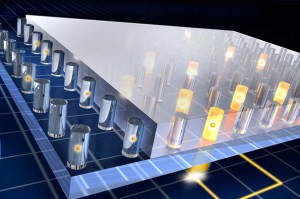
Advancing science and technology
The National Science Foundation is awarding grants to create three new science and technology centers this year, with two of them based in Cambridge. The two multi-institutional grants total $45 million over five years.
-
Science & Tech
Seeing depth through a single lens
Researchers at the Harvard School of Engineering and Applied Sciences have developed a way for photographers and microscopists to create a 3-D image through a single lens, without moving the camera.
-
Science & Tech
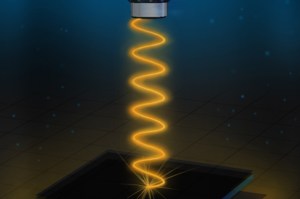
New device hides from infrared cameras
A new device invented at the Harvard School of Engineering and Applied Sciences (SEAS) can absorb 99.75 percent of infrared light that shines on it. When activated, it appears black to infrared cameras.
-
Science & Tech
Nanoparticles shine with customizable color
Engineers at Harvard have demonstrated a new kind of tunable color filter that uses optical nanoantennas to obtain precise control of color output. The advance has the potential for application in televisions and biological imaging, and could even be used to create invisible security tags to mark currency.

-
Science & Tech
For cutting-edge biomedical materials, try corn
One might expect, these days, to find corn products in food, fuel, and fabric, but a corn-based glue that can heal an injured eyeball? That’s a-maize-ing.
-
Science & Tech
Digging deep into diamonds
Researchers at Harvard’s School of Engineering and Applied Sciences find that a diamond nanowire device could lead to a new class of diamond nanomaterials suitable for quantum cryptography, quantum computing, and magnetic field imaging.

-
Science & Tech
Evelyn Hu named professor of applied physics, electrical engineering in SEAS
Evelyn L. Hu, a pioneer in the fabrication of nanoscale electronic and photonic devices, has been named Gordon McKay Professor of Applied Physics and Electrical Engineering in Harvard University’s School…
-
Science & Tech
Scientists demonstrate highly directional semiconductor lasers
Applied scientists at Harvard collaborating with researchers at Hamamatsu Photonics in Hamamatsu City, Japan, have demonstrated, for the first time, highly directional semiconductor lasers with a much smaller beam divergence…
-
Science & Tech
Creating semiconductor lasers
Lasers are often considered to be highly directional light sources: their beams are able to propagate over long distances without substantial spreading. This, however, is not always the case. Semiconductor…
-
Science & Tech
Researchers develop new technique for fabricating nanowire circuits
Scientists at Harvard’s School of Engineering and Applied Sciences (SEAS), collaborating collaborating with researchers from the German universities of Jena, Gottingen, and Bremen, have developed a new technique for fabricating…
-
Campus & Community
Laser advance could open up new markets
Applied scientists from Harvard University have, for the first time, demonstrated high-power continuous wave (cw) room-temperature quantum cascade (QC) lasers made by a well-established mass production semiconductor synthesis technique. The…
-
Science & Tech
Solitons may be the next wave in electronic circuits
Harvard scientists have solved the puzzle of how to generate a special form of wave in small electronic devices, allowing the electrical equivalent of the pulses of light that carry…
-
Science & Tech
Berkman Center helps launch StopBadware campaign
The problems caused by badware have very serious implications, both for every day use of computers, and for the long-term viability of the open Internet. On Jan. 25, 2006, the…
-
Science & Tech
Student makes cableless cable
Matthew DePetro ’05 earned top honors for his senior design project, “Wireless Cable Television.” The first-prize entry “untethers” standard cable TV and even eliminates the need for a wall outlet.…
-
Science & Tech
New use found for black silicon
In 1999, Harvard researchers used laser pulses to etch the surface of silicon, the most common substance used in electronic devices. By accident, they created a material that efficiently traps…
-
Science & Tech
Student-designed lamp brightens Harvard dorms
Halogen lamps became increasingly popular through the ’90s. Their high-wattage bulbs gave off a clear, pleasant light and — at $15 to $25 — even a student could afford them.…