Featured series

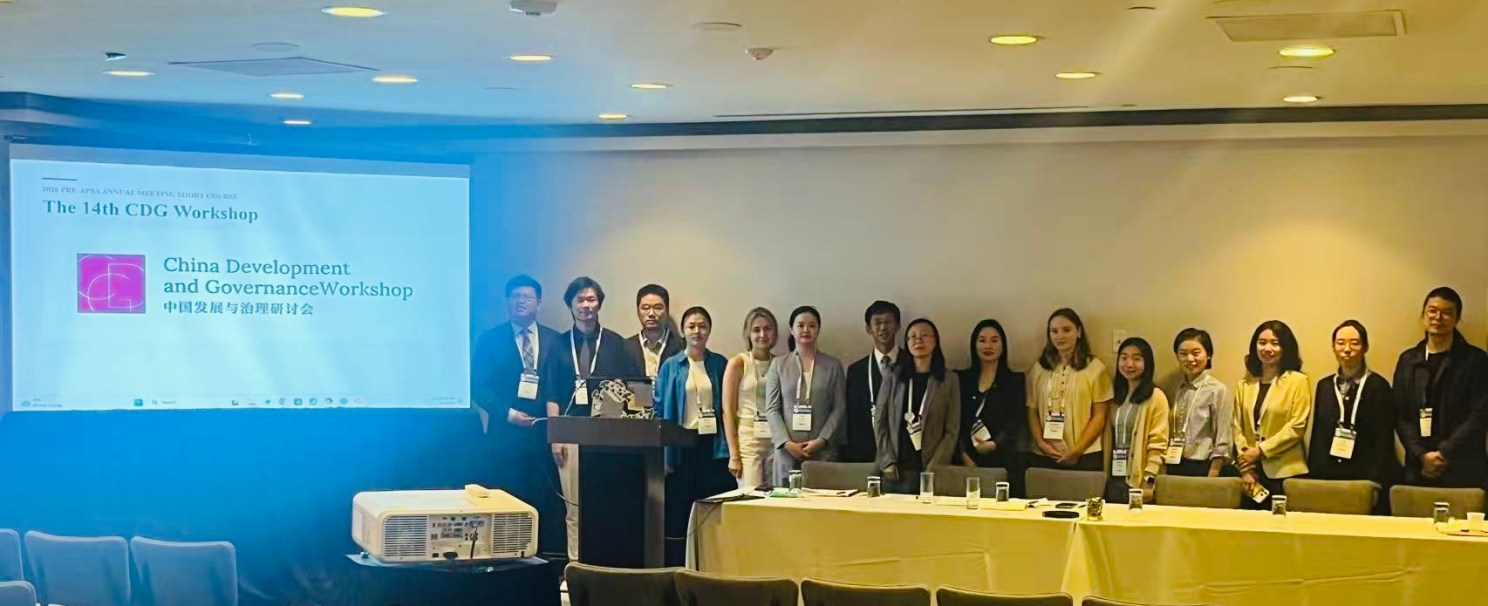
Scholars from universities and research institutions across the United States, China, Hong Kong, Macau, and the United Kingdom gathered in Boston on September 2 for the 14th China Development and Governance (CDG) Workshop — a roundtable held in conjunction with the pre-ASPA (American Political Science Association) annual meeting.
The workshop, titled “China Development and Governance: Understand, Rethink and Rebuild,” brought together 10 researchers to discuss emerging questions about governance, political behavior, economic development, technology, and culture in contemporary China.
The event was organized by Chunying Yue, an associate at Harvard University and a research associate at the Macau doctoral think tank, and Dapeng Wang of Peking University and the Macau doctoral think tank. Invited co-chairs were Zhilei Wu of the Macau doctoral think tank, Ruozhu Li of City University of Hong Kong, and Jing Ge of Florida International University.
The workshop opened with remarks by Yaokun Shen of The George Washington University, followed by Yue’s keynote, “China Development and Governance: Reflections on the Past, the Present, and the Future.”
Yue emphasized the importance of understanding China’s development from multiple perspectives and connecting empirical research with broader questions about institutional change, technological transformation, political participation, and social development.
“Research excellence does not happen only through individual effort. It also grows out of an academic community where scholars share ideas, support one another, and create opportunities for collaboration. Looking toward the future, I hope the CDG Workshop can become even more international, interdisciplinary, and comparative,” Yue said.
Yue also shared her perspective on the future of research on China’s development and governance.
“China should not be studied only as an exceptional case. China should be an integral part of broader comparative research on development and governance. China is part of a broader world,” she said.
The first roundtable addressed political information, local governance, cultural change, financial regulation, and urban development. Ying Chi of Duke University presented research on how uncertainty surrounding state repression may influence information-seeking and political learning in China. Yiwei Jiang of University College London examined the incorporation of new rural elites into local governance through United Front work. Xiaobei Li of Beijing Union University explored how generative artificial intelligence may transform literature and cultural governance. Vivian Liu of the Macau doctoral think tank discussed China’s anti money laundering reforms following the 2019 Financial Action Task Force mutual evaluation. Yongjun Wang of Macau University of Science and Technology examined the role of major sporting events in promoting urban development.
The second roundtable turned to local government finance, policy implementation, ideology and propaganda, community identity, and technological competition. Pang Yu and coauthor Zengke He of Peking University examined the relationship between investment capacity, official incentives, and local government financing vehicle debt. Leizhen Zang of Renmin University of China discussed governance trade-offs following the conclusion of China’s poverty-alleviation campaign.Shen presented research on ideology and propaganda in contemporary China, while Ge examined technological fragmentation in the context of U.S.-China rivalry. Yue and Wang, together with coauthor Chenlin Cai, presented “Murals and Community Identity in Chinese Communities in the United States.” The project examines how murals and public art can contribute to cultural continuity and community identity.
The workshop’s roundtable format paired each presenter with a discussant and included an open discussion after each presentation. The format encouraged participants to connect research across disciplinary and institutional boundaries and to explore broader questions arising from the presentations.
The CDG workshop series was established to create an ongoing forum for scholars studying China’s development and governance. The 14th workshop continued that effort by bringing together established researchers and early-career scholars for intellectual exchange and potential collaboration.
The event concluded with remarks by Dapeng Wang. He emphasized the continuing importance of asking meaningful questions about China’s development and governance.
“Our task as scholars is not to provide simple answers to complex problems, but to keep asking better questions, developing better evidence, and engaging with one another in good faith,” Wang said.
As China continues to undergo significant economic, technological, political, and cultural transformation, interdisciplinary and comparative approaches remain important for understanding both the country’s domestic development and its evolving relationship with the wider world.