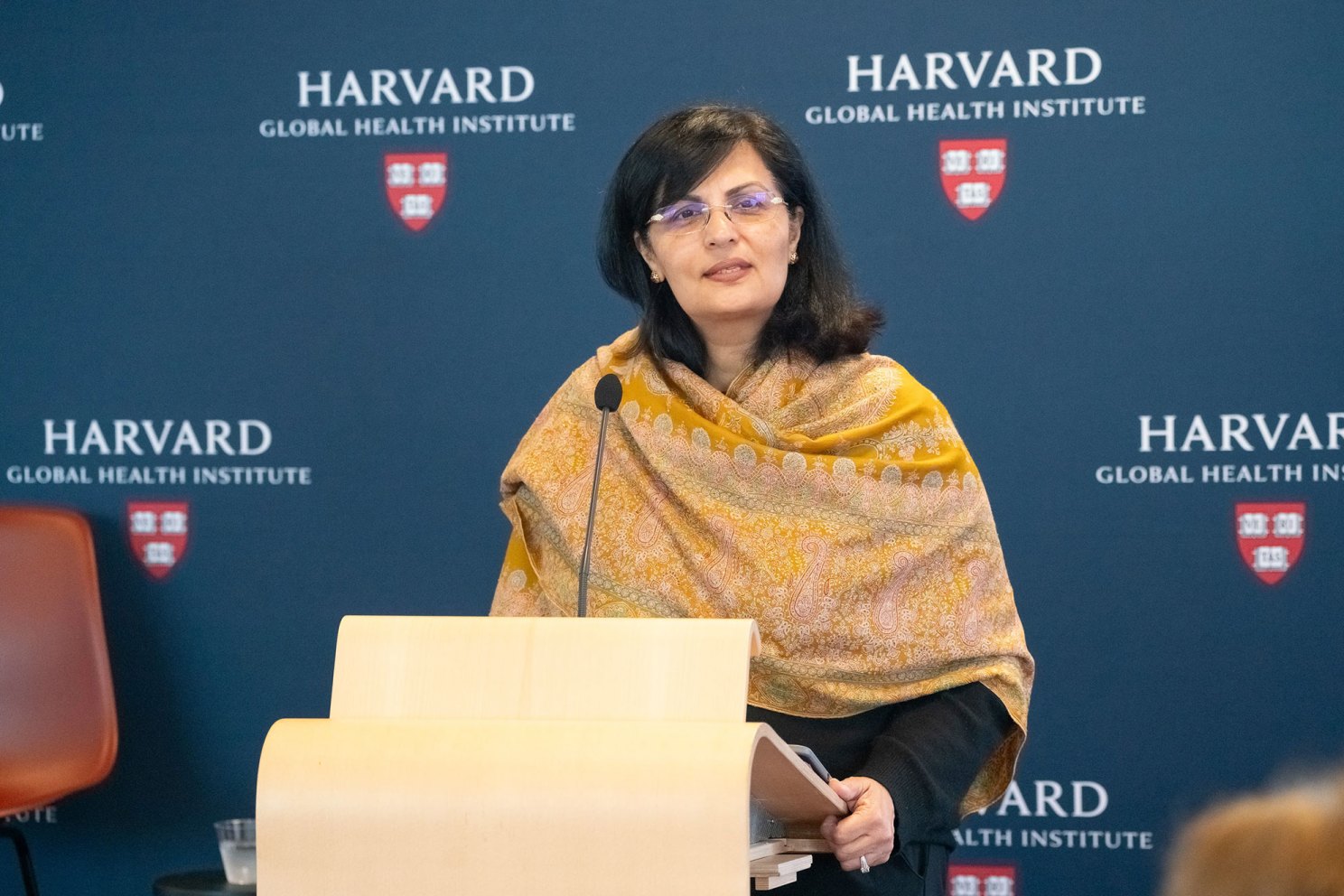
At the 2026 Global Health Symposium, hosted by the Harvard Global Health Institute (HGHI) on April 16, policymakers, practitioners, academics, and students gathered around a central idea: Achieving global health equity in an age of scarcity requires moving from fragmented systems to shared responsibility.
Across sessions on multilateral architecture, emergency response, workforce training, and reforms in Africa and Latin America, speakers argued that today’s global health architecture is expensive, duplicative, and politically fragile — ill‑suited to a world of pandemics, climate shocks, and fiscal austerity. Progress will depend not only on new tools, but on institutional courage, political imagination, and genuine power‑sharing.
“Progress demands honesty about what is failing, clarity on what must change, and collective action “not as a slogan but as a practice,” said Louise C. Ivers, faculty director of HGHI.
Fragmented architecture, fragile gains
Keynote speaker Sania Nishtar, CEO of Gavi, the Vaccine Alliance, traced global health’s evolution from tropical medicine to international health, primary care, product development partnerships, and today’s large multilateral organizations such as the Global Fund, Gavi, and PEPFAR. The gains have been enormous: a decade of added life expectancy, a 60 percent drop in under‑5 mortality, and an estimated 75 million deaths averted through vaccination.
Yet early warning signs are emerging. Child mortality is creeping upward in some places, and the Organization for Economic Co-operation and Development has recorded the largest drop in official development assistance in decades. Nishtar warned this is not a short‑term fluctuation but a structural shift affecting many donor countries.
The fiscal squeeze exposes the weaknesses of an architecture in which health ministers must navigate dozens of agencies and initiatives — each with its own reporting and oversight requirements. The result, she argued, is “huge fragmentation” and administrative burden, especially for low‑ and middle‑income countries.
Nishtar called for reforms that align external funding with national priorities and consolidate and clarify mandates among global actors. She urged deliberate planning for the future of entities such as Gavi and the Global Fund so their strengths are preserved without fueling further proliferation. Diplomatic processes that produce only vague consensus statements after years of negotiation, she argued, are no longer adequate. Hard choices must be placed at the center of global health governance.
Priority setting as a political act
The first panel translated these structural concerns into day-to-day reality. Addis Tamire of Amref Health Africa described how priority setting in many African countries is “less about rational evidence-based decisions and more about managing constraints imposed by donors and domestic politics.” External vertical programs, earmarked funds, limited fiscal space, and weak institutions result in “co-produced and fragmented” priorities.
Kalipso Chalkidou of the World Health Organization’s Performance, Financing and Delivery Department highlighted the macro‑fiscal picture. In many low‑income countries, out‑of‑pocket spending has grown faster than public health spending for 15 years, and domestic funding that rose during COVID‑19 has fallen back to 2010 levels. Several African governments now spend more servicing debt than on health and education combined. Without addressing international taxation, debt, and broader economic rules, she argued, debates focused only on specific interventions are incomplete.
From the donor side, John-Arne Røttingen, CEO of Wellcome Trust and co-author of the Lusaka Agenda, described the political challenges of shifting from powerful disease-specific programs to more flexible, systemoriented models. “Health is a political struggle,” he said. There is no functioning global political system, so progress hinges on domestic accountability, taxation reform, and efforts to curb illicit financial flows.
The panel advanced a concrete definition of solidarity: design and budget choices that prioritize the worst off, align with country‑led plans, and maximize value for each constrained dollar.

 Featured series