Featured series

Campus & Community
Intellect is not enough
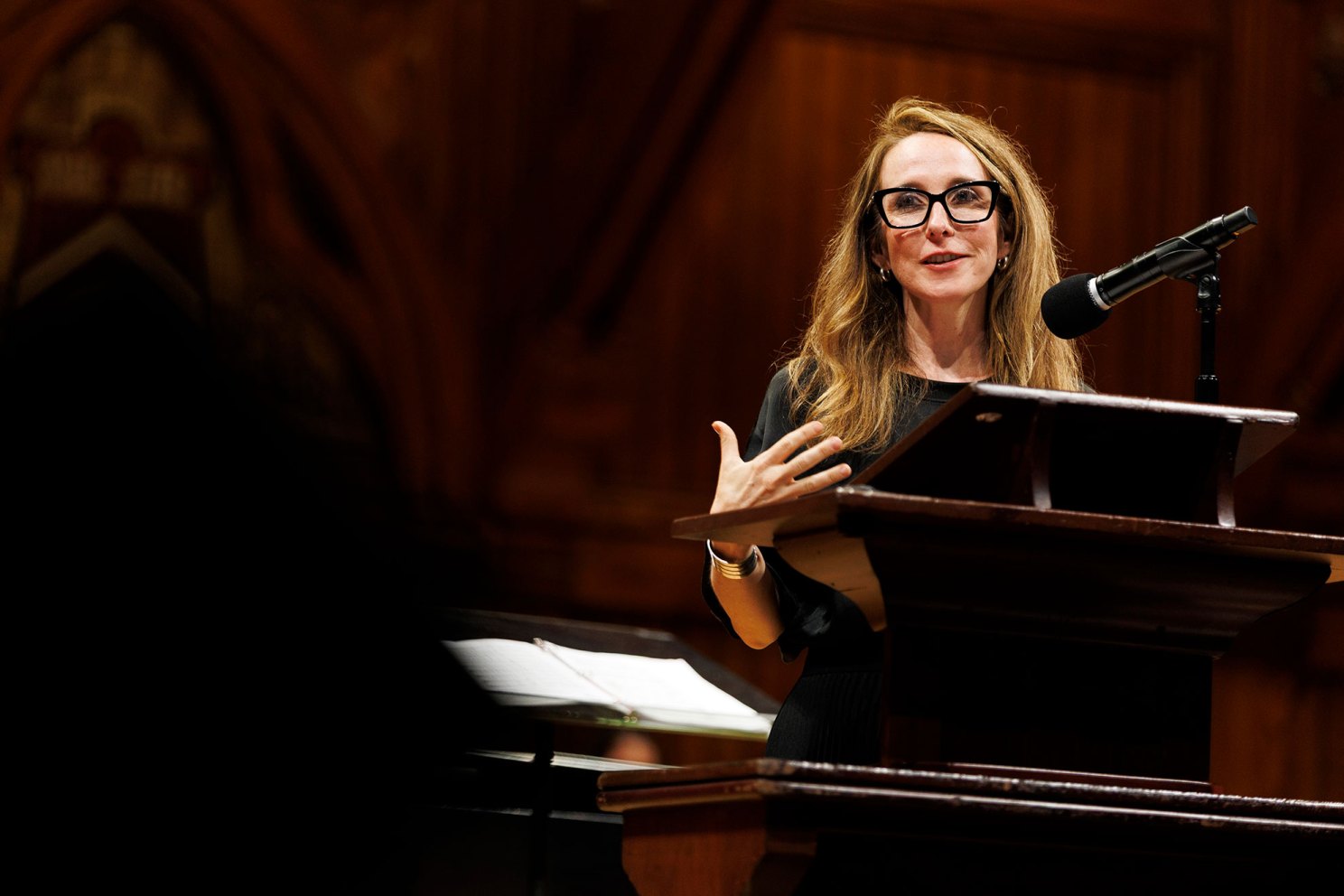
Writer and poet Meghan O’Rourke.
Photos by Stephanie Mitchell/Harvard Staff Photographer
Phi Beta Kappa speakers urge Harvard grads to build character
Part of the Commencement 2026 series
A collection of features and graduate profiles covering Harvard’s 375th Commencement.
Sanders Theatre swelled with poetry and music, orations and awards on Tuesday morning, at the unofficial kickoff to Commencement week.
These were the 234th literary exercises of the University’s chapter of Phi Beta Kappa, inaugurating Harvard College’s top-performing juniors and seniors into one of the nation’s oldest academic societies.
But the celebrations were cut liberally with injunctions and warnings — sometimes stern — about the great responsibilities that fall upon new chapter members, half of whom are poised to graduate on Thursday.
The intellect and drive of these students are not in question: The chapter admits, at most, only one in 10 undergraduates based on their academic performance. But throughout the 90-minute program, speakers insisted that, on their own, intellect and drive are not enough — for responsible citizenship, or even for a meaningful life.
The chapter’s new members were enjoined to keep, and cultivate, their intellectual courage, in an opening invocation by the Rev. Matthew Ichihashi Potts, the Pusey Minister, and by Meghan O’Rourke, the exercises’ poet.
Potts’ invocation followed on Ralph Waldo Emerson’s famous address at the 1837 exercises. “The scholar’s basic task is a form of bravery,” Potts said. “The scholar turns toward danger, and by taking courage to comprehend that danger, defies it.”
O’Rourke — herself a PBK graduate of Yale, and now a professor and editor on that campus — noted that as she joined the society ahead of graduation, she felt “proud to have done what was asked of me, and done it well.”
The difficult part comes next, she said, as each young person figures out “what you are going to ask of yourself.”
It is frightening work, she said, drawing upon the tradition of James Baldwin, who was a teenage preacher long before he was a writer.
Baldwin came to see the two roles as almost antithetical, she noted: “‘When you are standing in the pulpit, you must sound as if you know what you’re talking about. When you’re writing, you’re trying to find out something that you don’t know … [even] what you don’t want to know.’”
O’Rourke read three poems, the last of them a recently finished reflection on holding her young son in the predawn hours: “Did You Use Your Time?”
It was long in coming, she said, begun in the immediate aftermath of mass killings at two mosques in Christchurch, New Zealand, in 2019.
My son’s skin, water-soft, is still unmarked
And he holds a bear in his left hand
And looking at it, he says,
“I love you, Mr. Bear.”
And what can I say?
I can’t say, “The love you have for animals
Doesn’t stop you from eating them.”
We have already compromised you.
There is everything you can do
And nothing to do, and everything to do.
And when you are old …
To whom will you tell
How much you loved the world?
Then came the formal address, delivered by President Emeritus Larry Bacow. As he looked over the crowd of mortar-boarded students, Bacow smiled and said: “You are some of the most ambitious people in the world.
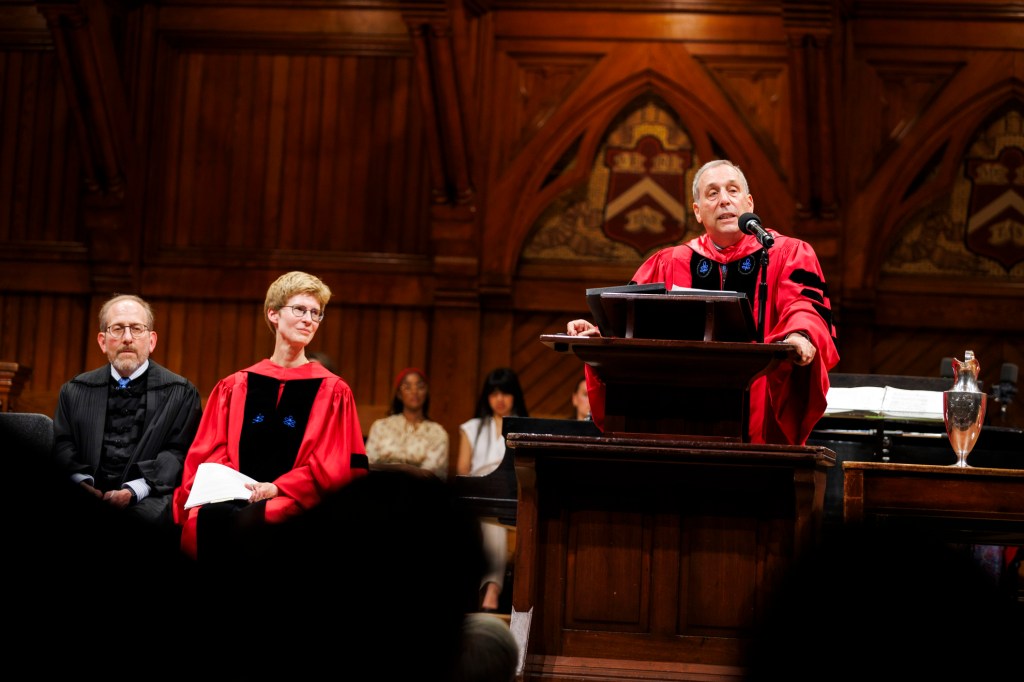
“I don’t say that as a criticism. Ambition is not a vice; it is in many ways what brought you here, not just to Harvard, but here, today, to Phi Beta Kappa.” Bacow added. (He was himself part of MIT’s inaugural PBK class in 1972.)
“But there’s a version of ambition [that] curdles into something else: an ambition that is never satisfied, that treats every achievement as merely a platform for the next one,” he said.
At times, Bacow — an economist and administrator, a lifelong student of institutions — sounded despairing about the current political moment.
Things he thought of as sources of consensus — like truth and universal human dignity, kindness and the rule of law — are “not as secure as we once believed.”
Bacow’s talk turned on the teachings of Simeon ben Zoma, a second-century Talmudic sage, who sought to overturn the commonplace understandings of power and achievement of his time.
“Who is wise?” ben Zoma asked. “One who learns from all people. Who is wealthy? One who rejoices in his portion.”
The powerful, ben Zoma found in turn, are those who “exercise self-control.”
It was that teaching that Bacow wanted to stress, given the moment.
The class of 2026, who came to Harvard amid the most profound disruptions associated with the pandemic, will leave campus with war raging in the Middle East, and as AI begins an unpredictable upheaval of the human intellectual enterprise as it has played out for millennia.
In remarks aimed — though never by name — at some among the nation’s ruling class, Bacow said, “We are surrounded by people who have confused the ability to compel others with genuine strength.”
Self-control, then, Bacow said, is not just a private virtue but a public duty — critical to finding remedies for our most urgent crises.
“Your election to Phi Beta Kappa tells us something about your minds. What you do next will tell us about your character,” Bacow said. “The world does not need you to be merely clever. It needs you to be good.”