Featured series


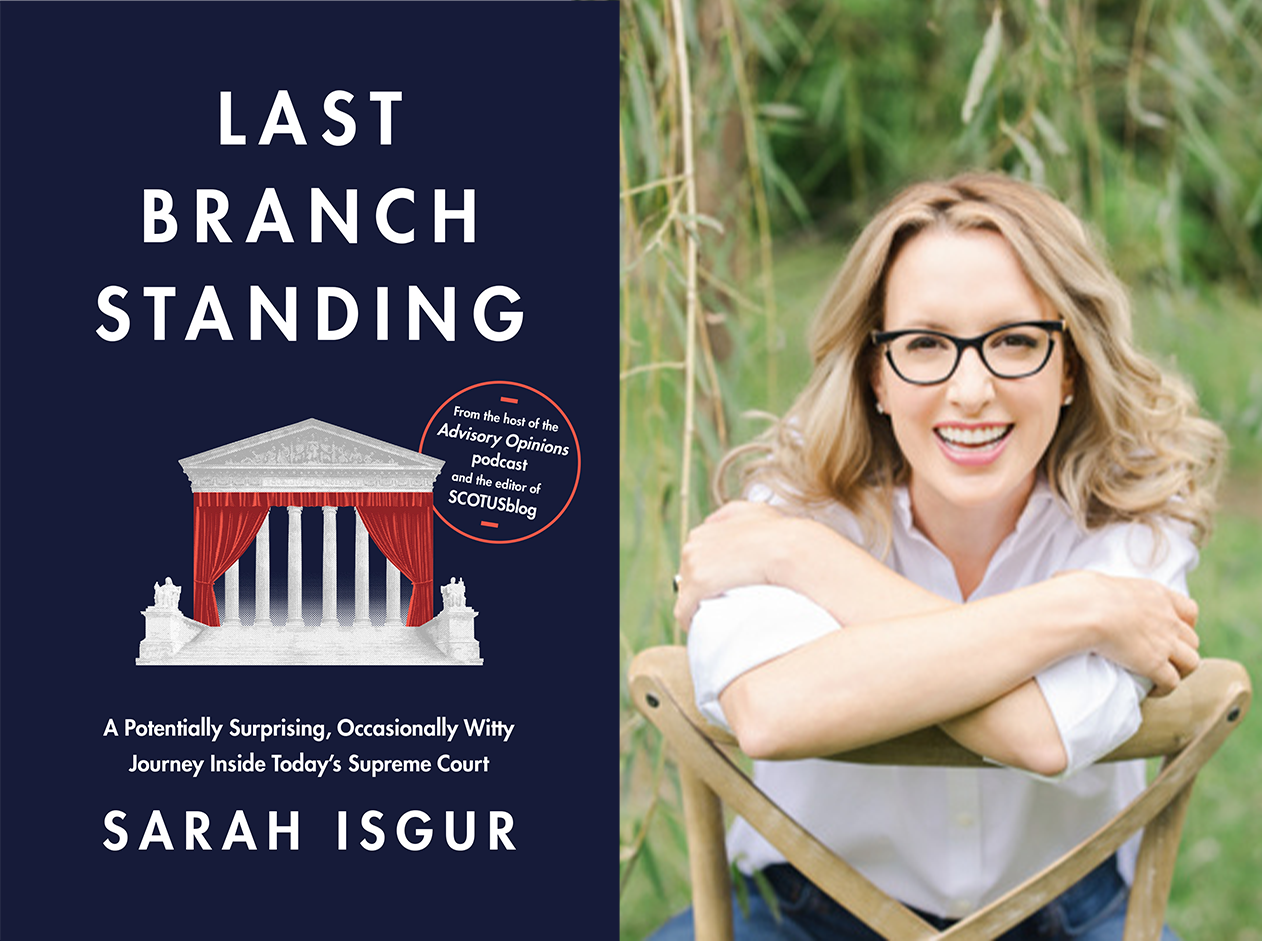
Sarah Isgur.
Photo by Laura Nockett
Nation & World
SCOTUS might surprise you
Sarah Isgur argues growing distrust of justices says more about our tribalism than any change in way judiciary works
Adapted from “Last Branch Standing: A Potentially Surprising, Occasionally Witty Journey Inside Today’s Supreme Court” by Sarah Isgur, J.D. ’08, Institute of Politics fellow ’16
In January 2000, 69 percent of Americans said they were happy with the way things were going in the United States. By 2024, only 22 percent did. Trust in institutions is on the decline. Less than half of Americans say they have confidence in the police, the medical system, or schools. Less than a quarter trust labor unions, businesses, or the media. And less than 10 percent trust Congress. (I’ve always wanted to meet someone in that 10 percent — did they misunderstand the question? Are they all the mothers of congressmen?)
The Supreme Court was once an outlier in this trend. From 2016 through 2020, its approval rating was actually on the rise — from 48 to 70 percent. But in the past few years, that has all changed. Since 2023, a majority of Americans have had an unfavorable view of the Court for the first time since they started asking nearly 40 years ago. The partisan gap is the largest it’s ever been. Less than a quarter of Democrats and Democratic-leaning independents view the Supreme Court favorably — the lowest in at least 30 years. For the first time, more people disapprove of the Court than approve of it.
What is driving this change and why now?
For many, the answer is easy. They think President Trump stole a seat that should have been filled by President Obama. Or the justices — especially the ones they don’t like — are unethical. Or the Court isn’t doing law; it’s all politics. And if they’re doing politics, they should be treated to the same skepticism or even vitriol that we deploy in every other part of our political debates.
Tribalism is deeply ingrained in our biology. It is also one of the most powerful motivators. In recent history, it has been used to justify genocides, gas chambers, and lynchings. The men who flew planes into the World Trade Center and the Pentagon and that field in Pennsylvania were certainly motivated by tribalism. The men who walked into a grocery store in Buffalo, a synagogue in Pittsburgh, and a Walmart in El Paso to kill people who didn’t look like them were motivated by tribalism.
“Tribalism is deeply ingrained in our biology. It is also one of the most powerful motivators.”
And yet tribalism has also been a driver of civilization and progress. Tribalism allowed Nazism and fascism to flourish in the 1930s, but it’s also what defeated them in the 1940s. It’s why we walked on the moon. Heck, it’s why these united colonies declared independence from Great Britain in 1776 and, therefore, why we have a Supreme Court of the United States to begin with!
Those who try to combat tribalism with logic often lose.
And I should know. I worked in politics for almost 20 years. I’ve worked on presidential campaigns for people like Carly Fiorina and Mitt Romney, as well as at the Republican National Committee. I’ve worked in all three branches of government — legislative, executive, and judicial. I’ve seen the differences between law and politics. Politics is about outcomes. Law is about process. Or at least it should be.
When one is a political operative, it’s actually easier to convince voters that the opposing candidate is evil than it is to tell them that he’s wrong. Partisans seem to crave the dopamine hit they get from the outrage. It’s the entire business model of some cable news — reality television filled with pundits and prognosticators who turn complex public policy trade-offs into easy-to-digest narratives about good guys versus bad guys. They keep viewers entertained by filling their time with stories of “those people” who are out to hurt us.
And for there to be an “us,” by definition, there must be a “them.”
For large parts of human history, we defined “them” by their religion or ethnicity. Today, in the United States, we are far more likely to define “them” by their politics. And on this I think we can all agree: Our politics are not healthy.
Our political process — the way our Constitution was designed to be amended and laws to be passed — is broken. Without a functioning Congress — ours has not completed all of the steps in the appropriations process on time since 1996 — and with a too-powerful executive branch churning out thousands of new regulations that change with each administration, both sides see the courts as their last resort to win in an existential fight for the country as we know it.
The Supreme Court is, in this sense, the last branch standing. It is certainly the only one of the three that our Founders would recognize.
And that’s exactly why, I argue, partisans are attacking the court now. Partisans can’t abide an institution that has its own legitimacy if that institution doesn’t bend to their partisan interests. From the left, there are calls to impeach justices, limit the court’s ability to hear cases, add seats to the court. From the right, there are calls to ignore the court’s decisions when the outcome isn’t the one they wanted.
The goal isn’t to convince you that Congress needs to do its job or that the presidency has become too powerful. They do and it has. The goal isn’t even to explain why the failures of those other two branches are dragging the court into every partisan squabble. Though they are.
The goal is to tell you what those critics — from both sides — are missing. The Supreme Court isn’t the same as Congress. Judicial philosophy isn’t the same as partisan politics. Many casual observers of the Supreme Court attempt to categorize the philosophies of its justices on a one-dimensional, left-right x-axis, like partisan politics. Conservative at one end, liberal at the other.
“The goal is to tell you what those critics — from both sides — are missing.”
The problem for these critics is that the justices are nothing like political candidates. Unlike a member of Congress, their votes are hard to predict. Interestingly, ask an AI model to predict the outcome of a Supreme Court case with any sort of political valence before oral arguments and about half the time it will tell you that the decision will be 6–3 along ideological lines — even though statistically that is one of the least likely outcomes. The justices surprise even our large language model overlords.
On a random day in early June 2025, each liberal justice wrote an opinion for a unanimous court on an issue conservatives championed. Justice Elena Kagan’s decision blocking Mexico’s $10 billion gun-violence lawsuit was cheered by the NRA. Justice Ketanji Brown Jackson’s decision on reverse discrimination was praised by conservative advocacy groups. And religious advocates heralded Justice Sonia Sotomayor’s opinion on tax-exempt status for Catholic Charities.
The decisions — on God, guns, and gays — had all been closely watched during the term as “big cases.” But once they had been decided unanimously and the decisions written by the court’s liberals, they were no longer considered big. The pundits waited for the more divisive 6–3ers to come down and then declared the court divisive.
But if they can’t predict the outcome of cases in advance — let alone which ones are important — isn’t it clear they’re missing something?
What these critics are missing is the existence of a different axis — the y-axis of judicial philosophy. This axis is all about justices’ philosophy on the institution — when to uphold decisions by previous courts they think were wrongly decided, how much to think about the consequences of a particular decision, whether they think of themselves as one court or one vote. And it is affecting everything from which cases the court takes, to when it takes them, to how they get decided, and all the other ways the Supreme Court’s internal practices and customs end up deciding the fates of millions of Americans.
I am hoping Americans are beginning to see the need for a more nuanced understanding of how decisions are made and what those decisions even are. Because often the real story isn’t the one that’s in the headline. “Supreme Court Strikes Down Trump-Era Ban on Bump Stocks for Firearms” could have more accurately read, “Supreme Court Says Only Congress Can Ban Bump Stocks,” or even better, “Supreme Court Says President Can’t Unilaterally Change Gun Control Law to Help Political Allies Avoid Tough Votes in Congress.” A girl can dream.
I am also hoping Americans can start to view the court as an institution that is the product of its history filled with people who have tried to do their duty as best they can. That’s it. Too often in our politics today, the person who disagrees with us isn’t just wrong. They are bad. They’re not mistaken; they’re morally corrupt and their motivations are evil. We’ve forgotten how to disagree because we’re so convinced of our righteousness. It’s how we judge one another, and it’s how we judge institutions.
We need to change this “Game of Thrones”–type of politics where we fight all-against-all warfare. Instead, we should replace it a “Ted Lasso” argument about the court — a show in which a bunch of flawed people are trying their best and struggling to find the right answers to our hardest questions.
Exploring these sides of the court will, I hope, offer some insights into why the rule of law in this little experiment we’ve been running on self-government for the last 250 years matters — and what we can do to preserve it.
Copyright © 2026 by Sarah Isgur. Published in the United States by Crown, an imprint of the Crown Publishing Group, a division of Penguin Random House, LLC.