Featured series

Nation & World
Why are white-Black marriage rates so low?
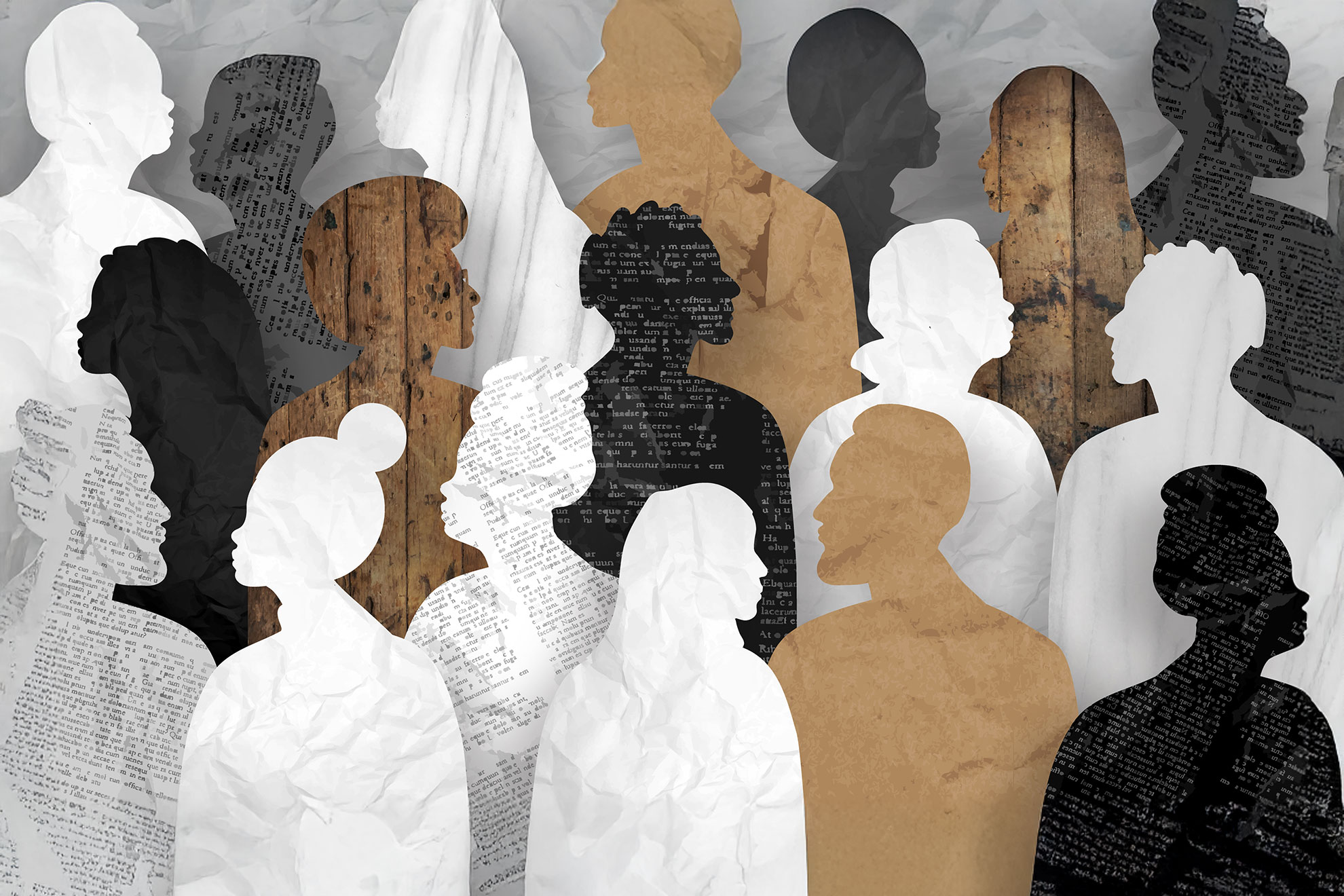
New research suggests increased exposure between groups results in more couplings across class but not racial lines
Americans rarely marry outside of their race or class in a nation where residential segregation is relatively common. It is a dynamic widely viewed as a contributing factor to income inequality and intergenerational social mobility.
A new National Bureau of Economic Research working paper examines whether increased exposure to members of other race and class groups affects marriage rates between Black and white partners, based on an analysis of Census data and federal tax records. The overall rate has grown slowly over the years and currently stands at only 11 percent of intermarried couples.
The answer is mixed.
Greater exposure appears to translate into more marriages across class lines but “has no detectable effect” when it comes to race, according to the paper written by Benjamin Goldman, Ph.D. ’24, assistant professor at Cornell University, Jamie Gracie, Ph.D. ’25, a postdoc fellow with Harvard’s EdRedesign Lab, and Sonya Porter, a U.S. Census Bureau researcher.
In this interview, which has been edited for length and clarity, Goldman and Gracie spoke about the role of residential segregation in both interracial and cross-class marriages and the implications for continuing inequality.
Why is it still relatively uncommon for Americans to marry outside their race and class groups?
Goldman: There can be two reasons at a very high level.
One is that people have some preferences, desires, or inherited norms across generations that marriages should be between certain types of people within your own community, whatever it might be.
The second is that even absent any kind of preferences along those lines, you could still get very low rates of intergroup marriage, simply for the reason that there might not be a lot of contact across group lines.
We live our lives in a very segregated way in terms of the places we work, live, and socialize. It’s plausible that the reason people tend not to date or marry across group lines is not because they don’t want to, but because it’s harder and there are fewer opportunities to do so.

Jamie Gracie.
Stephanie Mitchell/Harvard Staff Photographer
Gracie: The goal of the paper is to try to understand what drives the low intergroup marriage rate. We basically take one angle on it, which is to think about the role of residential segregation as opposed to going through every single factor and determining how much they each contribute to the fact that Americans rarely marry outside their race or class groups.
What did you learn about the role of residential segregation?
Goldman: What we found was that neighborhoods are important, but it doesn’t mean that you’re meeting your spouse on the corner while you’re trying to cross the street.
Neighborhoods impact where you work and who you socialize with. Distance and neighborhoods might matter even for dating app technologies, which are now the most common way young folks meet. Those dating apps require you to set a search radius, essentially limiting the pool of possible partners to people who live near you, which is, in some sense, exactly the type of exposure channel we study in the paper.
Gracie: We wanted to test one theory, which is that it’s possible that residential segregation plays a role in the fact that there isn’t that much mixing across people from different groups.
We know that neighborhoods are segregated in terms of race and class. We found that when neighborhoods happen to have people from low- and high-income backgrounds living in the same area, more of these cross-class marriages form. However, the same wasn’t true for interracial marriage.
Why is that?
Gracie: At the beginning of the research, it wasn’t obvious that these two types of marriages should react differently to exposure. The main contribution of the paper is to document that difference, as opposed to necessarily trying to understand why.
Goldman: Part of the reason we focused on the role of exposure was because we saw in the data that a lot of marriages in the U.S. tend to be among two people who have lived very near each other in the past.
We started by looking at two people who just got married this year, and we asked ourselves: Five or 10 years ago, where were those two people living? We saw that most marriages are between two people who might have just lived a few miles away from each other.
That lends itself to the second point of the paper: If people tend to marry from the pool of their neighbors or those they live nearby, which is already a selected set of people across race or class lines, then that’s a natural way in which you could have that polarization in the marriage market.

Marriages between Black and white individuals make up 11 percent of all interracial marriages, compared with 43 percent for Latino-white pairings and 14 percent for Asian-white couples. Why is this rate so relatively low?
Goldman: There are two reasons why we focus on the white-Black pairing in particular, as opposed to all the other different pairings.
One is that’s the pairing where you see the lowest amount of cross-group marriage. Also, if you look at statistics on white-Black household income inequality and white-Black intergenerational mobility, what you see is that who people marry matters for that difference.
Part of the reason why white individuals in the U.S. have higher household incomes than Black individuals is not only because they might earn a bit more on average, but it’s in large part because they’re more likely to have two earners in the household or marry someone who comes from a higher income.
In that sense, white-Black marriage is important to understand because it’s an input into these broader income disparities between these two groups.
Unfortunately, our paper is less-well-positioned to answer why white-Black marriage rates are so low. Instead, what we do is we reject one possible hypothesis, which is that it’s all about segregation in neighborhoods and lack of contact between white and Black individuals.
A possible explanation is that it’s not enough to reduce segregation in neighborhoods because even when you have racially diverse neighborhoods, people still self-segregate in terms of their social lives and their own communities. A different explanation would be that people have more ingrained views or preferences toward marrying across race lines.
What are the implications of low intergroup marriage rates for inequality and social mobility?
Goldman: This is fundamental for how we think about issues relating to inequality and the exchange of privilege across generations.
If you think about a world where all the high-income people marry each other, or all the low-income people marry each other, or people who go to college only marry other people who go to college and so on, what you have is that in the next generation, kids will grow up in households of either haves or have-nots.
You’ll either have two parents who are very privileged and have a lot of resources, or, in some cases, none, or you’re more likely to grow up in a single-parent household. How the marriage market shakes out is first-order in determining the distribution of resources that children will have in the next generation.
As economists, we tend not to give normative prescriptions, but from an empirical perspective, you could say that if you had more mixing across class lines in marriage, the children in the next generation would grow up in more equitable circumstances, and there’d be less of a difference in the resources between the kids at the bottom and top of the distribution.
There’s good reason to think that that would be important for fostering access to the American Dream and for a more equitable and dynamic society in the next generation.
Gracie: What we don’t know a lot about is how these preferences, or whatever is not coming from the residential segregation factor, are formed. Does growing up in a more mixed neighborhood shape your attitudes toward people of different groups? We don’t have an answer to that. But I think that’s the type of question that one could think of as future research.