Culture Lab Innovation Fund grants awarded to 4 projects
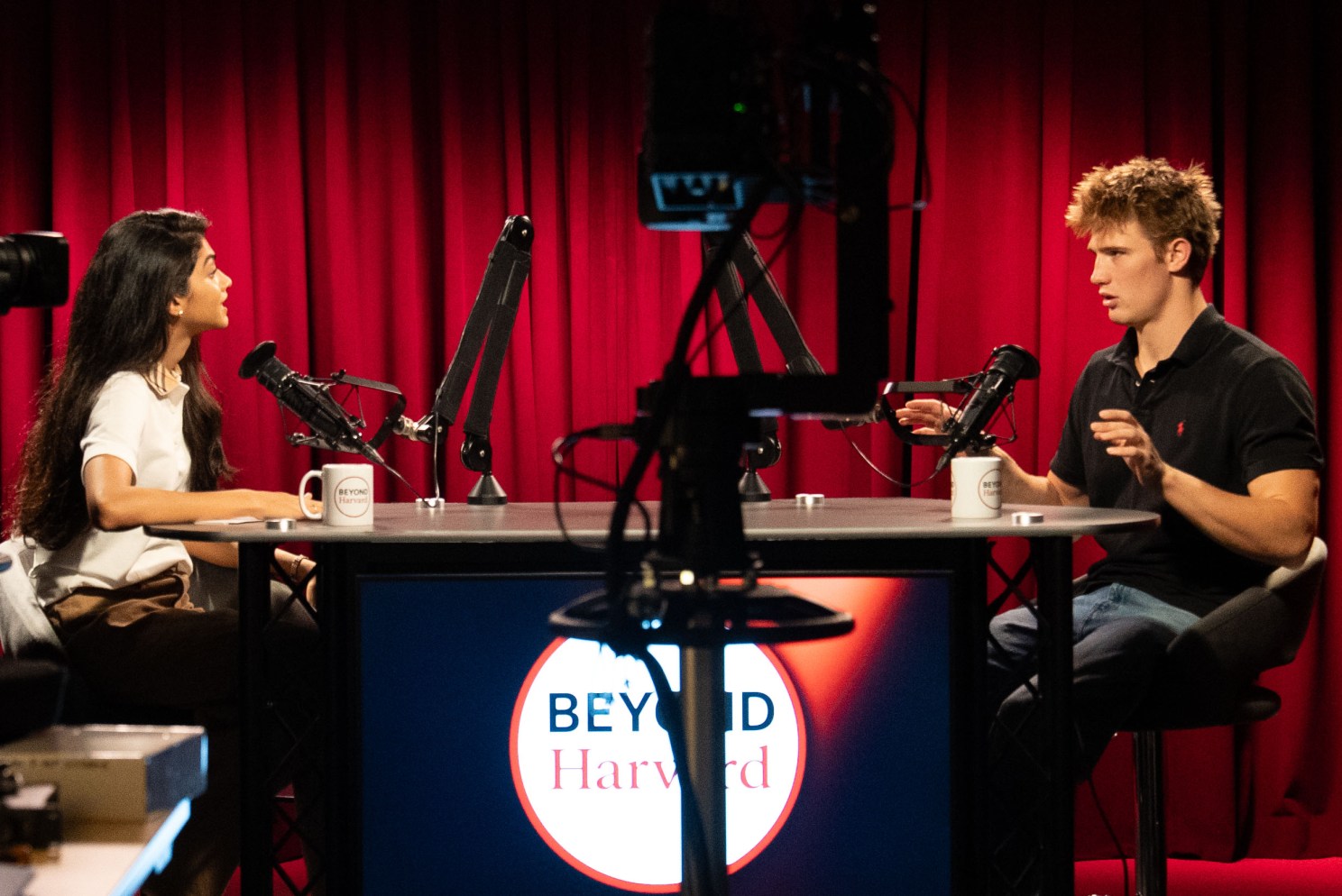
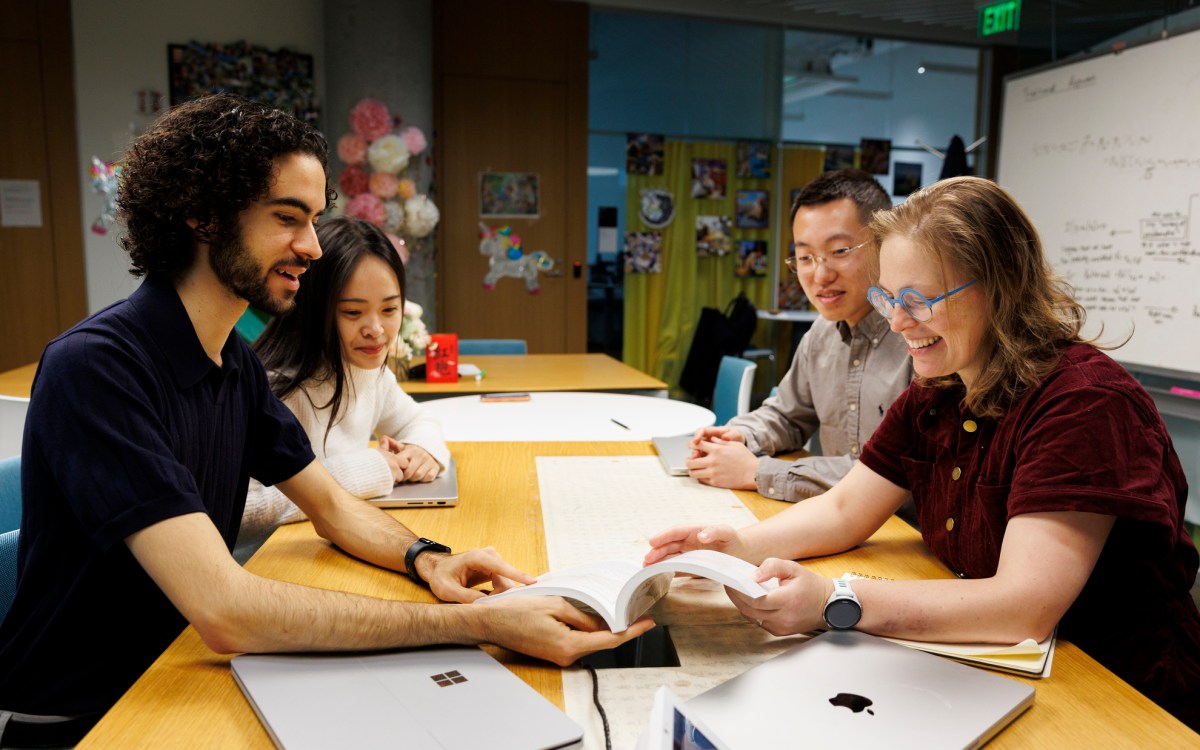
Beyond Harvard podcast host Rashana Weerasinghe, Ed.M. ’26, interviewed Joe Baker ’28, a member of Harvard College’s men’s heavyweight rowing team, in Hauser Studio.
Community and Campus Life (CCL) has announced the four recipients of this year’s Cultural Lab Innovation Fund (HCLIF). Administered by CCL, HCLIF aims to “advance a campus culture where everyone can fully participate in University life at Harvard” through support for unique programs that bring community members together from different backgrounds and perspectives.
The projects will receive up to $15,000 to support programs and events across Harvard Schools that foster belonging, community, and connection. Three of the projects are new recipients, while one received funding last year and will be expanded via a scaling grant this year.
“A Harvard where everyone can thrive is built through everyday moments when people feel seen and heard, and these projects create those moments,” said Sherri Charleston, chief community and campus life officer. “This year’s grantees bring community members together across Schools, backgrounds, and areas of study in innovative ways. We are proud to support their work and look forward to seeing how it deepens belonging across Harvard.”
2026-27 recipients
Backstory is an initiative of Harvard Law School’s Negotiation and Mediation Clinical Program that invites students to share personal narratives about their backgrounds, identities, and experiences while sharing a meal together. With grant funding, project leaders will host four to six peer-guided, small-group conversations over the course of each semester. Backstory aims to create a space for students to share their own story and to hear and understand the lived experiences of others. Participants will practice deep listening and reflection while exploring universal themes such as community, change, and personal development.
The Beyond Harvard podcast is a peer-to-peer podcast that shares the stories of students from across Harvard University. An initiative of the Harvard Lemann Center for Entrepreneurship and Creativity, the five episodes aired to date have achieved significant success, ranking in the Top 100 of Apple Podcasts in education. Grant funding will support production of 20 additional episodes to air during the 2026-27 academic year, featuring students from at least 10 different Harvard schools and programs.
“The Beyond Harvard podcast offers a powerful way to build community across campus,” said host Rashana Weerasinghe, Ed.M. ‘26. “The podcast features stories from all Harvard Schools: capturing different lived experiences, disciplines, and perspectives on one platform. Hearing other people share their journeys beyond the classroom helps build meaningful connections, recognize shared experiences, and feel a greater sense of belonging across campus.”
The Music IS Medicine Festival is an interdisciplinary initiative that explores the role of music in wellbeing, cultural understanding, and innovation. Grant funding will support a week-long program of discussion groups, live performances, and experiential workshops. The festival seeks to facilitate cross-disciplinary collaboration by engaging participants from at least five Harvard Schools with the goal of developing a replicable interdisciplinary model and program framework that will be a pilot for an annual Music IS Medicine series.
“Music has long served as a powerful tool for healing, cultural expression, and human connection, yet the communities at Harvard exploring these intersections across medicine, engineering, the arts, and humanities rarely have opportunities to engage in shared dialogue,” said Onovughakpor Otitigbe-Dangerfield, Rowland Institute post baccalaureate fellow and project manager of Music IS Medicine. “Through the inaugural theme, PULSE: Polyrhythmic Understanding of Life, Sound, and Embodiment, we will explore how Afro-diasporic polyrhythms connect cultural histories, biological systems, and innovations in rehabilitation and design, demonstrating what becomes possible when we bring different forms of knowledge into conversation.”
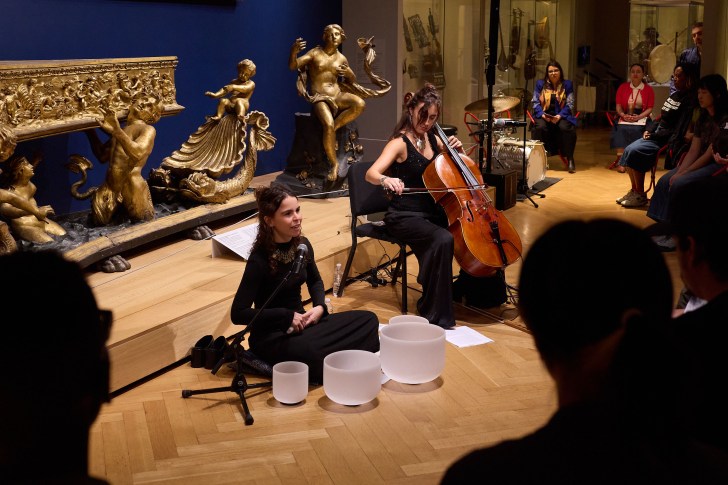
Paula Ortiz, M.Div. ’26, and Lia Pikus, M.T.S. ’27, facilitate a Deep Listening Workshop in September at the Metropolitan Museum of Art in New York City.
Photo: Argenis Apolinario
The Resonant Listening Initiative team will build upon the Deep Listening Series Workshop Series, which was funded through a 2025-2026 HCLIF grant. Last year, the team hosted a series of seven deep listening sessions, during which participants fully and intently focused on all sounds around them. With funding from the 2026-2027 HCLIF, the team will expand the sessions’ breadth to encompass community organizing principles, creative and artistic practices, and philosophies that can translate to academic contexts. A capstone, day-long “Integration Retreat” for 20 participants will close the year.
“The Resonant Listening initiative aims to cultivate perceptual bandwidth to recognize and engage the many kinds of communication and connection that happen beyond and before the emergence of verbal language,” said Lia Pikus, M.T.S. ’27, one of the Resonant Listening Initiative’s co-founders and facilitators. “In this way, it takes listening as a foundational vehicle for embodied relationship building.”

 Featured series