Featured series

Science & Tech
How to reject mediocrity

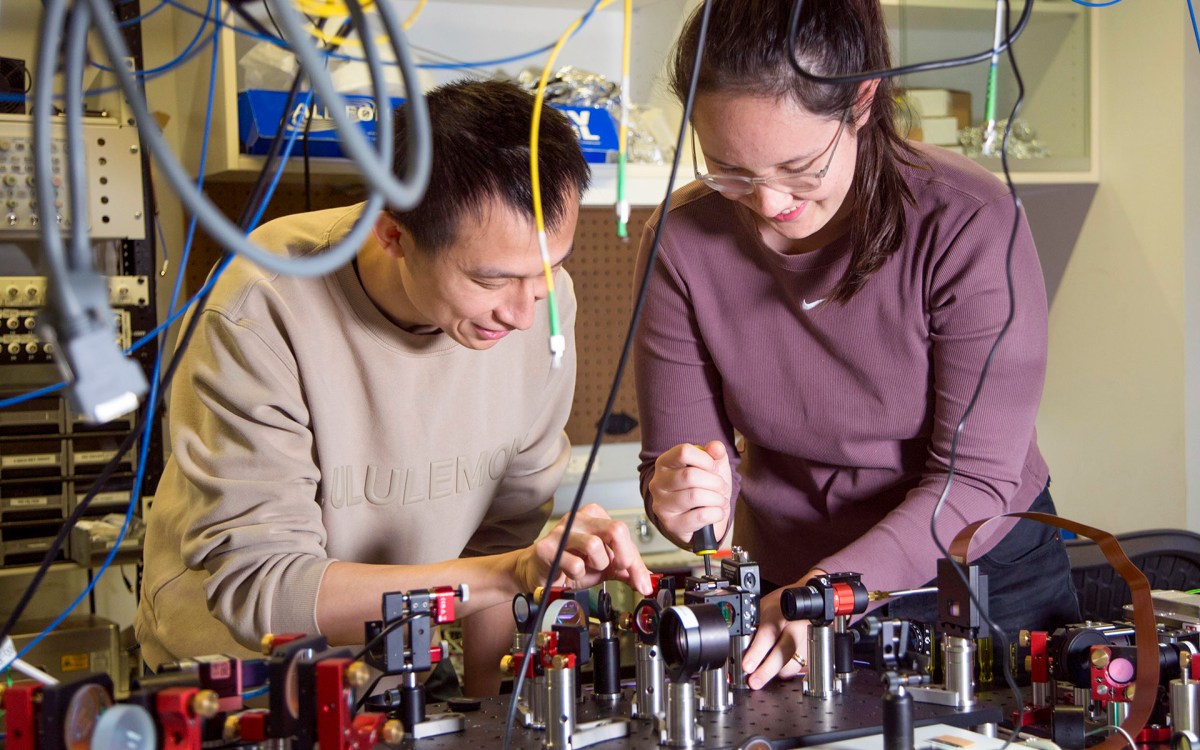
Trevor DePodesta (from left), Chau Vu, Ruishi Zou and Elena Glassman.
Niles Singer/Harvard Staff Photographer
SEAS initiative offers a human-centered rejoinder to the march of the machines

A series of faculty interviews contemplating a new age of disruption.
What if AI didn’t have to be this way?
That’s the core question animating the Center for Human-driven AI Research and Methods (CHARM), a new initiative from the John A. Paulson School of Engineering and Applied Sciences.
The answer, its leaders say, favors depth over speed.
“We’re not just interested in stanching cognitive debt — we’d like to build people up,” said Elena Glassman, CHARM co-founder and an assistant professor of computer science at SEAS. Among her methods is an AI writing assistant that can help students craft technical papers without running the risk of plagiarism — or mediocrity.
We spoke to Glassman and another CHARM co-founder, the Yahn W. Bernier and N. Elizabeth McCaw Professor of Computer Science Krzysztof Gajos, about their mission to shape and elevate human-centered artificial intelligence.
This interview combines responses from separate conversations and has been edited for clarity and length.
Gazette: What are the ideological assumptions you see embedded in dominant models of machine intelligence?
Krzysztof Gajos: A lot of recent AI work has been about making things bigger, faster, more accurate, and this is often not the right thing to strive for. It’s so easy to tell these simple stories: If our doctors make 5 percent more accurate drug prescriptions, we’ll have a healthier population; if we save teachers 5 percent of their time, we’ll have smarter kids. But it turns out that the connection from saving somebody 5 percent of their time to the societal impact is very indirect. Often the efficiency gains don’t result in the societal impacts we strive for.
What would happen if we directly designed for the societal impacts we want to have?
I have an example from my work with [CHARM co-founder and Hershel Smith Professor of Computer Science] Finale Doshi-Velez, where it took us several years to realize we were solving the wrong problem. We were trying to help doctors prescribe antidepressants for people who had tried a couple of drugs that weren’t working — these were complex cases. Professor Doshi-Velez had built an amazing machine-learning system that could suggest things to the doctors, and we spent time figuring out how to deploy it in the office — what kinds of explanations to provide, all of that. But it wasn’t helping the doctors become more accurate.
We kept working with them, and the doctors realized that the tool was taking their eyes off the patient. They didn’t need a slightly more effective drug: They needed a more invested patient. Where the doctors made a difference was in talking to the patients, making sure they understood the options and were really invested in the treatment.
The opportunity for technology was to help the doctor and the patient have a good conversation about the most promising drugs, their side effects, and the preferences of the patient. Human relationships are part of the healing process. We realized we needed to design around that, instead.
Elena, why was now the right moment to launch CHARM?
Elena Glassman: Well, universities produce people, and, incidentally, PDFs. People are hopefully transformed by their experience here, with more knowledge and skills in addition to personal development. Meanwhile, companies are often in the business of products.
Products can feel magical when they accelerate you in the moment, regardless of whether they make you better in the long term. They might even degrade your knowledge and skills over time; people have come up with plenty of terms for this, like cognitive debt and cognitive offloading.
“Ultimately, we want to develop and refine the generalizable knowledge that can guide future designers — and inform future users — about how different alternative system designs might help or harm them.”
I think universities are uniquely positioned to consider what workflows and interfaces actually support people long-term. At CHARM, we’re not just interested in stanching cognitive debt — we’d like to build people up. Ultimately, we want to develop and refine the generalizable knowledge that can guide future designers — and inform future users — about how different alternative system designs might help or harm them.
Can you give me an example of such a system?
Glassman: Sure. I have a tool that is meant for supporting the writing of new academic papers, but it doesn’t generate text for you — for many reasons.
Writing is transformative to the one who is wrestling with translating (albeit imperfectly) their internal personal representations into a consensual symbol system like English. Academic writing is about saying something that has never been said before — something that builds on but does not reiterate prior work. And accepting AI-generated text puts you at risk of plagiarism you can’t even recognize because AI can too poorly paraphrase source material that you’ll never have time to read.
So instead of generating text for you, the AI surfaces relationships between your draft and prior relevant work, as well as common and uncommon ways prior writers presented their ideas, so you can know the rules before you (strategically) break them. For example, as you’re writing, you can request 25 or more analogous sentences that other people wrote in their papers that were written for the same audience, and the system will render those sentences to show emergent common and uncommon writing patterns (that are possibly better or more appropriate for me).
That feels like a tool that could be helpful, but it also requires some scruples on the part of the user to choose the harder path.
Glassman: Right. You could say, “Why would I use Elena’s tool when I can just type the bullet points of my study methodology into Claude and ask it to write me a methodology section?” But then you’re in the position of editing a text you didn’t write, and maybe you don’t catch that the AI subtly misrepresented what you had. Maybe you don’t explain your work in a better way because the AI gave you the average way. When you care, I want you to have the choice to invest in your own abilities instead, so you’re not stuck at “average.”
More broadly, what is the role of universities in the age of AI?
Glassman: First off, I’ll direct our attention to a moment of previous transformation — I’ll call it a fad — which was the massive open online course, or MOOC, that was supposed to end residential learning as we knew it, because everyone would have the best teacher. (As if there was a best teacher, and everyone could learn equally well from them.)
MOOCs still exist in many forms; many people who don’t have access to residential education continue to benefit from them. I’m not disparaging the technology. But the hype around their transformativeness did not acknowledge the importance of the relationship between the teacher and student. I like to think of that relationship as a kind of conduit. The better the relationship, the higher the bandwidth of that connection in terms of knowledge transmission and skill development.
Gajos: From the research perspective, of course you can make an impact being inside Google, Anthropic, or OpenAI, but there are superpowers that you have when you’re not there. Essentially, everyone who talks about the future of AI, whether it’s the president, the CEOs, or on-the-ground workers, speaks from a position of helplessness: “It’s going to happen; there’s nothing I can do.” Really?
So there are two things we can do in academia. The first is to document — to provide evidence of things that are not going well, provide evidence that people don’t learn when they are being supported by AI in the way we build AI today. The second is providing evidence that things can be better, that it’s feasible and effective to do things differently.