Featured series


Nation & World
Schools that ban cellphones see uptick in test scores
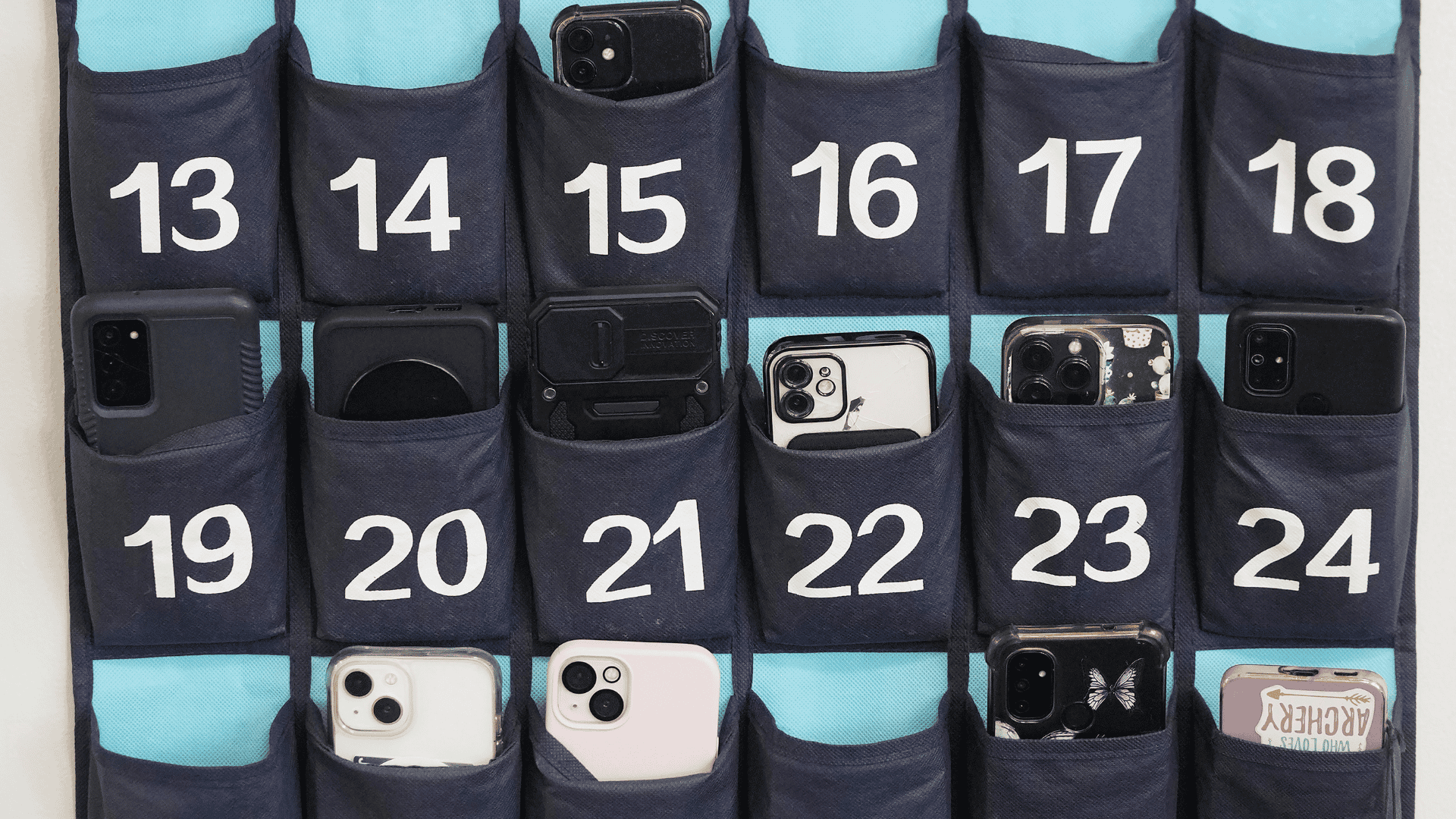
Students in a Utah high school check their cellphones in storage units.
AP Photo/Rick Bowmer
First large national study of policies shows modest but meaningful boost to learning
We’re nearing two milestones in the smartphone era.
January will mark 20 years since Steve Jobs first unveiled the iPhone from a stage in San Francisco.
And it has been nearly a decade since almost every American teenager had access to a smartphone, according to Pew surveys.
But only now are we beginning to study the effects of smartphones on learning — and that’s alarming, since test scores have suffered as smartphones marched to near ubiquitous adoption, falling by about two-hundredths of a standard deviation, year after year, since 2013.
Education researchers were not on hand to study what happened as phones piled up in classrooms, but now they have a second chance: by studying what happens amid a wave of sweeping in-school bans being implemented state by state.
In the first research paper from the States Leading States Initiative — part of the Center for Education Policy Research (CEPR) at the Harvard Graduate School of Education — researchers find a measured but promising effect of those bans.
They’re not a quick fix for the “slow leak” of student achievement. But — if sufficiently strict — they do seem to cut into the steady tide of academic losses incurred by the nation’s students, and may, over time, see students’ scores climbing slowly rather than ebbing away.
In this conversation edited for clarity and length, the education economist Thomas Kane, CEPR’s faculty director, discusses what the paper found, limits of the research, and what he’d recommend researchers — and policymakers — pursue next.
Gazette: This is the first large national study of smartphone bans in schools — and it was a long time coming. The circumstantial case for phones impeding learning is at least suggestive, I would think.
Thomas Kane: Student achievement has been declining since about 2013 in the U.S., in what we call a “slow leak” in the paper. And there have been similar trends in many Western European countries and in Canada, especially in reading.
Many parents and policymakers have been concerned about how much of that decline is due to cellphone use. Of course, there are other possible explanations, too: Until a couple of years ago, I personally thought the most likely explanation in the U.S. was a decline in test-based accountability. But given the international nature of the decline, it seemed important to try to study the effect of in-school cellphone use.
How do you set about isolating that effect?
We missed our chance to see the impact, school by school, as these phones were coming into the classroom. But now we had a chance to see the natural experiment run in reverse, as schools implemented strict cellphone bans. And what we found was that — after a ban — the gain in achievement growth was about 0.01 standard deviations, equivalent to between a week and two weeks of additional instruction over the course of a year.
By conventional standards — compared to, say, interventions such as tutoring — 0.01 standard deviations would be small. But it turns out to be about half the size of the annual achievement losses since 2013: small losses that accumulated over time. And even if the impact of these bans is small in any given year, we would also expect the gains to accumulate over time.
This was a large study of many different approaches to a ban, and many different metrics. Test scores have suffered most, as you’ve noted, among students at the low end of the distribution already. Was there evidence that the bans helped particularly in that cohort?
Say you take two kids who start the year in different places: one high-scoring, one low-scoring. We did not find that a ban would generate a much larger boost for the lower-scoring student. But we found something else that was a little surprising.
Among all students, regardless of their baseline achievement, there’s a subset who were seeing big losses in reading over the course of the year, and bans seem to stop that loss. One interpretation of that is there are just some kids who are a bit more distractable, and taking the phones away prevents those large achievement losses. This may make sense to parents of multiple children. For instance, I have two sons, both pretty high-scoring — but one is much more distractible than the other.
But I’m also really curious — and there actually is some survey evidence to suggest this — that many low-scoring students are spending a ton more time on social media outside of school. So the plummeting of scores at the bottom may be related more to out-of-school phone use than in-school use. We don’t have the data required to do that study yet, but I’d love to investigate that.
That was going to be my next question. It seems to me that whatever smartphones have done to our brains — adults and children — it isn’t limited to the moments when we are using them. They divide our attention, they provide these rapid dopamine loops — by design — and over time that may make it harder to read, say, “Romeo and Juliet” or “The Catcher in the Rye.”
Yes — and if we do now have some evidence that in-school bans do produce some boost in achievement, maybe there’s still some residue. If in part of my mind I’m thinking about the YouTube videos I watched last night, or the argument on Snapchat that I got in at 10 p.m., I’m still thinking about that. An in-school ban won’t take that effect away.
It could well be that out-of-school use is more consequential, especially in the lower-achievement students. If it’s that lower tier of students doing three- or four-hour binges at night, one can imagine that spills over into the school day.
The maddening thing is that social media companies know how much time students are spending on their platforms — but their data has just never been linked to the academic outcomes of individual students. That could raise all sorts of privacy concerns, but I think it would be possible to aggregate data and de-identify in a way that would protect student privacy.
One sort of ban that you studied relied on a different type of new tech in schools: Yondr Pouches, neoprene bags whereby students lock their phones away for the duration of the school day. Those involve an investment of, you estimate, around $425 a classroom. Does that feel worth it, based on the observed gains in scores?
Well, if it’s a week or two weeks of additional instruction per year, then yes, probably. Would it cost you more to get that extra learning time some other way? The lockable pouches are about a fifth the cost of a teacher’s salary, on a per-student basis — and that’s not including the cost of operating the building.
It’s a relatively small effect, but it’s about half the year-over-year loss as cellphones became ubiquitous, and it’s a cost-effective way of adding one to two weeks of learning.

Thomas Kane.
File photo by Veasey Conway/Harvard Staff Photographer
The pouches were judged to have effects equivalent to other kinds of “strict bans,” as you outlined them in the paper. Can you explain what that means versus instructional-time bans, say?
We defined a “strict ban” as using these pouches, storing the phones in centralized locations in the school, or keeping phones off-campus altogether.
We focused on the pouches because Yondr shared their data about which schools were implementing them and when. But people are developing other technologies to implement strict bans: With one company, students install an app on their phone and the phone can sense when it’s within school boundaries and disables everything but phone communication during that time. And I’m sure there will be other approaches.
The key idea is that you’re not relying on teachers to enforce it, with inevitably some teachers more lax than others. And you’re not tempting students with having the phone in their backpack — half a second away.
Most of these bans are relatively new. But one of the more hopeful findings in the paper bears on the pouches: that reading scores seemed to improve even more in the second year of a ban relative to the first.
At this point, what we’ve found is there isn’t a statistically significant difference between being in the first year of a ban or a later year. One problem is that we don’t have many schools in the third or fourth year of a ban. We will have more evidence with each passing year on whether the impacts remain the same or grow or diminish.
We’re going through a moment of high parental anxiety, even anger, about the presence of technology in K-12 classrooms. And earlier this year, Meta agreed to pay out $17 billion to states — rather than fight out a lawsuit about data collection and addictive app designs. As you unveiled in this paper, you encouraged states to use some of that money for further study of the effect of tech on learning. What would be your general policy proposal for a state like Massachusetts, where no statewide ban policy is in place?
Well, I’d encourage all schools to implement some form of a strict ban on cellphones during the school day. And I’d also encourage states to request data from the social media companies, on students’ out-of-school use, so that we can learn whether the widespread anxiety is well-founded or not. That anxiety is already leading to policy action, without — necessarily — a lot of evidence. I guarantee you that there are some surprises to be found in those data.
For instance, maybe we’ll learn the main problem is late-night use, and it has disrupted sleep that impacts student achievement. And that would lead to one regulatory approach. But if we found that actually it’s the aggregate amount of use, the deadening of the attention span you mentioned earlier, [that] is the problem — that implies a different set of regulations.
So we ought not to just shoot from the hip. With the Meta settlement, the company has committed to sharing data, and part of what we’re trying to do is ensure that the data received will provide some of these answers.