Featured series




Illustration by Dave Higginson/Ikon Images
Work & Economy
Your neighbor’s no Bezos, but he might be ‘stealthy wealthy’
Insights on tax policy, inequality from economist who co-wrote ‘The Everywhere Millionaire’
A majority of Americans blame billionaires for the nation’s ever-growing income and wealth divide. But economists Eric Zwick and Owen Zidar say there’s a much larger, but little-known cadre of very rich folks who may be even more important in closing the gap.
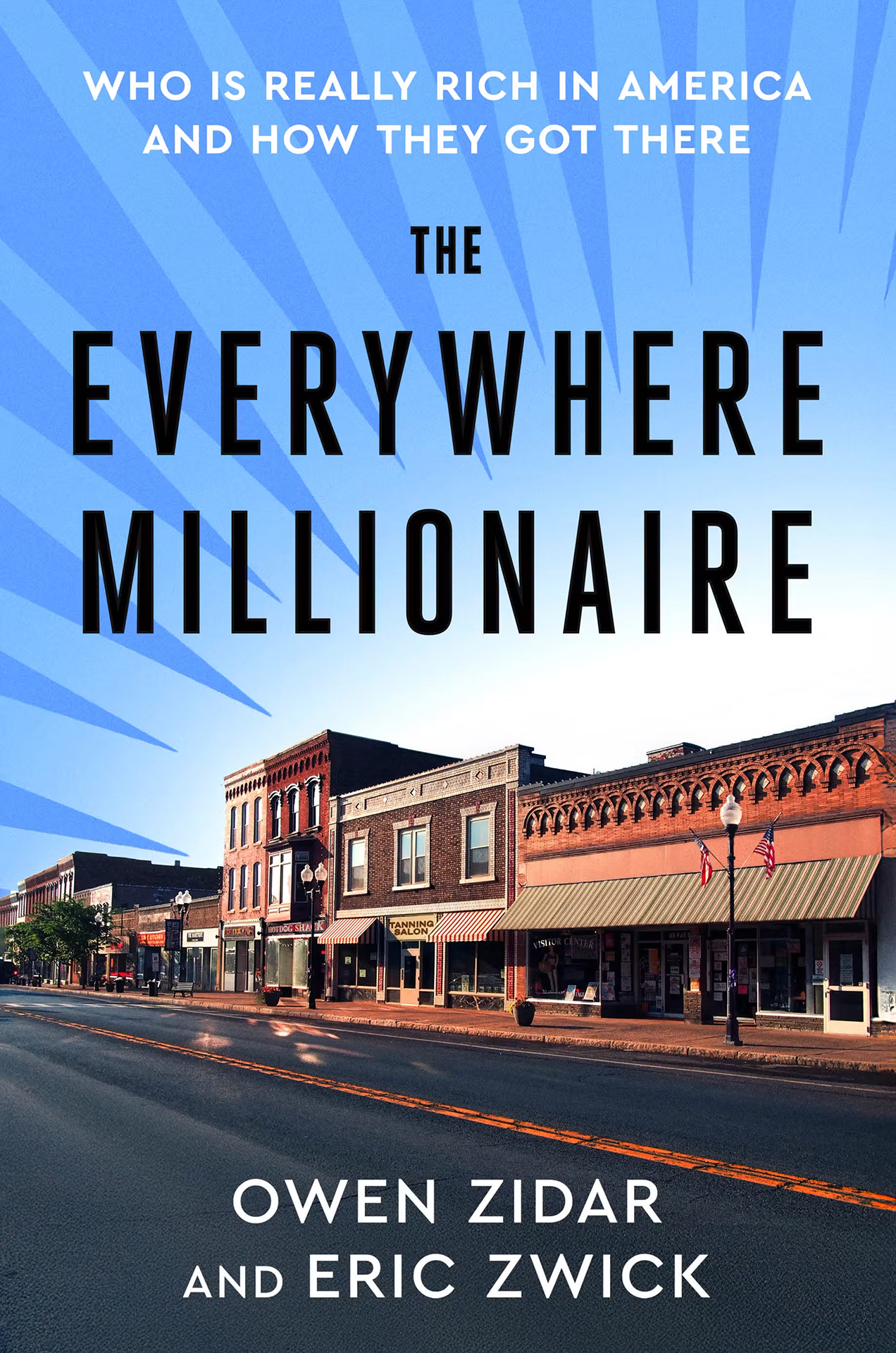
In a new book, “The Everywhere Millionaire: Who Is Really Rich in America and How They Got There,” the pair dug through federal tax records to get a fuller, more precise picture of prosperity in the U.S.
What they found was a large and hidden pool of Main Street millionaires. Most often, these are very successful local entrepreneurs who own ordinary businesses like gas stations, supermarkets, plumbing supply companies or car dealerships.
These “everywhere millionaires” collectively hold many times the wealth of the entire Forbes 400 — and wield considerable political power.
In this edited interview, Zwick, M.A. ’11, Ph.D. ’14, explains how this happened and what it can tell us about wealth and inequality in the nation.

Gazette: What makes someone an “everywhere millionaire”?
Eric Zwick: We define an everywhere millionaire as somebody who has a net worth of at least $5 million and has an ownership stake of a private business. That’s a really important part of their wealth.
That definition applies to about 3 million Americans who, collectively, have an average wealth of around $25 million. If you add all their wealth up, it’s more than 10 times the size of the Forbes 400 list in terms of their total wealth combined. So, it’s a much larger amount of resources we’re talking about.
Of course, individually, a typical one is not going to be as rich as Elon Musk or Jeff Bezos. But each of them is quite rich in the way that a normal person might think about what makes somebody really rich.
The book refers to them as the “stealthy wealthy” because these are people who aren’t flashing their cash and often are unglamorous industries, like fast-food franchises and car dealerships. Why did you want to study this particular group?
Three reasons. One is they are central characters in the story of rising income and wealth inequality over the last 40 years.
If we look at the rise of the top 1 percent income share, which is one famous measure of what’s going on with income inequality, more than half of the rise comes from income that flows through pass-through businesses to these private business owners.
It’s not the Elon Musk story. Elon has gotten really rich, and the Forbes 400 has gotten relatively richer, but they still just command a far smaller share of total resources. To understand what’s going on with income and wealth inequality, you need to understand these everywhere millionaires and how they got there.
A second reason is there’s a lot of conversation about the health of the American dream. One version of the American dream is starting a business to get you from the bottom to the top of the income distribution in a generation.
“About a quarter of everywhere millionaires inherited their business. That’s quite a lot. So, it’s an interesting window into upward mobility and opportunity in the country.”
These folks, a lot of them did come from middle-class or lower backgrounds. The typical everywhere millionaire didn’t inherit their firm or didn’t come from a large rich family, and so, it does tell us something about the health of the American dream — that it’s still possible. There are a lot of paths available, even in unglamorous locations and occupations.
At the same time, if you’re born to rich parents, you’re much more likely to be a star entrepreneur. There’s advantages that are quite substantial that accrue to those kids who win the birth lottery.
About a quarter of everywhere millionaires inherited their business. That’s quite a lot. So, it’s an interesting window into upward mobility and opportunity in the country.
And then the third reason is about trying to understand economic and political power in the economy. We tend to focus on the richest and most powerful people and end the conversation there.
There’s an everywhere millionaire in every congressional district.
They have a lot of employees; they pay a lot of sales tax. They’re central figures in the culture, and that means they also have a lot of political power.
In some industries, they’ve used that power to either reduce their tax burdens or protect themselves from competition in ways that are bad for consumers and workers, and we want to interrogate that power when it’s not being used wisely.
Over the last 40 years, you and your co-author say, widespread use of a tax-shift strategy known as “pass-through” businesses has been one of the key drivers of the growth of this cohort of rich folks. What effect has this had and what are some of the other factors?
The tax story is partly a story of them getting richer through being able to keep more of the proceeds of their businesses over time as the tax rates have come down. It also enabled us to see them for the first time.
In the mid ’80s, there was a big tax reform. It was a bipartisan reform — President Reagan and Democrats in Congress.
For the first time it brought the personal income tax rate down below the level of the corporate tax rate. Before, for an entrepreneur, you would have wanted to be a traditional corporation so that you could get that lower tax rate.
Now you want to be what’s called a pass-through business because you pay tax on the personal rate and it’s lower. That led to an explosion and transformation of business activity in the U.S.
Fast-forward 40 years, and more than half of the income, nearly half of the employees, and the vast majority of businesses in the economy are pass-through businesses, which was not at all the case back in 1980. So the tax code played a role in amplifying their growth but also making them visible.
There are a lot of non-tax factors that are important for thinking about why these private businesses have gotten so valuable and why they’re making so much money.
What are some examples of this?
There’s a wave of globalization, which is opening up product markets for not just large multinationals but also for mid-market businesses that can sell and also hire lower-cost workers in the supply chain offshore. These firms benefit in the same way that multinationals do in a lot of industries.
You have deregulation across states that made it a lot easier for these businesses to grow regionally, across state borders.
You have a decline in interest rates, which made it a lot easier to finance growth and also made the businesses more valuable when people turn around to sell them because people are going to pay more. Private equity is willing to pay more when they can finance that purchase with very low interest rates. Those are three examples.
Does the existence and recognition of this large, successful cohort of rich people tell us anything about wealth inequality in the U.S. or the attainability of the American dream?
If you have the view that the American dream is dead, we’re saying it’s more alive than you think. It might not be exactly where you’re looking.
There’s this traditional path to achieving the American dream, which is a very standard credentialed, labor market story — do well in school, get a really high SAT score, go to the best college you can, then go to the blue-chip company to get a job and rise up the corporate ladder or whatever.
That’s a path that works for a lot of people.
But if you have this view that you have to get on that path and if you fall off that path then you’re screwed, that’s definitely not at all supported by the data.
One striking example is if you look at the relationship between SAT scores and the probability of starting a successful business, it’s actually pretty weak. The relationship is much weaker than the relationship between that and your salary at age 35.
So, there’s a different set of skills or abilities or work ethic or whatever that seems to sustain and support successful entrepreneurs that’s much broader than scholastic aptitude by itself, which is another element that’s missing from a lot of American dream narratives that we want to emphasize.
One popular idea to reduce inequality in the U.S. is to focus on the wealth of the biggest billionaires and to constrain the rapid growth of tech and finance-based fortunes. In the book, you say that’s not going to bridge the inequality gap in any significant way. Why not?
Taxing the billionaires is a good idea for closing some loopholes in the income tax that they particularly benefit from. We should have pretty fair tax treatment of people who are high earners, across the types of people that we’re talking about.
The problem with just focusing on the billionaires is that there’s not that much money there, collectively, and so we’re leaving a lot on the table, and we’re failing to recognize other areas where the tax code has been eroded to the benefit of these everywhere millionaires.
They’re individually very rich, but the Forbes 400 is still 4 or 5 percent of total household wealth. There’s this much larger class of people that have really substantial resources, and the book is hopeful, but also shows them with very extravagant consumption habits in some cases.
And I think that’s evidence suggesting that they can afford to pay a little more tax, and they wouldn’t probably notice.
And so, rationalizing the tax burden on this group of people could raise a ton of money and at relatively little economic cost. I think for thinking about our fiscal problems, that should be an important part of the policy tool kit.
Zwick and Zidar will discuss the book with Jason Furman, the Frank and Denie Weil Director of the Mossavar-Rahmani Center for Business and Government and Aetna Professor of the Practice of Economic Policy, on Wednesday, 12:30 p.m.-1:30 p.m., at the Malkin Penthouse at HKS.