Featured series


Nation & World
Is it time to start cutting red tape on government programs?
Journalist’s new book argues ‘administrative burden’ unfairly hits nation’s most vulnerable hardest, suggests solutions

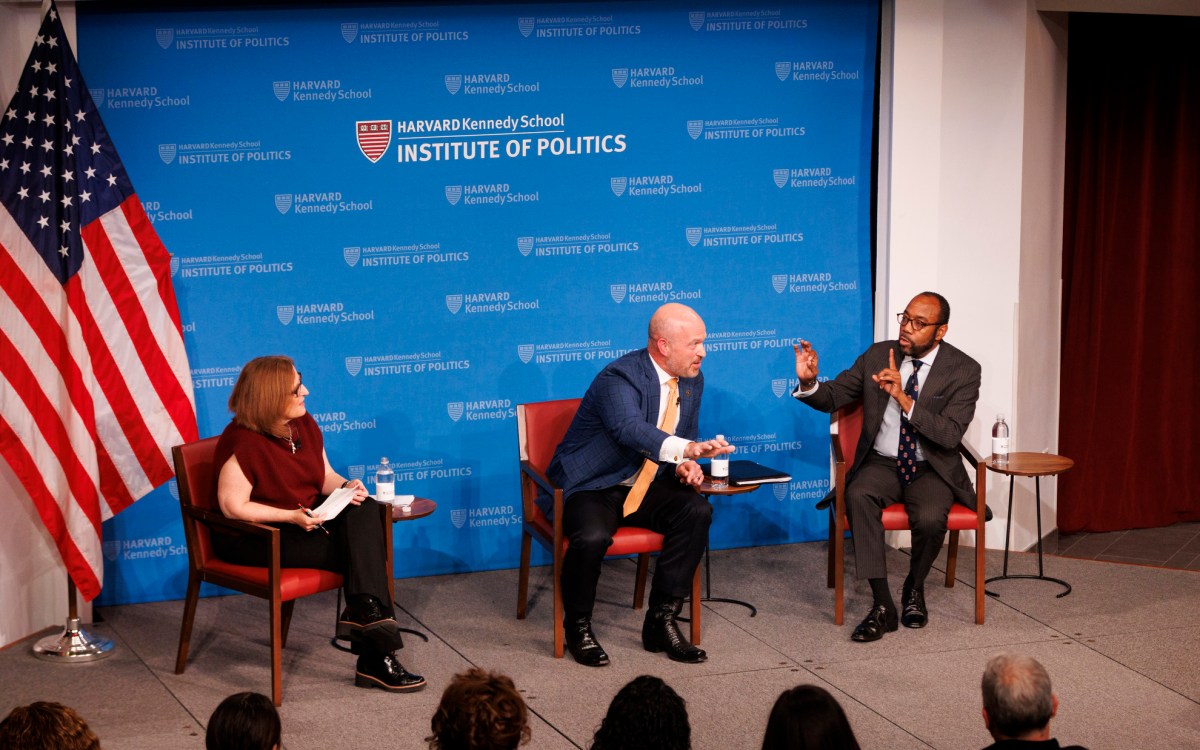
Photo by Sharon Lehm
Politicians are eager, especially at election time, to tout government programs intended to help their constituents, such as Medicare and Medicaid, veterans’ benefits, food assistance, or financial aid for low-income families with children.
What they don’t talk about is how onerous it often is to obtain these benefits and services. There are complicated forms to fill out, lines to stand in, calls to make, and long waits for paperwork to be processed.
Bureaucratic red tape often wastes a lot of time and tends to unfairly burden the most vulnerable Americans, argues journalist Annie Lowrey ’07 in a new book, “The Time Tax: How the Government Wastes Our Time — and How to Fix It.”
In this edited conversation, Lowrey, a staff writer at The Atlantic, explains the civic costs and why it doesn’t have to be this way.
Gazette: What is the time tax, and who does it affect?
Annie Lowrey: The time tax in the academic literature is called “administrative burden.” Administrative burden is a way of assessing or looking at the process of bureaucracy, on the people being bureaucratized.
This is how much work, whether that is time, money, or emotional labor, is spent figuring out how to use a benefit or to vote, is actually ending up with the end user, whether that’s a citizen, a consumer, a student, or someone else.
I think of the time tax as being the sum of excessive, unnecessary, silly, in some cases frankly stupid burdens we have to deal with, whether intentional or not.
A time tax might be when your gym lets you sign up online but makes you quit in person. That’s a time tax. They’re trying to get you not to quit. They’re trying to annoy you into spending money.
This affects all Americans. We all wait in line at the DMV. You have to figure out how to register to vote and then go get your ballot in, whether that’s by mail or in person. In recent elections, we’ve had people wait up to 11 hours in line to vote.
Generally, these time taxes are much more intense for lower-income Americans as well as members of “out groups,” so that includes Black Americans, members of our Native American tribes, LGBTQ Americans, Americans with disabilities, immigrants, people with criminal justice involvement. All of these groups end up waiting in line and doing way more paperwork than other people do.
One reason is because they interact with the state way more often and use more government programs that they have to apply for.
If you’re a high-income person, you might get a home mortgage interest deduction or a 529 savings plan for your kid. You’re going to get them as long as you apply and maybe your tax person or your financial person does them.
Whereas if you’re low-income, you have no choice. If you need SNAP [the Supplemental Nutrition Assistance Program formerly known as food stamps], you’re going to go to that office because you’ve got to feed your kid.
“A time tax might be when your gym lets you sign up online but makes you quit in person. They’re trying to get you not to quit. They’re trying to annoy you into spending money.”
Are some areas in government doing a better job than others in terms of the burdens they impose?
Absolutely. In terms of best, I would put Social Security’s retirement program up here. For most people, whenever you retire, and you want your benefits, they come by direct deposit until you die. This is amazingly effective; they really have this customer service orientation.
After 9/11, Social Security went to the survivors centers to find families and say, “Hey, you might be getting survivors’ benefits. Can we help you?” The first benefits for the survivors of the 9/11 victims I believe went out on Oct. 7 or 14, 2001, so, right after.
Whereas the absolute worst programs are state-managed programs aimed at very-low-income Americans. I think the worst major program is TANF [Temporary Assistance for Needy Families]. It is also a New Deal program, also created in 1935, under a different name, Aid to Families with Dependent Children.
It is so onerous. There’s a really strict work requirement. You have to check in with a civil servant who might be really nice and want to help you or might be really punitive.
You have to answer questions about where you are, where you’re going, what you’re doing, who you’re with. There’s a five-year time limit. If you screw up on your benefits or you don’t comply with orders, you are “sanctioned,” and they call your benefits back.
These are some of our most at-risk infants and toddlers, some of our most at-risk mothers, and we treat them like they’re on trial. It is not treating them like they are worthy citizens that we want to help. That’s just one example.
Why is this happening? Is it incompetence, indifference, political obstruction, all of the above?
It is one of these all-of-the-above type things. We’re looking at deep, deep structural forces here.
One is our racial diversity. We are very, very racially diverse compared to many of our peer countries. This reduces social trust. It makes it so that we have a real emphasis on fraud, a really deep skepticism of people who are seeking aid. We don’t have universal programs, universal services, in the way that other countries do.
Federalism: We have 56 Medicaid programs in this country; we have more than 100 TANF programs in this country. We have how many state tax offices?
The federal government is limited in what it can do, and so you have things being administered at all different levels of government. Whereas, if you look at some of our peer countries, like Britain, they do relatively little at the local level.
There’s other things. I think Republicans end up generating time taxes because they want to shrink government programs. Democrats end up creating time taxes because they want to meet hyper-specific needs with technocratic means. They’re constantly, “Let’s do another very specific semi-refundable tax credit if you’re in an area with low building rates.” Who’s going to use that?
I think a lot of it is because the government provides options for citizens but then expects citizens to figure out those options.
Social Security is obligated to get retirement payments to everybody qualifying. The rules are really clear. A Social Security officer can’t say, “Oh, this person slightly messed up their paperwork, so I’m not going to give them their retirement benefits.” I’m not saying that the program is perfect, but generally, the orientation is if you worked, you deserve this.
A lot of other things aren’t like that. People get kicked off Medicaid all the time, including children, for screwing the paperwork up. We just create tons and tons of bureaucratic work. Government pushes work onto citizens in a way that I consider distasteful and annoying, but also corrosive to democracy, really regressive, really bad for people. It really undercuts faith in government too.
What can be done about it?
This is a problem that is composed of 1,000 little problems. It is not the sort of thing where there’s going to be one magic-bullet solution. This is not “We have high joblessness; we need a stimulus bill.” This is there are a kajillion problems at all levels of government, the incentives are screwed up, and nobody is responsible.
On the other hand, it means there are a lot of really great fixes.
One that would help all Americans is the IRS. Nine in 10 of us take the standard deduction. The IRS already has all of the information that it needs. It could do our taxes for us. It could send your tax forms to you pre-filled. This would be non-obligatory.
For a lot of families, I think they’d like that, and it would probably be more accurate. The IRS would love to do this, but they’re legally not allowed to do it.
We need to be thinking about broader and deeper fixes. The first thing the government needs to do is get a handle on the problem. Find these pain points and eliminate them.
In some cases, that could mean supplanting bad programs with good ones. I would be a fan of amping up the child tax credit and getting rid of TANF. A refundable CTC would do the same thing way better, and you wouldn’t have to go fix all these little things.
And then, going to the states and saying how much time is it taking people to do this? What are your procedural denial rates? Can we give you incentives for getting people on the program instead of keeping them off?
All of these different programs have different income measures.
For instance, SNAP. If you’re an adult, it’s do you have an income of 130 percent of the federal poverty line or less, plus there’s a secondary measure. For Medicaid, it’s 138 percent. You could harmonize those and make it so that the programs could cross-qualify people. That would be really useful.
You say time taxes also undermine people’s trust in government to solve problems. How detrimental is that?
It’s enormously damaging, and there is tremendous research showing that good policies create positive feedback loops. They encourage participation.
Social Security is a great example of this. It encourages political participation. It encourages voting. It makes people more excited to show up at a community meeting. It gets people involved in institutions that will come out to protect or promote the policy, like AARP in the case of Social Security.
Bad policies have the opposite effect.
We give the government, federal and state and local, $8 trillion a year, but we don’t come out and say, “Hey, what are you doing with the money I’m giving you — on average 21 percent of my earnings per year?” They make people withdraw. They make people less likely to vote, less engaged. People give up. And this is a really, really big problem in American life.