Featured series

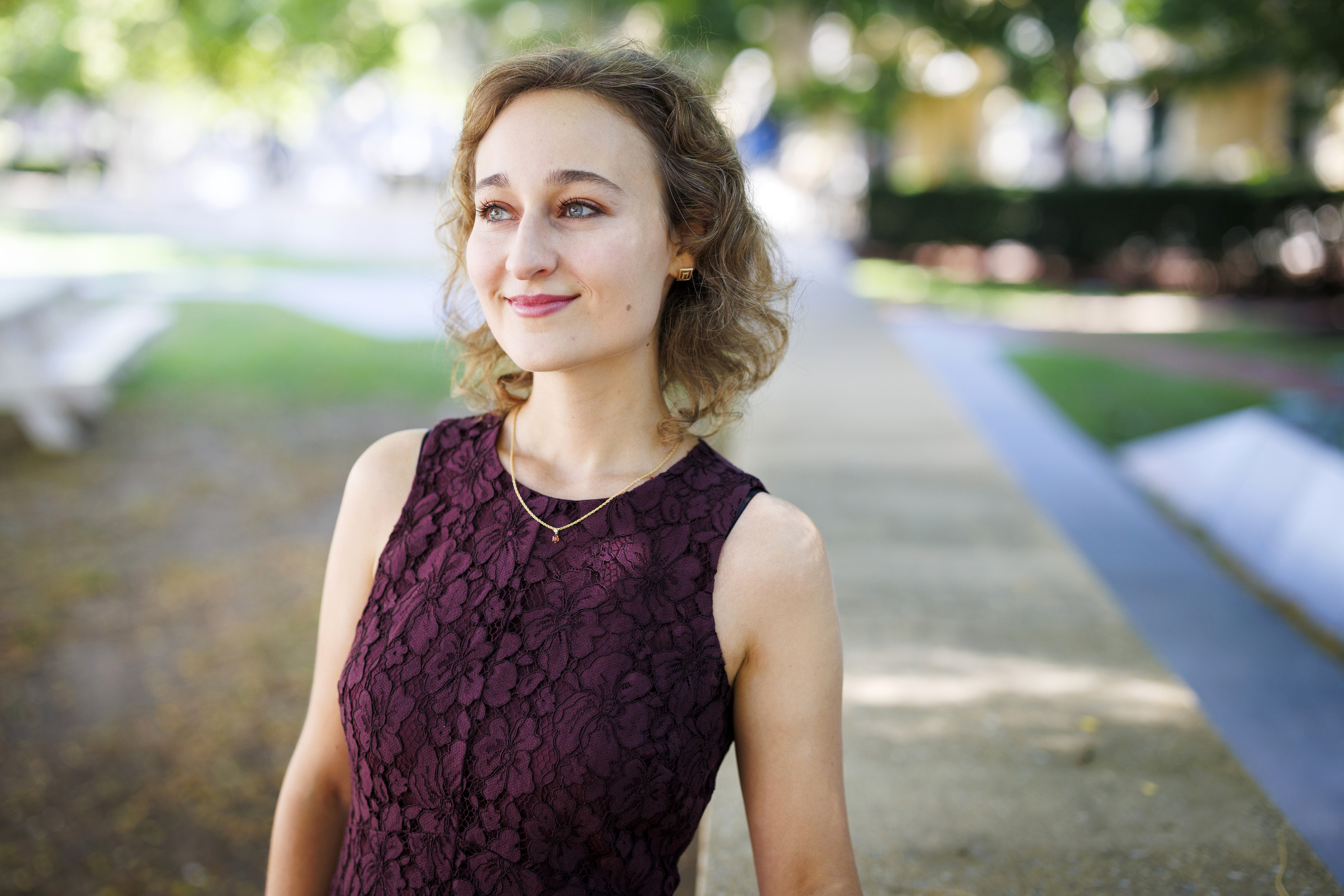
Sophia Zervas.
Stephanie Mitchell/Harvard Staff Photographer
Arts & Culture
Making music is magic. Understanding it is even better.
Why Sophia Zervas traded a career in the arts for academia

A series focused on the personal side of Harvard research and teaching.
From her first piano lesson at age 6, Sophia Zervas seemed destined to become a professional musician. It wasn’t until her final year of pursuing a double bachelor’s degree in voice and piano performance at the University of Colorado, Boulder, that another class — on ethnomusicology, the study of music in its social and cultural contexts — changed everything.
The discipline lured Zervas away from the spotlight of the stage to the archives of academia. Now a Ph.D. candidate in ethnomusicology in the Department of Music, Zervas finds herself a rarity in the field as both a scholar and a classically trained musician.
“Understanding music as a cultural phenomenon, not just as an object in and of itself; that’s what really drew me to ethnomusicology,” said Zervas. “As an artist you produce something that’s ephemeral, and even if you record it, it doesn’t capture the moment of being on stage. As a scholar, you produce something, an article or a book, which can be quite rewarding, because you’ll always have that piece.”
Although Zervas still performs occasionally, she really feels at home using her musical training to understand “the way people make meaning around music.”
“Understanding music as a cultural phenomenon, not just as an object in and of itself; that’s what really drew me to ethnomusicology.”
Sophia Zervas
“Being a musical performer involves an intellectual challenge, an emotional challenge, and also a kinesthetic challenge,” Zervas said. “It’s very exhausting compared to being in the archives or doing ethnographic interviews, but there is something really wonderful about taking a piece of music and breathing life into it.”
For the past six years, Zervas has studied music and cultural institutions in 21st-century Turkey. How she chose the country that sits at the crossroads of the East and West was a bit of an accident, she said. With a mixed background of Lebanese and Greek roots, Zervas was always fascinated by the music of the Mediterranean. She focused on Turkey because of her interest in the intersection between politics and culture.
Zervas studied Turkish at Boğaziçi University in Istanbul and spent more than two years in the country doing field work through a traveling fellowship from Harvard and a doctoral scholarship at the Orient-Institut Istanbul. She researches state cultural policy under the current administration of Recep Tayyip Erdoğan, who was the country’s prime minister from 2003 until 2014 and has been president since 2014.
According to Zervas, the early years of Erdogan’s mayorship in Istanbul, around the mid-1990s, were marked by a rise in traditional music, but also musical syntheses, such as the Janissary military bands, which play traditional songs mixed with jazz. In the early 2000s, she said, multiculturalism through music took off because the country was campaigning to join the EU.
“Then in the mid-2010s, a series of socio-cultural ruptures happened and there is a rise in censorship in music,” said Zervas. “You see a turn from a more positive building up of cultural policy to a more repressive one in the later years.”
Zervas’ adviser, Kay Kaufman Shelemay, G. Gordon Watts Professor of Music and of African and African American Studies, said the work is timely “given the activity in Turkey and a number of other authoritarian regimes to control directions in the arts.”
“The topic of music and politics is also a sensitive one,” said Shelemay. “Sophia is quite keenly aware of the challenges of her specialization. She has found a dissertation topic that is relevant across borders today and is quite innovative in her approach to the interaction of music and politics in modern Turkey.”
After graduation in May, Zervas plans to apply for jobs in academia but remains open to performing. Last year, she was invited to give a small concert at the Orient-Institut Istanbul. She played pieces by Monteverdi, Mendelssohn, and Brahms, among others, and enjoyed a return to the spotlight.
“It was a really joyful experience,” said Zervas. “It was nice not to have to perform for a jury or a grade, but just to perform for an audience of people who I knew well and who were appreciative and excited about the music. So, hopefully, after the Ph.D. is over, there will be more opportunities for that.”