 Featured series

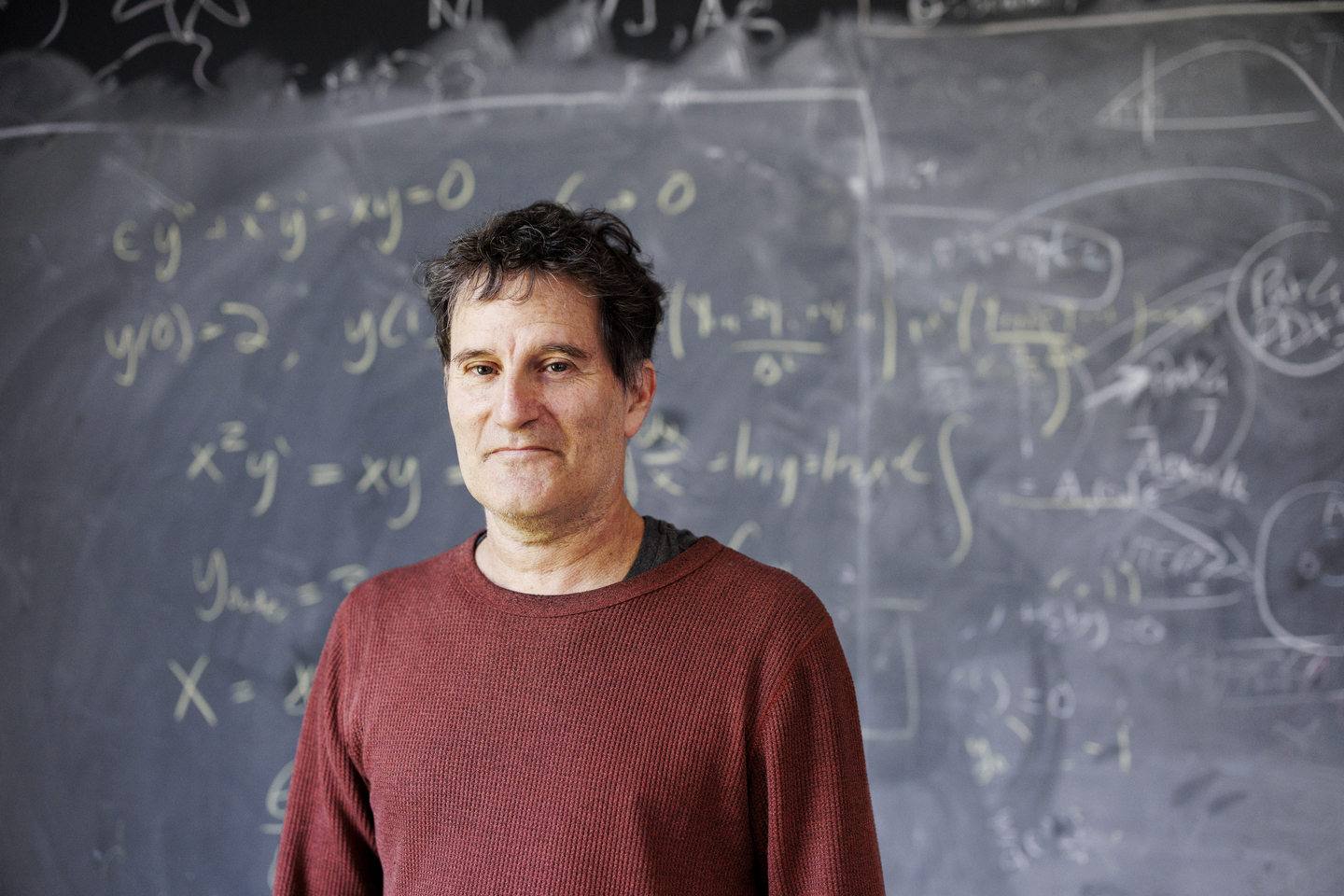
Michael Brenner.
Stephanie Mitchell/Harvard Staff Photographer
Science & Tech
‘I don’t know if this is going to turn out well.’
With a split-screen view of a turbulent tech revolution, Michael Brenner makes a case for the value of human guidance
This is the first installment in “Confronting AI,” a series of faculty interviews contemplating a new age of disruption.
Michael Brenner is one of Harvard’s inaugural Catalyst Professors, a role designed to foster collaboration between the University and the private sector — in his case, at Google. Brenner, who has appointments in Harvard physics and at SEAS, has been thinking deeply about what it means to do math and science in the age of AI, how to teach students, and the value of collaborating with industry. We talked to him about the role of universities in this uncertain moment in the history of knowledge.
This interview has been edited for clarity and length.
Gazette: There’s been a lot of discussion about the role of universities in the age of artificial intelligence. Many people think that part of it is to be a kind of moral force, a defender of human values in the face of automation. What do you make of that?
Brenner: I can’t talk about morality. But let me give you my version of that.
Obviously, the type of work that’s building out the LLM systems is simply impractical for a university, even Harvard, to lead at — just look at the cost of a data center. But we have an absolutely central role, both universities in general and Harvard in particular, which is that we’re arbiters of truth.
The example I would give is that when the Navier-Stokes result came out — and this is something that I worked on when I was a graduate student — I dropped everything to find out if it’s correct.
I basically spent five days working on it, and although I’m not quite convinced that it’s correct, it’s clear to me that progress has been made. But I think the world has been much too quick to declare that because the computer-assisted proof by an LLM has solved one of the major open problems in mathematics, that therefore the solution is actually true.
I mean, I’m not the arbiter — the world is going to have to decide when progress has been made, when arguments are true. We have to decide when the directions are correct. Maybe morality does come into it. So all right, fine, we’ve arrived at morality.
What should universities be doing?
There should be professors who are committed to the pursuit of knowledge, genuine understanding, without bias, for what is true and what is important, and we should be educating students to do that. That’s our job. And if there are machines that have opinions on that, great. I’m all for listening to the opinions of any entity that has opinions. But I don’t think machines can be the arbiters of truth.
“I’m all for listening to the opinions of any entity that has opinions. But I don’t think machines can be the arbiters of truth.”
In my view, the role of Harvard, and the role of universities in general, is even more important than it was before.
I don’t really have much patience for the party line you’ll hear in the newspapers, which is that now that we have machines that can do science, do we really need graduate students? I think the answer is that we need more graduate students, not less. The reason is that graduate students should be more effective now. The Harvard Math Department should be doing better in 10 years than it did in the last 10 years because either they’ll decide these tools are bullshit and they won’t use them, or they’ll figure out how to use them to advance mathematics faster, which is good.
You mentioned the party line that shows up in press reports. Can you articulate what that argument is, and why you think it’s wrong?
The party line is that now that we have AI, fields like mathematics are being transformed. Problems that have been open for 50 years are being solved, and we humans can’t understand the solution, and isn’t it amazing that AI solved it? The party line is that this is where we’re going as a society — that intelligence is going to be entrusted to machines, and that’s where all knowledge is going to come from, so we don’t need people, we don’t need to train experts in mathematics and physics and chemistry. And I just don’t believe that at all.
The expert is actually more important. Because anyone can think that they solved the Riemann hypothesis, but we need experts who can actually figure out if that’s true.
For a lot of people, it’s scary to hear these companies saying they’re building things that might kill us all, might put us out of work, might already be escaping our control — but look! It can also make you a meal plan! It’s a hard vision to get on board with.
I say this as a person who’s talking to you from the Google Cambridge office, and I understand — or I think I understand — what the state of the art is. So I’m biased. But I also think these things are dangerous. I do not think this is a joke. I’m really worried. I spend part of my time working on AI safety for this reason: I cannot morally do what I do without trying to figure this out. Until now, it’s taken deep knowledge to use science to cause harm. We’re transitioning to a society where maybe you don’t need somebody like me, a physicist with deep knowledge. This is an extraordinary risk to society.
The governments of the world are going to have to figure out how to deal with this, and that cuts back to Harvard.
We have on one hand a technical problem related to computer science, which is, “How do I take a model and make it smart enough so it can help us develop novel vaccines, but safe enough to not give out dangerous knowledge to the wrong people?” That requires physics knowledge, biology knowledge. It also requires deep knowledge about policy, international relations. At Harvard we have all of that expertise.
“Wouldn’t you like a place where there are deep thinkers with deep knowledge of how to influence government, how to understand physics, how to understand computer science, and who are unbiased, who aren’t doing it to make money, who are just in it to help humanity?”
Wouldn’t you like a place where there are deep thinkers with deep knowledge of how to influence government, how to understand physics, how to understand computer science, and who are unbiased, who aren’t doing it to make money, who are just in it to help humanity?
Can you take more about your perspective as a Catalyst Professor, with appointments both at Harvard and at Google?
A big part of the reason I’m at Google is that there are things I can work on here that, to be totally honest, I can’t work on from the University. We have the expertise at Harvard, but we can’t stop an LLM from giving the answers it’s going to give. There’s a level of influence that’s only possible inside these companies.
I’m also more able to be helpful to my students. I have a class of 120 undergraduates who are worried about getting jobs. They’re asking me, “What do I need to learn to make sure I can be relevant in this world?” If I didn’t spend part of my time at Google, I wouldn’t be able to give them the best advice. At SEAS, we’re really lucky to have both me and Boaz Barak with Catalyst appointments. We have a very good view of what’s going on inside both Google and OpenAI, and I can’t believe that’s not a good thing. Boaz is teaching AI alignment to graduate students as someone who’s doing that work at OpenAI, and, I mean, that’s who I’d want teaching me AI alignment: a great intellectual who is actually doing the work.
What has it been like for you personally to be on the frontier of AI development?
I have to be honest with you: I’ve spent most of my life at Harvard training students, and I continue to do so. In the end, I think that’s the biggest impact I’ll have made in the world: training people who then go off and do things. But I also feel like I’ve been training my entire life for this: the combination of things that are required to think about this, the technical pieces.
I don’t know if this is going to turn out well. But I also feel that I have some influence, certainly more influence than anyone who might be very technical but isn’t also inside Google. On the other hand, my primary interest is to advance knowledge and to help train people to function in the world. I hope that answers the question.