Featured series
Health
She studies cell lineage in the eye. Now she’s leaving research lineage of her own.
Award-winning biologist Connie Cepko, who advanced work on vision-threatening disease, passes the torch to scientific successors
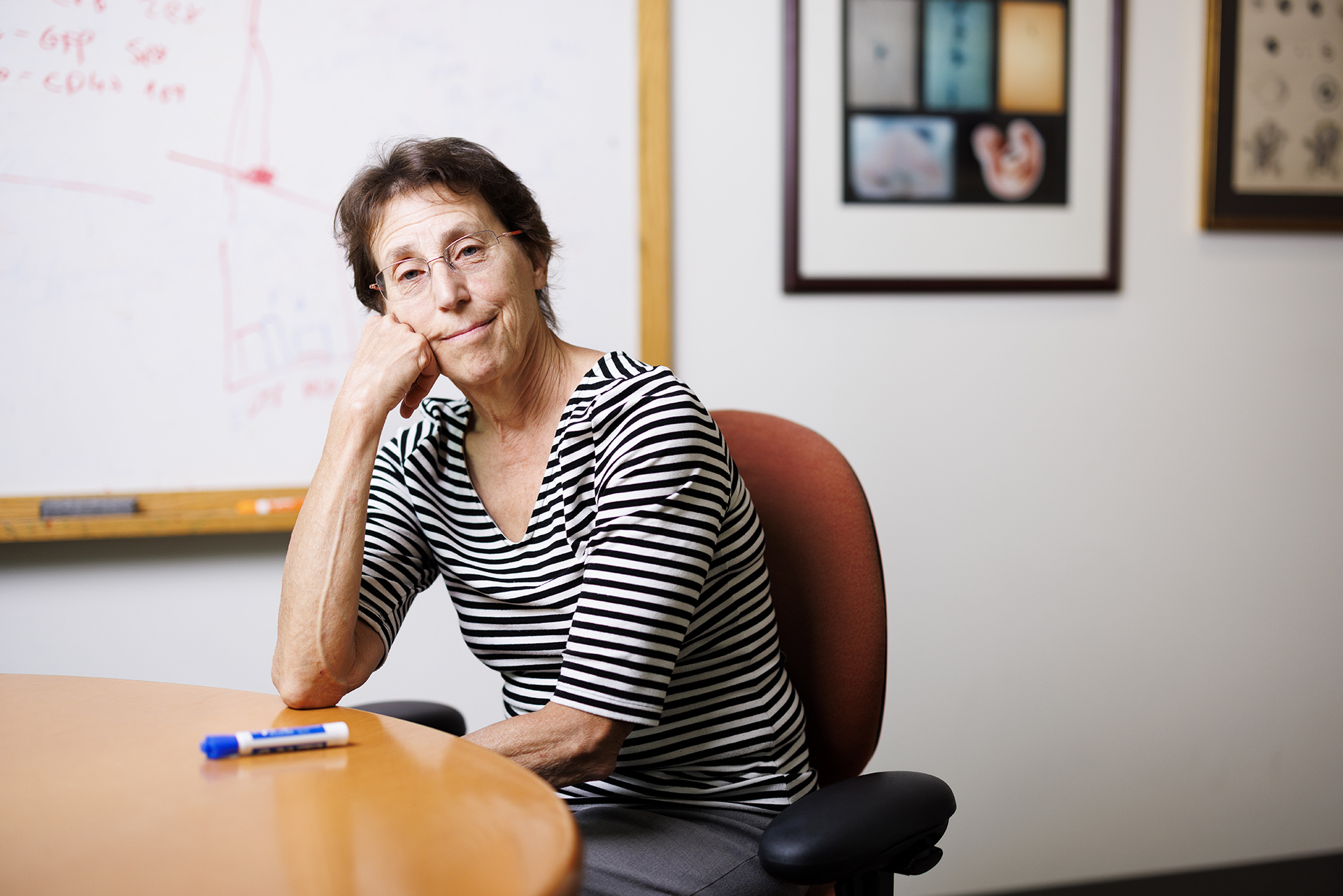
Veasey Conway/Harvard Staff Photographer
Connie Cepko is not tired. She’s not burnt out. And she’s certainly no less fascinated by the complicated and beautiful human eye than she was when she started researching it some four decades ago.
When Cepko, the Bullard Professor of Genetics and Neuroscience at Harvard Medical School, retires on July 31, it will be on principle: It’s time, she says, to pass the torch of scientific discovery to a new generation.
“I still love what I do,” she said. “But it’s time to step aside and make resources available for the up-and-coming junior people who want to do what I do, especially right now with a contraction going on because of the federal government.”
For decades, Cepko’s lab has made major advances toward gene therapies for vision-threatening diseases such as retinitis pigmentosa and age-related macular degeneration (AMD) that affect millions. She has been an investigator with the Howard Hughes Medical Institute since 1994 and has won numerous prestigious awards, including the Bressler Prize in Vision Science and the Friedenwald Award for research in ophthalmology.
Cepko didn’t start out decades ago with treatments in mind. Her early passion was for understanding the development of the retina. In the 1980s, she used retroviral vectors to tag retinal progenitor cells and the process by which a common set of “mother” cells produced the stunning 120 cell subtypes involved in human vision.
Later, researchers in her lab would demonstrate a remarkable oscillating pattern of cellular development, the first and only glimpse into the timeline of cell genesis at that level of precision.
It was an unexpected phone call that turned her attention to therapeutics.
“After about 20 years of doing developmental biology, I got a call from a guy named Alan Schwartz, who just coincidentally was the president of the U.S. Tennis Association,” Cepko said. “His opening line was, ‘What are you doing about blindness?’ Just out of the blue. I’d never heard of this guy, and I’d never had anyone ask me that.”
“He asked what I would do if it was my own child. I had to own up to it. I said, ‘Well, I’d probably work on it.’”
Schwartz’s grandson had been born with Leber congenital amaurosis (LCA), a rare genetic retinal disease characterized by the dysfunction of the photoreceptors — the rods and cones that capture light and make vision possible. Children with LCA are born blind or nearly blind. At the time, there was no treatment for LCA.
Cepko explained that she was a basic scientist. She did the research that, she hoped, clinical or translational researchers would develop into therapies.
Schwartz didn’t buy it. “He asked what I would do if it was my own child,” Cepko said. “I had to own up to it. I said, ‘Well, I’d probably work on it.’”
So she did.
In the process of tracing retinal cell lineage, her team had identified some of the genes that, when mutated, lead to blindness. Researchers had identified hundreds of disease-related genes associated with blindness. Designing a bespoke therapy for each one — a process that can take years and millions of dollars — seemed impractical.
So Cepko and her team decided to pursue a gene-agnostic approach.
When a person loses vision, it’s usually due to loss of function of the cone photoreceptors, which are essential for high-acuity vision and color perception. But in many conditions, including retinitis pigmentosa, the genetic mutation actually affects the rod photoreceptors, which are responsible for night vision.
Therefore, Cepko reasoned, the cones had to be dying from a bystander effect: something in the retinal environment causing them to die independent of a genetic mutation. That meant she could potentially design gene-agnostic therapies to address those environmental conditions in any number of disease indications created by any of the hundreds of genetic mutations.
Over time, she identified seven genes that could be inserted into the eye via an AAV vector (essentially, an engineered virus) to combat the oxidative stress, inflammation, and metabolic problems that contribute to cell death in many retinal diseases.
It took years to thoroughly test each treatment in multiple models of disease to prove that the treatments really were gene-agnostic.
“Connie is especially rigorous and thorough in the way she attacks a research question,” said Grant Zimmermann, the managing director of business development at Harvard’s Blavatnik Biomedical Accelerator, which has worked with Cepko to catalog about 40 inventions from the lab to select the most promising technologies for commercialization. “If she gets interesting results in one of her models, she’ll repeat it using two, three, four different experimental variations before she convinces herself she’s got the right answer.”
The data on her gene-agnostic therapies are promising. But demonstrating safety and efficacy in humans will take years. Cepko plans to stay involved as a consultant to those who are carrying the work forward. And she’s keenly following her trainees’ work as they move forward in their careers, blazing a path that began before Cepko and will follow after.
Science proceeds slowly. The discoveries made by one researcher become the therapies developed by their trainees. The naming of one’s mentors is the tracing of one’s scientific genealogy. (For what it’s worth, Cepko’s was Richard Mulligan, Mallinckrodt Professor of Genetics and professor of pediatrics, emeritus, at Harvard Medical School and Phillip Sharp, a Nobel laureate, at MIT.)
Cepko is just as proud of those who come after her: Emma West, now the co-founder and CEO of the biotech company Digital Biology, whose gifts with experiment design revealed the oscillating pattern of cell differentiation; Ryan Delgado, who is developing an even clearer window into cell lineage; Xiang Ma, whose work on extracellular vesicles could open up new avenues for delivering treatments.
(Besides her scientific lineage, Cepko also notes she has a hugely important personal one, which includes daughters Leah and Ellie and her grandchildren.)
“Connie has created a training environment in which people are encouraged to grow not only as scientists, but also as independent thinkers,” said Ma, who has worked with Cepko for nearly 12 years.
“Connie has been a role model for me in rigorously performing good science while being extremely humble,” said Yunlu Sawyer Xue, a former postdoc in the Cepko lab. “She’s super smart and has a great taste in research directions. I could see science coming out of her lab directly benefiting visually impaired patients in the next couple of years.”
Also in this series:
-
Linda Bilmes is doing the math
Kennedy School budget analyst has made it her life’s mission to elucidate the heavy toll of war: ‘If we don’t account for something, we don’t value it.’
-
Almost everyone she knew growing up were laborers. Now she researches inactivity.
Epidemiologist I-Min Lee has published hundreds of papers on exercise and heart health in her time with the Harvard Alumni Health Study and the Women’s Health Study
-
Finding ways to ‘drug the undruggable’ diseases
Greg Verdine’s approach embraces improvisational thinking, ‘crazy stuff,’ and he thinks it may be future of medical research
-
Demystifying migraine
‘It’s not an imagined headache, and it’s not a mild condition,’ says Michael Moskowitz, Brain Prize recipient for his dogma-defying research
-
An Alzheimer’s breakthrough 10 years in the making
After latest study, Bruce Yankner’s inbox exploded: ‘I try to get back to everybody … I try to provide hope.’
-
In the grip of ‘horror and anger,’ Gawande grows more determined
As global health suffers, his focus on patient-first systems feels more urgent than ever
-
Reeling in a big scientific discovery
William Kaelin pursued Nobel-winning findings using a fisherman’s instinct
-
‘Shared humanity’ is their call to action, here and there
No letup in doctors’ commitment to easing suffering in world’s danger zones