Featured series


Campus & Community
Lessons from Beyoncé on public policy

Ayushi Roy.
Photos by Niles Singer/Harvard Staff Photographer
Professor sees parallels between songs on overlooked life experiences of the marginalized, unintended gaps in government safety net
What can Beyoncé teach students about public policy?
A lot more than you might think, says Ayushi Roy, an adjunct lecturer at Harvard Kennedy School who teaches students how to use digital technology to better provide government services.
The pop superstar’s 2024 album, “Cowboy Carter,” highlights the historically overlooked contributions of Black artists to the evolution of country music and presents an unexpected but relatable framework for Roy’s students as they consider the actual effectiveness of government policies.
The course, “Ameriican Requiem: Beyoncé, Benefits and the Gap Between Promise and Delivery,” asks students to go deep into the nation’s social safety net to figure out how and why good intentions can fall short.
“She frames the album as a conversation about the erasure of African American people from country music,” said Roy. But after seeing Beyoncé perform, “You realize that she’s actually making a commentary about Black erasure from ‘country,’ the body politic, not country as a genre of music, and that really inspired me.”
The 35-time Grammy Award winner tells a story of an America where the experiences of women and other marginalized people were overlooked in the official record in much the same way the perspectives and needs of the users of government-assistance programs like Medicaid and the Supplemental Nutrition Assistance Program get overlooked in the design and delivery of services, said Roy.
“My hope is that I help the next generation of policymakers think more expansively about the kinds of input that define good policy,” so that they can identify potential administrative, operational, and implementation hurdles before they become a hurdle.
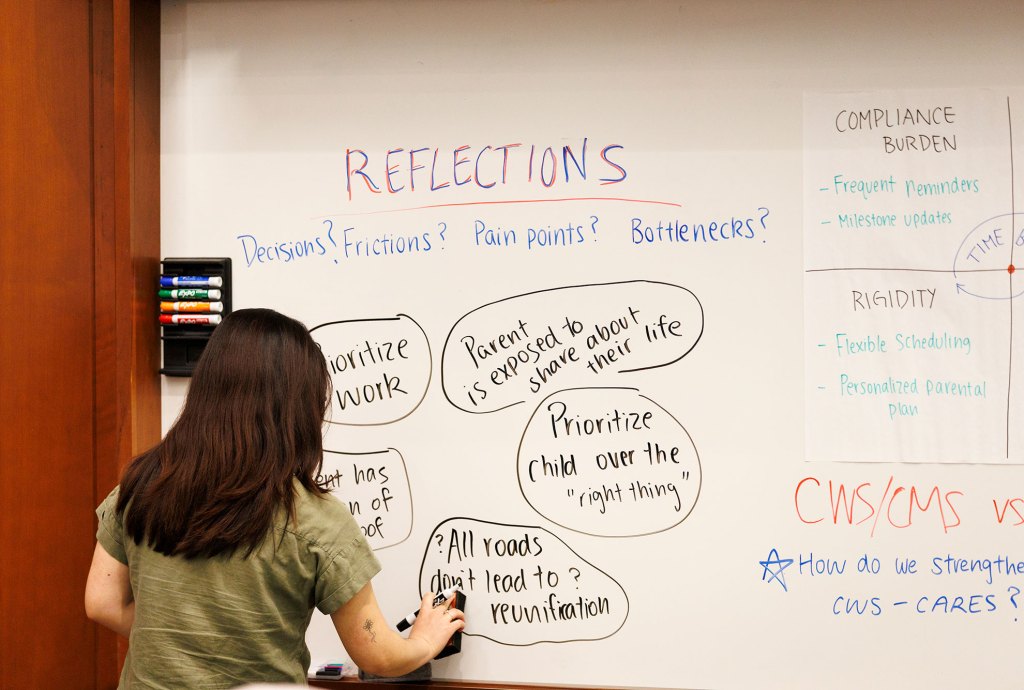
In one recent class, while Beyoncé’s “Protector,” a song about motherhood, played quietly in the background, students heard from practitioners, including a former secretary of health and human services for California, about the state’s child welfare system and the Byzantine process that parents must navigate to be reunited with children who’ve been removed from their care.
To better understand the obstacles, a student team built a child reunification simulation program that takes users through the types of conflicting demands and difficult decisions that families often confront. For instance, court hearings that run long could jeopardize a parent’s job, or required parenting classes at inconvenient times or distant locations could wreak havoc on family budgets and work shifts.
The program offers recommendations for ways to ease or eliminate some of the system’s intrinsic frictions.
“A lot of the way the Kennedy School teaches policymaking is based on economics classes, econometrics classes, statistics classes. That’s a really heavy part of the M.P.P. and M.P.A. core curriculum,” said Roy.
“What is often unspoken is that data, when aggregated and anonymized, isn’t really capturing both the commonplace as well as distinct experiences of the American public. And that is really what makes the difference between [delivering] good policy and standard policy,” said Roy, who would like to see more emphasis on teaching of government implementation, so graduates are better prepared to work on the delivery side of programs and services.
Solving these structural challenges, so that those drafting social safety net policy and those charged with ensuring those in need of assistance do, in fact, benefit, requires a lot more than new apps or fourth-generation AI chatbots in government offices, Roy said.
“I do know as a practitioner, having served in the government for over a dozen years, that the building of technology is the easy part; managing the political feasibility and the implementation is the hard part,” she said.
“Applying private sector technology practices in government is not the solve. It’s really about building this incredibly well-versed student and student professional base of people that think about implementation critically.”