Featured series

Nation & World
Breyer makes case for civic education
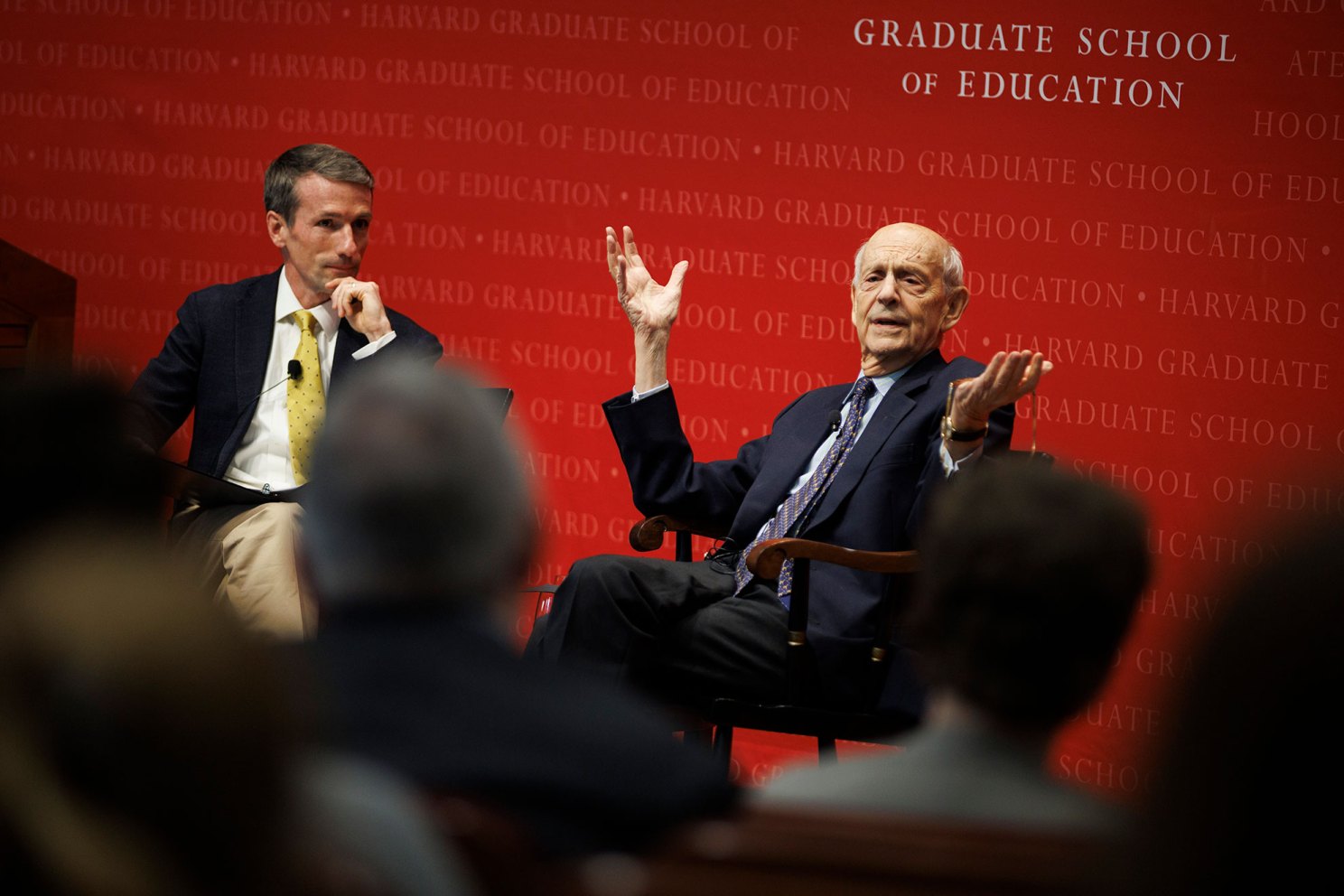
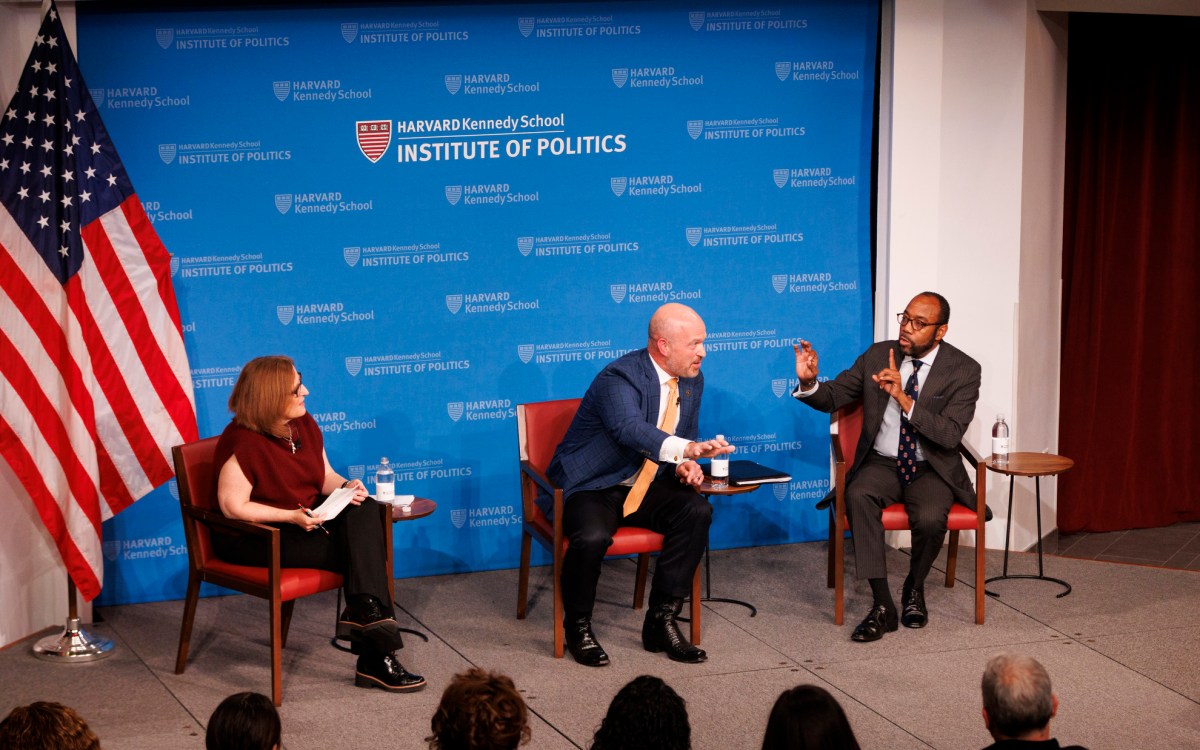
Justice Stephen Breyer (right) with Martin West.
Photo by Grace DuVal
Retired SCOTUS justice says path to less polarization runs through the classroom
Retired Supreme Court Justice Stephen Breyer argued that civic education could help reduce polarization and strengthen citizenship during a forum at the Ed School last month.
“We are in sort of a period where people seem to be arguing quite a lot and disagreeing,” Breyer, who is now Byrne Professor of Administrative Law and Process at Harvard Law School, said in a conversation with Martin West, academic dean and Henry Lee Shattuck Professor of Education, on April 21. “I think in the longer run, the only possible solution is to restore 12th-grade civics.”
Breyer, who served on the court from 1994 to 2022, spoke about his own civic education in San Francisco public schools, which helped spark his interest in public service and taught him the value of civic participation in a democratic government.
“We used to get in a bus and go to Sacramento,” said Breyer. “We’d see the legislature in session, and we’d have ‘Youth in Government Day,’ where everybody took on the position of somebody in San Francisco’s government, so that the kids knew by the time they graduated that they’d better participate in that government — that it’s their government.”
Throughout his career, Breyer has highlighted the role of public education, among other institutions, in strengthening democracy. His books include “Making Our Democracy Work: A Judge’s View.” In 2021, he wrote an 8-1 decision supporting student free speech off-campus, arguing that “America’s public schools are the nurseries of democracy.”
When asked about the role of the Supreme Court in civic education, Breyer said that justices should write in a clear way to ensure that citizens understand both the complexities and the practical impact of a ruling. To underline his point, he recalled a meeting between the Dalai Lama, the exiled spiritual leader of Tibetan Buddhism, and several Supreme Court justices.
“When the Dalai Lama came to the Supreme Court … he asked, ‘What do you do when you have to decide a case that is under the law but immoral?’ We all said, ‘Well, you try to prevent that …’ And if you actually can’t prevent it because it is in the law, you do your best to explain it.”
When asked for advice on how to foster constructive dialogue, Breyer brought up his service as chief counsel of the U.S. Senate Judiciary Committee in the 1970s — specifically the example set by the committee’s chair, Sen. Ted Kennedy.
Kennedy, a Democrat, sought to reach across the aisle, said Breyer, paraphrasing the senator’s message to his staff when it was time to negotiate with Republicans: “Go talk to them, but don’t talk too much. Listen. If you listen long enough, very often, not always, but very often, they will say something that you genuinely agree with.”
Breyer praised the work of several foundations and organizations that are promoting civic education among middle- and high-school students. He noted his own work with the University of Pennsylvania’s Annenberg Classroom, which offers free lessons on the Constitution and the Supreme Court.
He said that he remains optimistic about young people’s efforts to participate in civic life and pursue careers in public service.
“They’re interested in what they might do to cure some of these problems in front of us,” he said. “And it’s the look in their eyes that makes me optimistic.”