Featured series

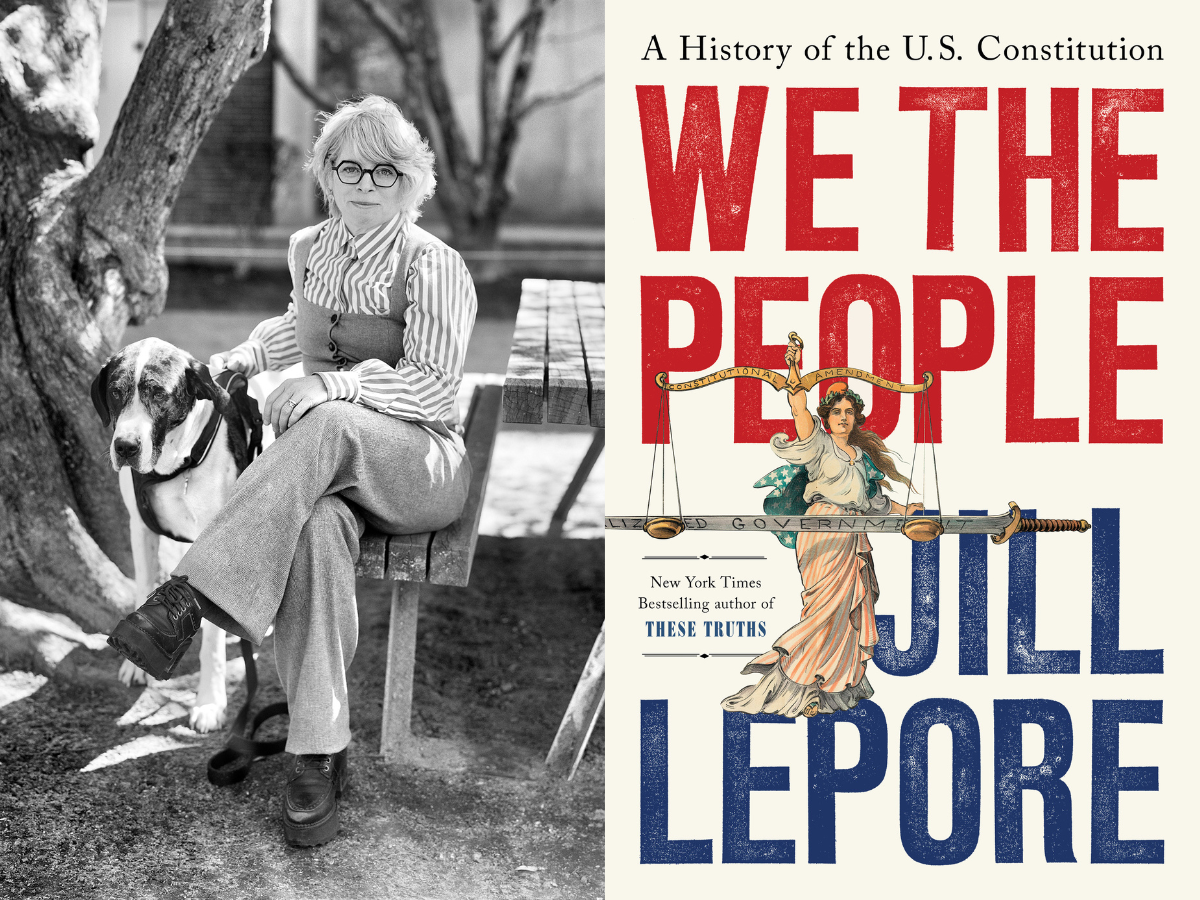
Jill Lepore.
Photo by Richard Renaldi.
Nation & World
Constitution was made to be amended. So what’s stopping us?
Jill Lepore argues in her new Pulitzer-winning history that it desperately needs update, traces emergence of roadblocks
Excerpted from “We the People: A History of the U.S. Constitution” by Jill Lepore, David Woods Kemper ’41 Professor of American History and Professor of Law at Harvard Law School.
We the People. The Constitution of the United States is made of things that are born, live, thrive, decay, and die: insects, animals, plants, ideas. In order to form a more perfect Union. Each of its elements began, long ago, in the loamy earth, hatching and creeping or slipping, slick and squealing, from the womb of the mind. Establish justice, ensure domestic tranquility. The text is written on parchment made from sheep, fleeced, their hides soaked in lime, stretched and dried. Provide for the common defense. The ink came from the buds of oak leaves, swollen to the size of musket balls by the eggs of wasps. Promote the general welfare. Its words were shaped by quills fashioned from the feathers of molting geese. Secure the blessings of liberty. Its lofty, momentous ideas came from the minds of men, long since dead, and from the books they read. To ourselves and our posterity. Of the nearly 200 written constitutions, the Constitution of the United States — the most influential constitution in the world — is also among the oldest, a relic, as brittle as bone, as hard as stone. Do ordain and establish.
But the U.S. Constitution is neither bone nor stone. It is an explosion of ideas. Parchment decays and ink fades, but ideas endure; they also change. The Constitution attempted to solve ancient problems having to do not only with the people and their rulers, the structure of government, and the nature of rights, but also with the knowability and endurance of law. Ingeniously, it accounted for the passage of time.
“But the U.S. Constitution is neither bone nor stone. It is an explosion of ideas.”
The U.S. Constitution was intended to be amended. “The whole purpose of the Constitution,” Supreme Court Justice Antonin Scalia once said, “is to prevent a future society from doing whatsoever it wants to do.” This is not true. One of the Constitution’s founding purposes was to prevent change. Another was to allow for change without violence. Amendment is so essential to the American constitutional tradition, so methodical and so entire a conception of endurance through adaptation, that it can best be described as a philosophy.
That philosophy has structured American constitutional and political development for two and a half centuries. It has done so in a distinctive, halting pattern of progression and regression in which constitutional change by way of judicial interpretation, in the form of opinions issued by the U.S. Supreme Court, alternates with formal amendment as a means of constitutional revision. This pattern has many times provided political stability, with formal amendment and judicial interpretation as the warp and weft of a sturdily woven if by now fraying and faded constitutional fabric. But this pattern, which features, at regular intervals, the perception by half the country that the Court has usurped the power of amendment, has also undermined the idea of representative government, increased the polarization of American politics, contributed to political violence, and led to the underdevelopment of the U.S. Constitution.
With only 27 amendments, the U.S. Constitution has one of the lowest amendment rates in the world. But since 1789, Americans have submitted nearly 10,000 petitions and countless letters, postcards, and phone and email messages to Congress calling for or opposing constitutional amendments, and they have introduced and agitated for thousands more amendments in the pages of newspapers and pamphlets, from pulpits, at political rallies, on websites, and over social media. Some 12,000 amendments have been formally introduced on the floor of Congress. During the era of rising polarization that began around 1968, members of Congress all but stopped bothering even to propose amendments. The more conservative the Court, the smaller the number of amendments proposed by members of Congress. Instead of arguing for amendments, legislators, lobbyists, and other advocates pursued different means of either securing or thwarting constitutional change: influencing the nomination and confirmation of Supreme Court justices and altering the method those justices use to interpret the Constitution.
“With only 27 amendments, the U.S. Constitution has one of the lowest amendment rates in the world.”
That only 27 amendments have ever been ratified is not because Americans are opposed to amending constitutions. Every U.S. state has its own constitution; these have been frequently revised and even replaced. One delegate to a 19th century constitutional convention in Missouri suggested that a state constitution ought to be rewritten every 14 years because every seven years “every bone, muscle, tissue, fibre, and nerve matter” — every cell in the human body — is replaced, and surely, in twice that time, every constitution ought to be amended, too. And that has nearly proven to be the case. Since 1776, the states have held some 250 constitutional conventions and have adopted 144 constitutions, or about three per state. Every state constitution
currently in place has an amendment provision. For most of American history, the states have been exceptionally busy holding constitutional conventions, but like the practice of amending the U.S. Constitution, the practice of holding state constitutional conventions has stagnated. (No U.S. state has held one since 1986.) Nevertheless, the practice of amendment by popular vote thrives in the states, where revision is exponentially easier to achieve. Since 1789, of more than 10,000 amendments formally proposed in the states, nearly 7,000 — well more than two out of three — have been ratified.
The difficulty of amending the federal constitution has had profound consequences. The U.S. Constitution is older than modern democracy and is burdened with all manner of vestigial provisions. Over time, both the U.S. states and other nation-states have amended their constitutions to replace aristocratic provisions. In the American federal government, such provisions — the Electoral College, the malapportionment of the Senate, and life tenure for Supreme Court justices — cannot be changed without first amending the Constitution and, in the case of the Senate, first amending Article V itself. (Article V places equal suffrage in the Senate effectively beyond amendment.) This impasse leaves Americans subject to what political scientists have called the “tyranny of the minority.” The Fifth Article was meant as a constitutional door, open to the people. After 1971, that door slammed shut.
The year 1971, the last time the U.S. Constitution was meaningfully amended, marked a turning point in the history of American constitutionalism. That year a method of constitutional interpretation that became known as originalism was put forward by a distinguished legal scholar, Yale law professor Robert Bork. The word originalism did not enter the English language until 1980, and it had virtually no currency before 1987, when Ronald Reagan nominated Bork to a seat on the U.S. Supreme Court. But it was in 1971 — just when formal amendment was becoming impossible — that Bork first advanced his theory that the only way to read the Constitution is to determine the original intentions of its framers and that every other method of interpretation amounts to amendment by the judiciary.
Originalism rose from the ashes of Article V. Originalists argued that if the Constitution requires changing, it ought to be done by the democratic method of Article V amendment rather than by nine unelected judges. This is an argument that, in earlier eras, liberals had made, too. (As with earlier progressives and midcentury liberals, conservatives’ objections to judicial power did not last past their acquisition of that power.) A problem with this argument, and it is not a small problem, is that Article V hasn’t worked since 1971. Scalia, asked in 2013 if he considered any part of the Constitution to be a flaw, pointed to Article V. It was “not originally a flaw,” he said, but it had become one because “the country has changed so much.” He said he’d run the numbers and concluded that, “if you picked the smallest number necessary for a majority in the least populous states, something like less than 2 percent of the population can prevent a constitutional amendment.” That is not a constitutional door. That is a constitutional barricade.
Bork’s method of constitutional interpretation came to be called “original intent originalism,” to distinguish it from “original meaning originalism” and “original understanding originalism.”
Notwithstanding the semantic schisms among originalists and the Senate’s rejection of Bork’s nomination, originalism steadily gained ground. “The Constitution means what the delegates of the Philadelphia Convention and the state ratifying conventions understood it to mean, not what we judges think it should mean,” said Supreme Court Justice Clarence Thomas in 2001. By then,
originalism had become not only the prevalent mode of interpretation on the federal bench but also strikingly familiar to the public, where, according to public opinion surveys, nearly half of Americans had come to see it as the only way to interpret the Constitution. Its outcomes mapped onto the policy agenda of conservatives, but as the liberal Supreme Court nominee Elena Kagan said during her Senate Judiciary Committee confirmation hearings in 2010, “We are all originalists.” By the 2020s, the dominance of originalism was so overwhelming that the constitutional scholar Cass Sunstein was left to ask, “If we are not originalists, what might we be?”
Originalists have not often agreed on what originalism is; it is also, perhaps surprisingly, quite changeable. The term is also confusing, since it is used to apply both to a serious and important set of arguments about constitutional interpretation and to a form of popular constitutionalism driven by views that range from patriotism and earnest admiration for the nation’s founding to xenophobia and white nationalism. As a method of constitutional interpretation, a great deal that has gone by the name of originalism is perfectly ordinary, unsurprising, and indispensable. All interpretation of the Constitution, like the interpretation of any piece of writing, involves a close inspection of a document’s text, meaning, purpose, and structure. These methods have been used since even before the death of the last surviving delegate to the 1787 Constitutional Convention, James Madison, in 1836. What was new about originalism as it emerged in the last decades of the 20th century — when the Fifth Article lay dormant — was its insistence that the only way to interpret the Constitution is to read it the way a probate judge reads a dead man’s last will and testament. Madison is that dead man.
Originalists deny that originalism is a method of constitutional change, insisting that it is, instead, a method of constitutional restoration. But originalism is a method of constitutional change; it provides a path to change by way of a new method of constitutional interpretation. That method is not original.
To interpret the Constitution — whether to determine the framers’ original intent, the document’s original meaning, or the public’s understanding of it — originalists consult the Constitution, Madison’s notes from the Philadelphia convention, the records of the ratifying conventions, and the Federalist Papers, 85 essays written in support of ratification by Madison, Alexander Hamilton, and John Jay, in 1787 and 1788. None of these sources were widely read in the 18th century, nor were they even widely available. The Federalist essays originally appeared only in New York newspapers. Madison’s notes were not published until 1840. Nineteenth-century law offices did not generally contain these materials. Before the 20th century, consulting sources like 18th-century dictionaries or the records of the ratifying conventions would have been impossible for most lawyers in the United States. Not until the 1980s, when many key historical collections began to be digitized, could these sources be extensively searched with ease, and not until the 21st century could they be searched at the stroke of a key by anyone with a laptop and access to the internet.
“The framers believed the Constitution to be not merely a text, words woven together, but also a set of unstated principles, no more material than a sunbeam or a shaft of light.”
At any rate, Madison himself did not endorse this method. The framers believed the Constitution to be not merely a text, words woven together, but also a set of unstated principles, no more material than a sunbeam or a shaft of light. They also warned against deference to the past. “Is it not the glory of the people of America,” a young Madison asked in 1787, “that, whilst they have paid a decent regard to the opinions of former times and other nations, they have not suffered a blind veneration for antiquity, for custom, or for names, to overrule the suggestions of their own good sense, the knowledge of their own situation, and the lessons of their own experience?”
Madison, the chief keeper of the records of the Constitutional Convention, did not believe those records had any bearing on the interpretation of the Constitution. “Whatever veneration might be entertained for the body of men who formed our Constitution,” he said, “the sense of that body could never be regarded as the oracular guide in expounding the Constitution.” He also warned against relying on the Federalist Papers, given, as he remarked, rather understating the case, that its authors had been “sometimes influenced by the zeal of advocates.” Late in his life, when both he and the Constitution were older — and when Madison sought specific political outcomes — he would on occasion urge deference to 1787. This isn’t evidence that Madison was an originalist; it’s evidence that both the meaning of the Constitution and the methods of discovering that meaning, far from being fixed, established, and beyond dispute, have never been anything other than changeable, contingent, and contested.
How James Madison, Thomas Jefferson, Alexander Hamilton, and John Quincy Adams came to their view of constitutionalism, and how Robert Bork, Antonin Scalia, and Clarence Thomas came to a very different view in the late 20th century, which they nonetheless claimed to belong to the late 18th century, is one of the stranger paradoxes of American constitutional history.
Copyright (c) 2025 by Jill Lepore. Used with permission of the publisher, Liveright Publishing Corporation/The Countryman Press, a division of W. W. Norton & Company, Inc. All rights reserved.