Featured series

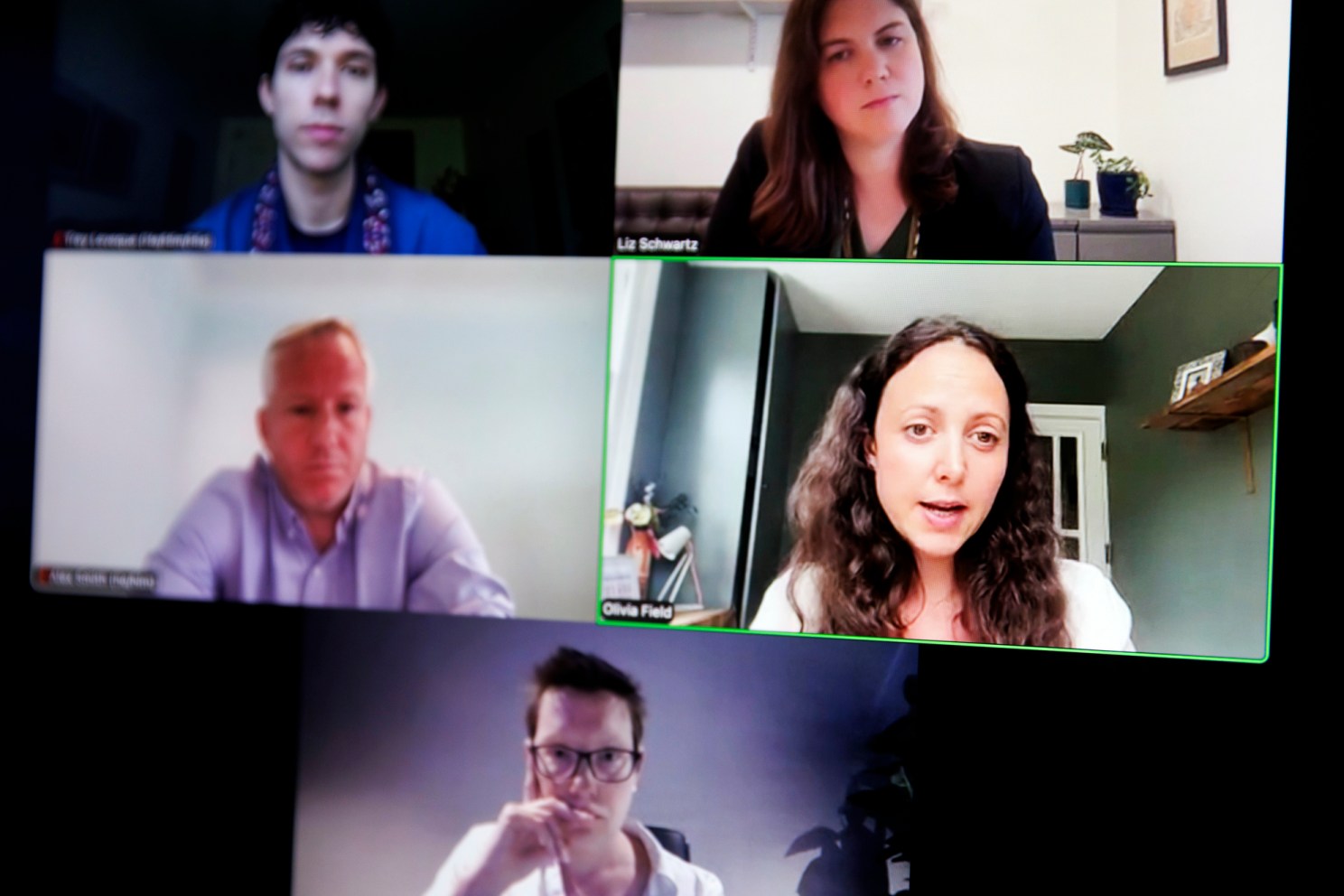
Trey Leveque (clockwise from top left), Liz Schwartz (moderator), Olivia Field, Tracey Crouch, and Alex Smith speak during the webinar.
Stephanie Mitchell/Harvard Staff Photographer
Health
How loneliness became major public health issue
U.K., U.S. experts trace rise in awareness through research, political involvement, pandemic
One of the first national efforts to combat loneliness as a societal health problem fizzled after the pandemic amid economic slowdown and political polarization. But the initiative also raised awareness sufficiently that is still recognized as a public health problem today.
“It started well, but I think it’s fair to say that COVID put a bit of a spanner in the works,” said Tracey Crouch, former United Kingdom minister for loneliness, of her nation’s efforts. “I do think there’s still a real drive from policymakers around the world to recognize the issue of loneliness, recognize the health impact, social impact of loneliness, and try to tackle it in their own unique ways.”
Experts from the U.K. and the U.S. agreed with that assessment at an event Tuesday hosted by the Harvard Kennedy School’s Shorenstein Center on Media, Politics and Public Policy. Acknowledgment of the depth and breadth of the issue in the U.S. got a major boost during the pandemic, but efforts in U.K. began earlier.
Alex Smith, a Shorenstein fellow and author of a recent report on the U.K.’s efforts to address loneliness, said globally the problem has been made worse by increased social change toward individualism, fostered by the development of smartphones and social media.
In the U.K., the response to the problem was ignited by academic research highlighting loneliness’s impact, which created a ripple effect across society and drew the attention of Member of Parliament Jo Cox after her 2015 election.
Philanthropy became interested and started to invest in the matter, and community programs began to show impacts that encouraged others to get involved.
Cox helped press the issue among U.K. political leaders. Her murder in 2016 as she walked to a constituent meeting caused an outpouring of grief and further energized efforts.
“Jo knew that while loneliness is a deeply personal and subjective emotion, its drivers and solutions were really everyone’s business, and there are solutions,” said Olivia Field, chief executive of U.K.-based Jo Cox Foundation. “Her legacy ultimately shattered the myth that it only affects older people and proved that it impacts people of all ages and all backgrounds. She refused to accept living in a lonely country.”
The surge following Cox’s death was driven by nonprofit organizations and governmental cross-party collaboration, which resulted in the completion of the work of the commission on loneliness, which Cox started. By 2017 the narrative had shifted to highlight that many people are affected by loneliness, making it less hidden and an open public health priority.
The next phase, Field said, was a unified call to action that included creation of the world’s first minister for loneliness, along with a national strategy, government funding, and a commitment to more research.
An important characteristic, Field said, was that the issue was a “blank canvas” politically in the U.K. That meant there was no institutional defensiveness to overcome and that working across party lines was easier.
“The winning formula included robust evidence alongside powerful storytelling,” Field said. “We used the hard data that had been collected for a couple of decades or longer to demonstrate the scale of the problem and its impact. We did that alongside human stories that made it relatable and undeniable. The sector consensus was absolutely critical, so we spoke with one unified voice.”
The health impacts of loneliness were recognized as important in the early years of the COVID-19 pandemic, when isolation and social distancing were key responses, said Smith, who is also founder of the Cares Family charities in the U.K. But the energy around the issue waned as the pandemic wore on.
“There’s not much you can say was good [that] happened in COVID, but one thing that did happen was that the stigma around loneliness was reduced.”
Tracey Crouch
The post-pandemic economic crisis, marked in the U.S. by the ending of government pandemic stimulus programs and beginning of high inflation, refocused public attention, as did other crises with global ramifications, such as the Ukraine War and increasing political polarization.
“There’s not much you can say was good [that] happened in COVID, but one thing that did happen was that the stigma around loneliness was reduced,” Crouch said. “People began to understand that it was a real feeling. Things could have been done differently but at least people were now talking about it.”
In the U.S., a high point in the fight against loneliness occurred in 2023, when then-U.S. Surgeon General Vivek Murthy issued an advisory about the ill health effects of loneliness.
Titled “Our Epidemic of Loneliness and Isolation: The U.S. Surgeon General’s Advisory on the Healing Effects of Social Connection and Community,” the publication drew wide attention to the issue.
Trey Leveque, former engagement chief of staff to Murthy, said the advisory grew out of Murthy’s belief that isolation and loneliness are not fringe issues but global ones. Loneliness, Murthy felt, highlights broad problems of social connection in the same way that rising hunger highlights poverty and other major social problems.
“The evidence and research became impossible to ignore,” Leveque said. “Researchers were increasingly demonstrating that social connection and disconnection affect not only emotional well-being but physical health, mental health, emotional outcomes, workplace performance, even civic participation. What has long been considered a private struggle in so many situations and scenarios had started to become recognized as a public health issue, which led to the report that Dr. Murthy put out in 2023.”
Though public attention and political intention have both become fragmented in the years since, panelists agreed that the issue remains potent.
Cultural shifts are continuing to occur, with Asian societies seeing a shift toward individualism and the declining pull of the central family that has been seen in other societies. Artificial intelligence has spread rapidly in recent years and may impact the issue in ways still unknown.
An important date in the U.K. comes June 16, when the 10th anniversary of Cox’s death is likely to draw new attention to the issue.
“I’m hopeful that some of the same actors and a new generation of actors will see — particularly with the arrival of artificial intelligence, which is going to change again how we interact — that how we interact with one another and our communities is a fundamental part of what it means to be human,” Smith said.