Featured series


Science & Tech
Bone-eating worms and other deep-sea survivors
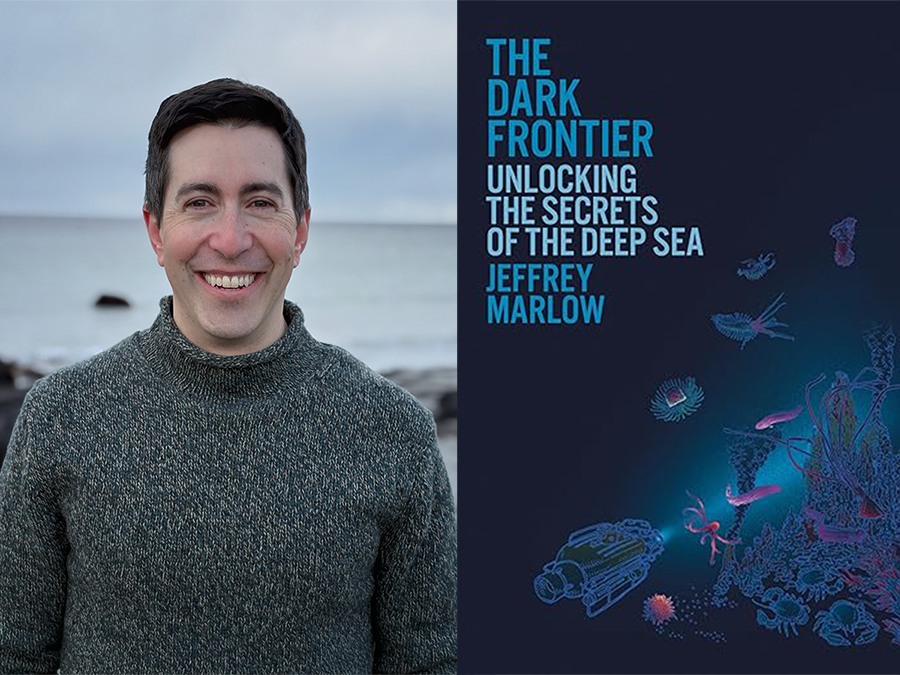
‘Dark Frontier’ author details life in one of Earth’s harshest environments and quest to carve out ‘national parks’ of the oceans
Home to translucent shrimp living in sulfurous vents, methane-eating microbes, and corals older than the Egyptian pyramids, the deep sea is among the Earth’s most extreme environments. It’s also under threat — from climate change, resource extraction, and overfishing, said Jeffrey Marlow, a biologist and the author of the new book “The Dark Frontier: Unlocking the Secrets of the Deep Sea.”
“It’s very easy to destroy these environments, and they take a very long time to come back, if they ever do,” he said.
Marlow, an assistant professor of biology at Boston University, completed postdoctoral research at Harvard’s Girguis Lab, where he researched the strange ways deep-sea microbes sustain themselves in incredibly harsh environments. During that research, he also served as a scientific adviser to the United Nations working group behind the Agreement on Marine Biological Diversity of Areas Beyond National Jurisdiction, commonly known as the High Seas Treaty, which took force this January.
In this interview, edited for length and clarity, Marlow shared what it’s like to venture thousands of meters below sea level, and to bring what he learned there to the halls of international power.
-
How deep is your knowledge of the ocean?
If you’ve got thalassophobia, this research-backed quiz is not for you.
 Quiz
Quiz
What is it like to visit the deep sea in a submersible?
It’s definitely a bizarre experience. On one hand, you’re visiting an enormous realm of geology and biology — all of the processes that occur in the deep sea are grand in scale. But on the other hand, the experience of being there is very small. You’re in this tiny little sphere. The headlights of the submersible only illuminate so much.
But what that does is it draws your focus to the tiny details. You aren’t looking at the huge cliffs around you; you’re looking at these little worms and these rocks with weird things on them, these little gas bubbles that might be coming out. It’s bizarre to be going through so much space to get to a place where perhaps no human has ever been and then focus on the minutia.
What are some of the more unusual creatures who make their homes in the extreme environments of the deep sea?
One of my favorites are the microbes that eat methane at methane seeps. They’re cool for a couple of reasons. Firstly, they turn methane, which is a strong greenhouse gas, into rock, which is just an amazing transformation metabolically, and also obviously important for our greenhouse gas budget. Secondly, they require a symbiosis. The process of using methane as an energy source without oxygen is not energetically possible on its own; it requires other microbes that breathe sulfate, to make up the difference. It’s only through symbiosis that the entire process is possible.
“We’re coming to understand more and more that life is interconnected, especially in extreme environments where there’s barely enough energy to survive on.”
Another of my favorites is a type of microbe called Oceanospirillales, which is also a symbiote. They live inside of Osedax, these fluffy worms that eat whale bones. After the flesh is gone from these whale skeletons, all that’s left are bones that have some juicy lipids deep inside. But they’re hard to get to. These microbes are able to break down some of the really hard molecules of a bone and feed it to the worm.
These are just two examples of deep-sea symbiosis. We’re coming to understand more and more that life is interconnected, especially in extreme environments where there’s barely enough energy to survive on. You often have to partner with another species to get by.
You’ve been involved with efforts to preserve marine biodiversity at the international level. How are you seeing deep-sea environments impacted by humans today?
The most obvious impact is trash, which you’ll find here and there in the deep sea. We’re also starting to see chemical changes. For instance, a study that came out a few years ago compared a type of plankton that was collected during the [1872-1876] Challenger expedition with the same type of plankton today and found that their carbonate shells are up to 76 percent thinner as a direct result of ocean acidification.
Beyond that, we’re seeing humans interact with the deep sea around resource use, both through oil drilling, which isn’t new, and deep-sea mining, which may be ramping up in the coming years. As humans, we tend to see our environment as a place to acquire resources, and the deep sea is kind of the next frontier of that perspective just as much as it is for scientific discovery.
Can you explain a bit about your work on the U.N. High Seas Treaty?
For several years, I’ve served as a co-lead of the Biodiversity Beyond National Jurisdiction working group for the Deep Ocean Stewardship Initiative, an NGO founded by scientists that was granted official access to attend and contribute to the U.N. process.
As a scientist, I felt at times that the process was quite slow. I came to learn that that was by design. They were really aiming for a treaty by consensus: It’s not that everyone is entirely happy with every word of the agreement, but rather that no one is extremely unhappy with it.
What emerged, in my view, is an amazing framework. Everyone in that room agreed, essentially, that the area beyond national jurisdiction is an important realm worthy of regulation and protection. The details are what matter, and they’ll be worked out in the coming years — and will probably always be updated as we learn more, and as we put things into practice and see what works.
The treaty creates a path for the creation of Marine Protected Areas. How will those work, and are there areas you’d like to see protected?
This would be a fundamentally new thing. I’m excited that we as a global community can put some places in the oceans aside for protection in the same way we put aside national parks on land.
“I’m excited that we as a global community can put some places in the oceans aside for protection in the same way we put aside national parks on land.”
I’d really like to see the Lost City hydrothermal vent system in the Atlantic Ocean protected. Most hydrothermal vents are very hot, and they spew acidic and metal-rich fluids into the sea. But the Lost City is different. It’s alkaline, and it’s a little bit cooler. It has some properties that make a compelling analog for where life originated on earth.
There’s also the Sargasso Sea, a big raft of sargassum seaweed that, through the confluence of ocean currents, is rather static in the Mid-Atlantic, off the coast of Bermuda. It has a lot of endemic species that could be at risk from overfishing and pollution.
I’m not an absolutist: We need our materials and resources from somewhere, and there’s likely a world in which getting things from the deep sea is the least impactful way to do it. But there’s still so much we don’t know about these ecosystems. I think there’s value in building a proverbial fence around some parts of our planet as long as we possibly can to preserve nature in its most pristine state.
At a more macro level, the treaty also changed the principles we apply to our engagement with the oceans, is that right?
Yes. Interestingly, what held it up to the very last minute was a debate between the principle of “freedom of the high seas” and the principle of the oceans as the “common heritage of humankind.”
Traditionally, we thought of the seas as a limitless frontier; there was no indication that any of the ocean’s natural resources were going to run out. That framework of the freedom of the high seas made intuitive sense: There was plenty for everyone, so who cares if I go and get what I need?
But as we’ve learned more about the limits and repercussions of resource acquisition, that regime needed to change. The treaty is now guided by both the principle of the common heritage of mankind and by the freedom of the high seas.
We do need a common language and a common framework to use these resources collectively. Whether or not that really happens remains to be seen, but it’s inspiring that the global community came together to come up with something that might chart the path forward.