Featured series



Mandë Holford.
Photos by Stephanie Mitchell/Harvard Staff Photographer
Science & Tech
How venom kills — and can lead to cures
Mandë Holford uncovers the secrets of deadly marine mollusks, how their toxins work with such targeted efficiency
A slow snail can be a fast killer.
Mandë Holford vividly recalls when she first witnessed the stunning power of venom. Holford was a chemistry graduate student studying peptides in human physiology and one day watched a video of a marine snail ambushing a fish, zapping it with venom, and swallowing it whole.
She was struck by how nature had taken ingredients similar to peptides and turned them into lethal weapons that target specific biological systems with ruthless efficiency. The video made Holford dream about taking her career in a new direction by combining chemistry and biology to study venom.
Last year, Holford joined the faculty as a professor of organismic and evolutionary biology and curator of malacology in the Museum of Comparative Zoology. Her research focuses on venomous sea snails and cephalopods, their toxins, and how those compounds might be turned into medicines for human diseases.
“These are nature-based drug factories,” said Holford. “We know they actually work. They’ve been tested over 500 million years of evolution. As I like to say, they’re evolutionary-tested, nature-approved.”
Days at the museum
Long before she dreamed of being a scientist, Holford wandered among dinosaurs, nature dioramas, and the stars of a planetarium.
Her parents often took their five children (Mandë was the middle child) to the American Museum of Natural History in Manhattan and turned the kids loose.
“My parents used it as childcare,” Holford recounts with a laugh. The kids were free to roam the exhibits with a few rules: Don’t leave the building, and meet at 5 p.m. under the elephant display.
While Holford developed an early fascination with natural history, her academic interest in science developed more slowly. She attended Brooklyn Technical High School and believed that science was mostly a matter of memorizing facts, not discovery.
“My parents said, ‘You have three choices — businessperson, doctor, or lawyer,’” she recalled. “I didn’t discover science until I was an undergraduate.”
She attended Wesleyan for one year but was forced to transfer to the City University of New York for financial reasons. To fulfill a science requirement, she enrolled in chemistry and, to her surprise, loved it. The professor, Larry Johnson, offered her a summer job in his lab.
“We were working with lasers, burning holes in molecules, making liquid nitrogen ice cream,” she said. “And I was just like, ‘This is a job?’ And Dr. Johnson said, ‘Yeah — and you get paid!’ I was hooked.”
Holford entered a Ph.D. program in chemistry at Rockefeller University and planned to study peptides but longed for a way to connect her subject with natural history and real animals.
One day, a visiting lecturer showed a video of a marine snail using venom to hunt fish. Holford recalls wondering, “How is that even possible?”
“And then he explained it was the peptides in their venom,” she recalled. “And that was the first time I thought, ‘There is hope. I can do the things that I’m interested in!’”
That visiting scientist was Baldomero “Toto” Olivera, a professor at the University of Utah who did pioneering research on predatory cone snails.
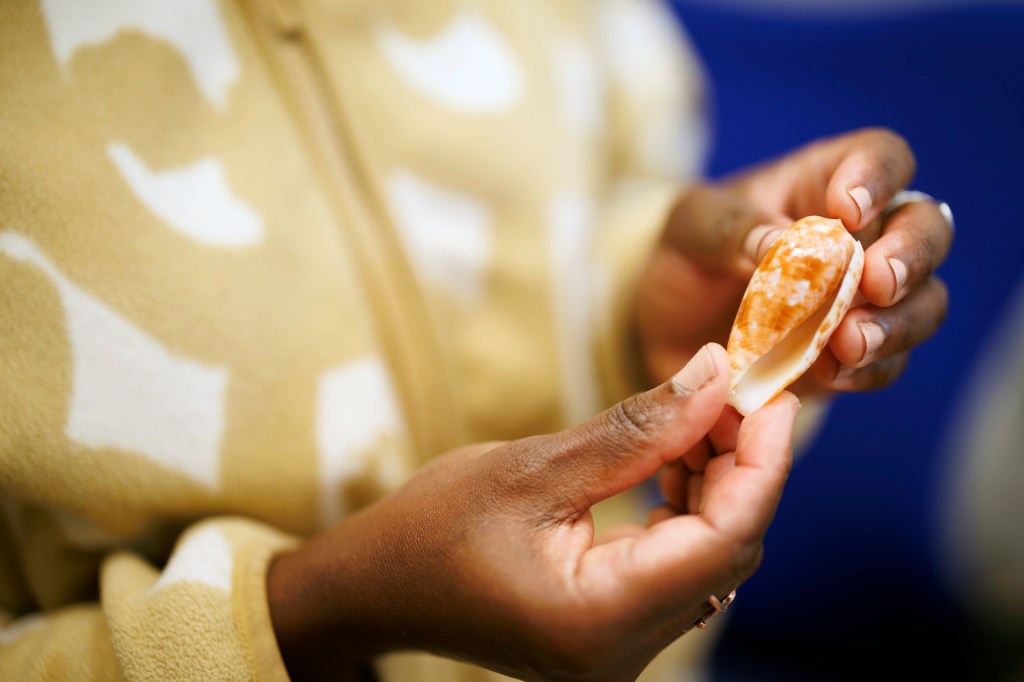
Holford eventually joined his lab as a postdoctoral researcher. She did fieldwork in Panama and Papua New Guinea, and studied taxonomy at the Natural History Museum in Paris, home to the most extensive mollusk collection in the world.
Holford chose to study the Terebridae, a family of marine gastropods nicknamed “auger snails” because their colorful, pointy spiral shells resemble drill bits.
At the time, they remained little known to venom science. In one of her early major papers, Holford and her colleagues used DNA to reconstruct a family tree of the different lineages of the Terebridae and identify which species had venom-producing glands.
Marine snails deliver venom with a proboscis — a long, extendable appendage tipped by harpoon-like teeth that can inject venom into prey.
Chemical warfare
Venom is a grand evolutionary mystery that begins more than 500 million years ago.
It first evolved among Cnidarians, an ancient phylum of aquatic invertebrates that includes jellyfish, sea anemones, and corals. (Holford and colleagues are investigating whether Ctenophores, or comb jellies, might have evolved venom even earlier.)
As Holford and her co-authors wrote in one paper, the innovation of venom shifted the struggle between predators and prey “from a physical to a biochemical battle.”
In many cases, venomous creatures have co-opted “housekeeping genes” that perform routine biological functions and turned them into weapons.
For example, genes that produce insulin — a hormone used by many species to regulate blood sugar — have been weaponized to make chemical weapons that lower the blood sugar of prey. First the snail releases this toxin into the water, lulling the fish into a sleepy lethargy, and then the predator paralyzes the prey with venom and swallows it whole.
Many of the genes that produce venom are highly conserved, meaning they are ancient genetic tools that have been employed again and again in novel combinations throughout the history of life.
“They’re hyper-diverse, under very high selection pressures, and constantly changing in response to what they’re attacking or defending.”
Mandë Holford
“It’s nature’s innovation hub,” said Holford. “They’re hyper-diverse, under very high selection pressures, and constantly changing in response to what they’re attacking or defending.”
Venoms have evolved independently in numerous lineages throughout history. There are some 220,000 known venomous animal types, roughly 15 percent of all species on Earth. They include sea anemones, jellyfish, starfish, sea urchins, cone snails, and octopuses, and bloodworms.
Natural cures
Holford seeks to discover these molecular secrets and how they might be engineered to serve human patients. She sums up her research agenda as “mollusks to medicine.”
A single snail might produce 50 to more than 200 venom peptides (strings of amino acids that are shorter than full proteins), but the cocktail mix varies among species. More than 3,000 different conotoxin peptides have been characterized so far, and scientists estimate that there may be up to a million varieties.
These venoms are fast, very potent, and very specific in targeting certain biological systems. “They go after blood, brains, and membranes,” Holford said. They are prime candidates for drug discovery because they reveal chemical pathways to manipulate cellular biology.
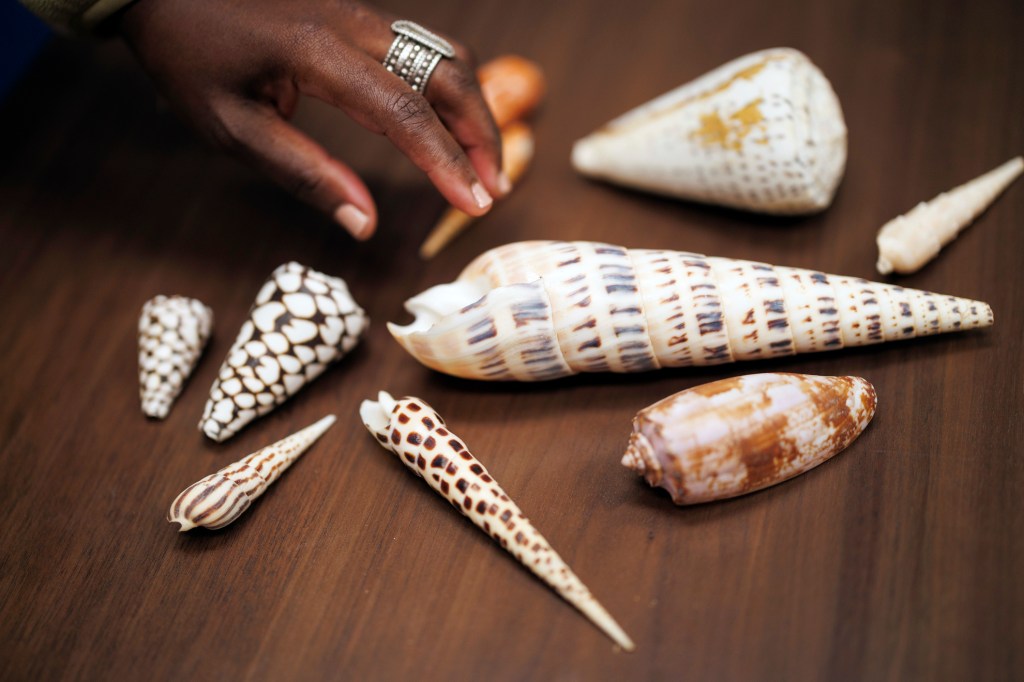
A collection Mandë Holford’s mollusk samples.
Harvard University
Many venom peptides, for instance, interfere with cellular ion channels, making them potential tools for investigating ion channel disorders such as pain or cancer.
In 2019, Holford’s team discovered that one terebrid snail peptide, Tv1, could inhibit the proliferation of liver cancer cells. The team has patented the discovery and continues researching the potential therapy.
Currently, there are seven FDA-approved drugs on the market derived from venom.
A peptide from the cone snail Conus magus was turned into the first non-opioid painkiller, Ziconotide (Prialt). Ozempic was derived from the saliva venom of Gila monsters. The blood thinner Bivalirudin came from leech venom.
Many more potential treatments are being researched or going through clinical trials.
“I call them nature’s drug factory.”
Mandë Holford
“I call them nature’s drug factory,” said Holford. “If we can figure out how they work, that will help us discover novel things for treating ailments.”
Splashing down at Harvard
Holford worked at Hunter College of CUNY before moving to Harvard.
She and her team (including five grad students, six postdocs, and a lab technician) recently settled into the Biolabs. Their space includes aquatic tanks for snails, squids, and octopuses, and equipment such as a synthesizer to make peptides and a mass spectrometer to analyze them.
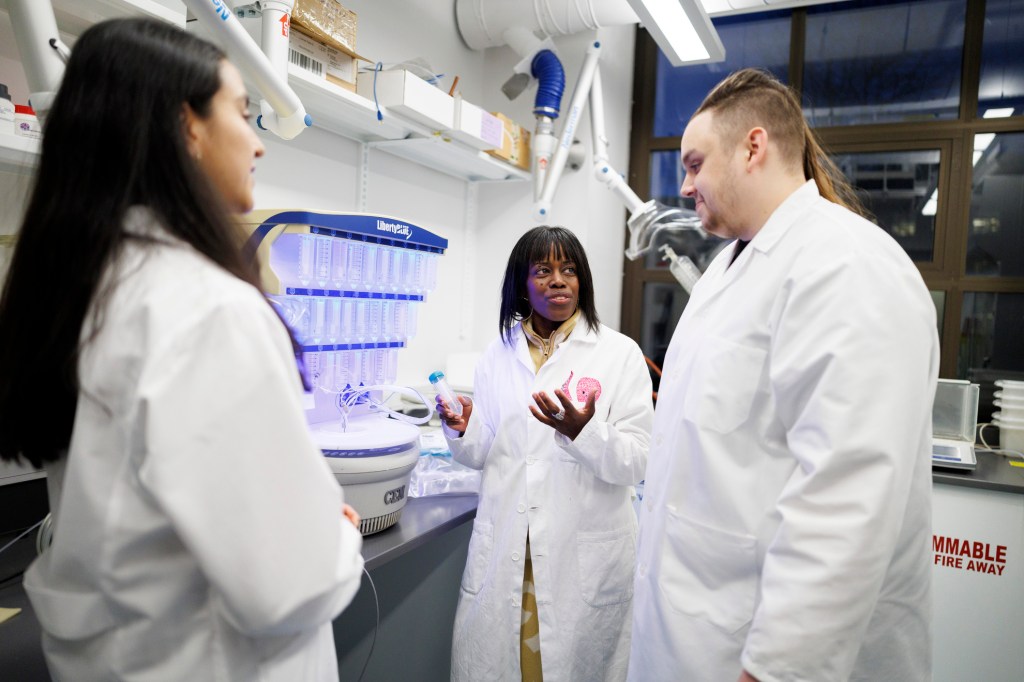
They pursue a variety of research projects, including designing organoids — replicas of organs grown from individual cells — to investigate the molecular mechanics of venom production and the development of venom-making glands in snails and cephalopods.
In another study, Holford’s team is examining the parallels between venom and the innate immune system (like venomous predators and their prey, pathogens and hosts have evolved in an ongoing “arms race”).
With peers in the U.S. and Europe, she launched VenomsBase, a new platform that integrates venom data and aims to create a more open research ecosystem for investigating venoms.
Even as she pushes forward the frontiers of science, Holford has not forgotten the wonder of a child wandering the museum and the importance of igniting curiosity in young people.
She founded Killer Snails, which creates immersive science curricula for students in grades 3-10. And she is particularly interested in promoting efforts to boost participation of underrepresented groups in science.
At a snail’s pace, the race for cures turns out to be pretty exhilarating.
“It’s all lessons from nature — she knows what she’s doing,” said Holford.
Holford’s research received federal funding from the National Institutes of Health and the National Science Foundation.