The timing couldn’t have been worse, or perhaps better, for Harvard Business School’s (HBS) “Centennial Global Business Summit,” a three-day conference Oct. 12-14.
U.S. Secretary of Education Margaret Spellings addressed concerns ranging from college financial aid to No Child Left Behind during a lecture at Harvard Kennedy School (HKS) Oct. 1.
John Ruggie, U.N. Secretary-General Ban Ki-moon’s special representative for business and human rights, recently announced that he is convening a leadership panel to advise him on how best to ensure that businesses worldwide respect internationally recognized human rights standards.
In September 1948, representatives of 18 nations at the newly minted United Nations were inspired by the tumult and horror of World War II to create a Universal Declaration of Human Rights (UDHR).
If she can help it, Washington Post journalist Sally Quinn prefers to avoid the phrase “spiritual journey.” Quinn, who co-moderates the blog “On Faith” with Newsweek editor Jon Meacham, finds the words overused. But she is quick to acknowledge that people’s relationship to faith can change over time — and having interviewed hundreds of scholars, politicians, and other American leaders about their religious viewpoints, she knows that the undergraduate years are often a period of remarkable transformation.
“We’ve been in a slow-motion train wreck … and now it’s just a train wreck.” This quip, by Jay Light, Dwight P. Robinson Jr. Professor of Business Administration and dean of Harvard Business School (HBS), was one of the observations offered at a panel discussion Sept. 25 intended to explain the Wall Street financial crisis to the Harvard community.
Harvard’s Institute of Politics (IOP) recently announced a nationwide expansion of its Campus Voices project, an effort started last fall allowing college students to share their experiences and activities tracking the people and events of the 2008 presidential race. The institute has now expanded the project to serve as a place where students across the country can voice their opinions and report on the different ways young people are politically engaged and active on their campuses and in their states.
R. James Woolsey Jr., a former director of the Central Intelligence Agency, has a favorite personal strategy for ensuring U.S. domestic security: his Toyota Prius hybrid, upgraded with an A123 conversion kit that allows it to run largely on a battery rechargeable by house current.
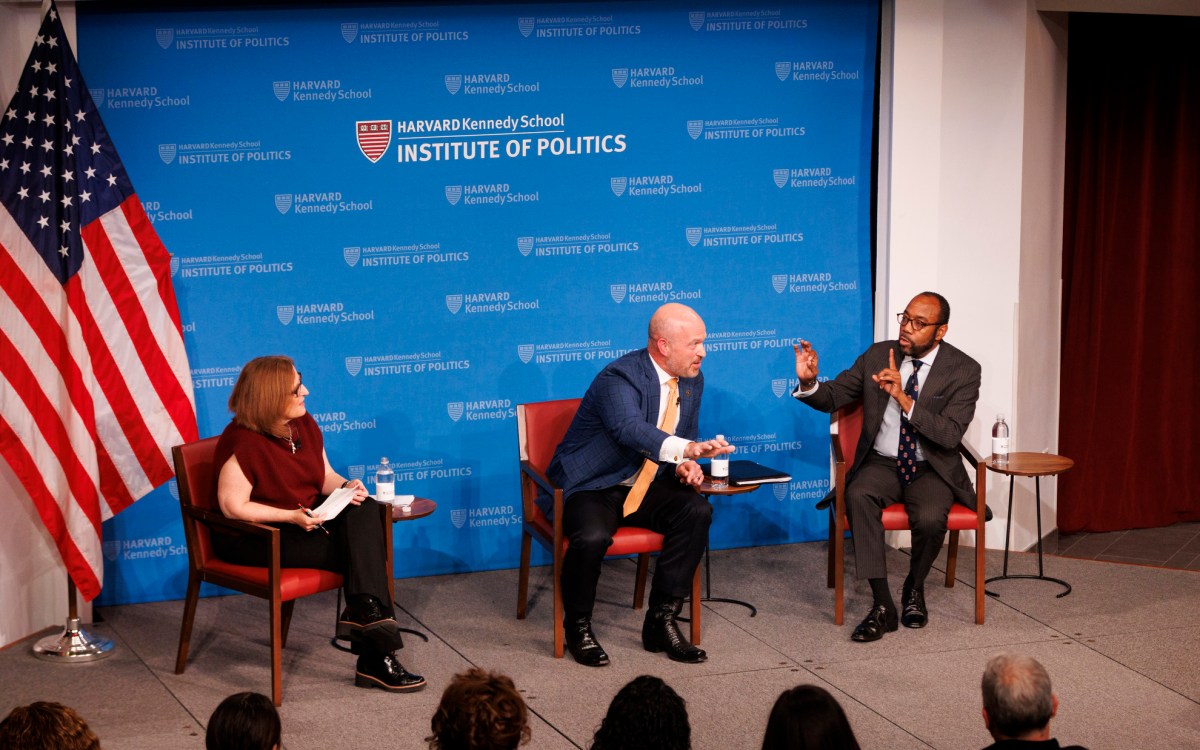
It was standing room only at the Harvard Kennedy School (HKS) as a former governor and a Harvard Law School (HLS) professor took on the issue of education.
Cass R. Sunstein, the Felix Frankfurter Professor at Harvard Law School and a former attorney-adviser in the Department of Justice’s Office of the Legal Counsel, spoke at the fourth annual Constitution Day lecture (Sept. 17) sponsored by the Office of the Provost.
Harvard President Drew Faust invites students, faculty, and staff to a special panel discussion Thursday, Sept. 25, on the current turmoil in the financial markets. “Understanding the Crisis in the Markets: A Panel of Harvard Experts” will begin at 4 p.m. in Sanders Theatre.
Those looking for a relaxing summer break may have opted for somewhere other than Iraq. But for one Harvard Law School (HLS) student, the visit to the country in August was about work — and duty.
At the time, some considered it the trial of the century. The weight of the U.S. government pitted against one of the most influential companies in the world accused of abusing its power and crushing the competition.
With an estimated 47 million Americans lacking health insurance, the subject of health care in the next administration has taken center stage as presidential nominees John McCain and Barack Obama approach election day. Senior health care advisers to both nominees hashed out the similarities and differences between the candidates’ stances at a jam-packed “great debate” at the Harvard School of Public Health (HSPH) last week (Sept. 12) that filled Snyder Auditorium, two overflow rooms, and part of the Kresge Cafeteria.
What do ancient Rome and the reign of Queen Elizabeth I have to do with the development of the United States government? A lot, according to Harvard government professor Daniel Carpenter.
Harvard Business School (HBS) Dean Jay O. Light and William C. Kirby, T.M. Chang Professor of China Studies and chairman of the Harvard China Fund, announced the opening of a Harvard office in Shanghai on July 2.
Jim Yong Kim remembers the drive home from the airport with his father, a dentist in the small Iowa city where Kim was raised. His dad asked Kim, who was on a break from Brown University, what he’d decided to study.
In the shadow of a hill where lepers once lived, a tuberculosis hospital designed for those infected with deadly, drug-resistant strains of the disease is giving hope to a new generation of medical pariahs in the tiny African nation of Lesotho.
It was a tough assessment for a health clinic, and Jim Yong Kim was standing in the middle of one when he made it. “A lot of these are known as places where you go to die.”
Jim Yong Kim walked out of the small cinder block room where an underweight boy of 5 lay, his heart rate down to 115 from the dangerous 150 beats per minute at which it had been racing moments earlier. Kim stripped rubber gloves from his hands. “That was incredibly gutsy,” he said flatly…
South Africa’s Valley of 1,000 Hills is a broad and breathtaking natural contradiction, an enormous valley whose floor is crowded with hills large and small, as if nature wasn’t quite sure what it was making.
In the heart of the South African AIDS epidemic, at a medical school named for the nation’s legendary anti-apartheid leader, a fight against a different sort of oppression is being waged.
Not long before the Sept. 11 attacks, Harvard-trained political scientist Louise Richardson gave up the full-time pursuit of her scholarly specialty — the origins of terrorism.
Federal Reserve Board Chairman Ben S. Bernanke said Wednesday (June 4) that education is both the best hedge against economic uncertainty and a student’s greatest asset, and urged Harvard College’s Class of 2008 to use their education to live rewarding lives and make the world a better place.
While still an undergraduate, Alexander Burns already had an impact on political discourse in the United States. Beginning in 2005, the history and literature concentrator has been a principal contributor to a political blog sponsored by the history magazine American Heritage. The job has allowed him to explore the pros and cons of contemporary issues, and to joust in print with some of the country’s most prestigious historians.
Born in the United Kingdom, but raised for most of her first six years in Hong Kong, transnational Harvard graduate student Yue Man Lee grew up a fervent lover of reading, travel, and food.
The world watched recently as the continuing tragedy in Myanmar unfolded. Millions were displaced earlier this month by a cyclone that devastated the country’s Irrawaddy delta, leaving 134,000 people dead or missing.
D. Sunshine Hillygus, Frederick S. Danziger Associate Professor of Government in the Faculty of Arts and Sciences at Harvard University, and Todd G. Shields, professor of political science at the University of Arkansas, extensively studied campaign strategy during the 2004 general election, work that may illuminate strategy in the current presidential race.

 Featured series