
 Featured series

Health
-

Living longer, disease-free
Healthy Aging Symposium convenes experts to discuss everything from ‘Nutrition 3.0’ to biology of dogs
-

Heart attack, stroke — and hip fractures
Endocrinologist discusses life-or-death stakes of weak bones and how to protect against devastating falls

 Data Visualization
-

Is your parenting style working?
Trends come and go but experts say raising happy, healthy kids requires certain key ‘ingredients’
 Podcast
-

The healing power of gene therapy
How researchers are seeing their work changing lives — from restoring children’s hearing to saving a baby born with a fatal disease
Podcast
-
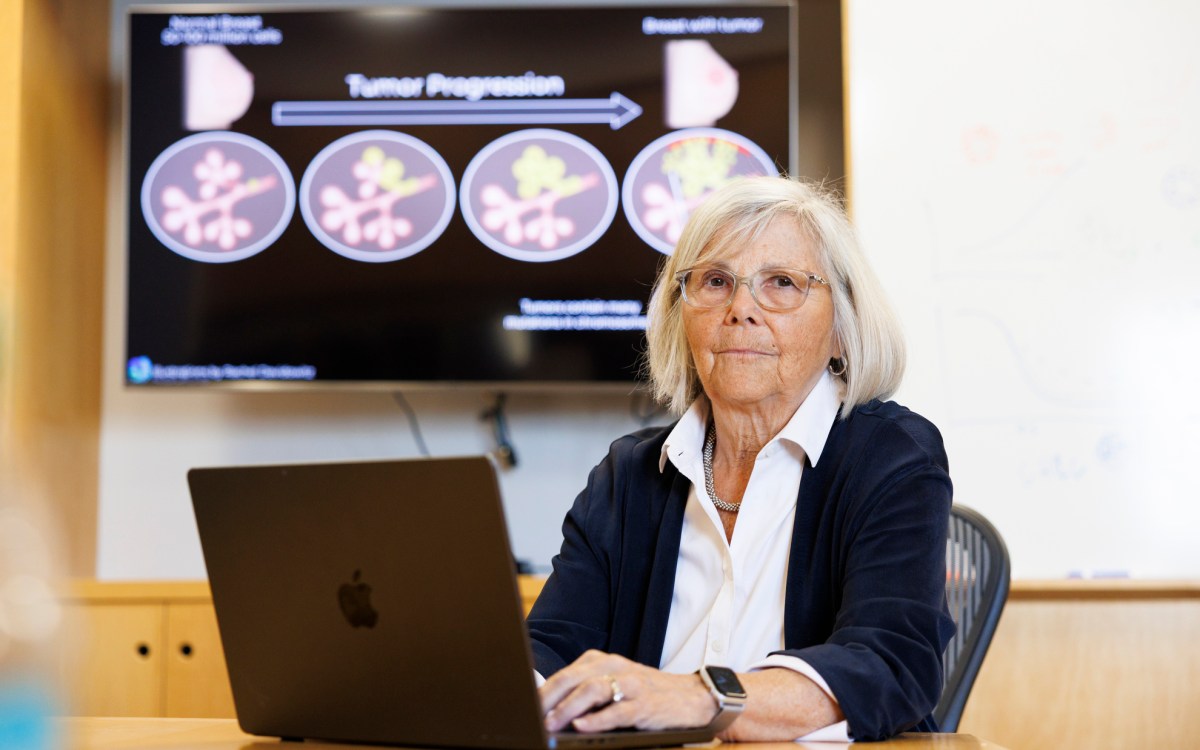
How did her sister become so sick so fast?
Joan Brugge’s decadeslong professional fight against cancer began when she tried to make sense of a tragedy

-

Who needs opioids?
HSDM team explores how artificial intelligence could help clinicians tailor pain treatment to individual patients
-
DFCI cancer research highlights age-related treatment effectiveness, patient cost concerns
New research from the Dana-Farber Cancer Institute highlights age-related responses to colon cancer treatment and patient attitudes toward cost of drugs to manage side effects. Research presented at the American…
-
Chemical leaches from plastic drinking bottles into people
A new study from Harvard School of Public Health (HSPH) researchers found that participants who drank for a week from polycarbonate bottles, the popular, hard-plastic drinking bottles and baby bottles, showed a two-thirds increase in their urine of the chemical bisphenol A (BPA).

-
Acid-suppressive medicines increase pneumonia risk for hospital patients
Ever since a class of drugs called proton pump inhibitors was introduced to the market in the late 1980s, the use of these acid-suppressive medications for heartburn, acid reflux, and other gastrointestinal symptoms has grown tremendously. The widespread use has extended to the inpatient hospital setting, where patients are often routinely given the medications as a way to prevent the development of stress ulcers.
-
Brigham face transplant recipient goes home
James Maki, a 59-year-old who became the nation’s second face transplant recipient in April to repair injuries from a horrific subway accident, left Brigham and Women’s Hospital on Thursday (May 21), thankful for what he called a “new chance to build my life.”
-
Evolution explored from all angles
From humanity’s close relationship to chimpanzees to the missing link between land and sea creatures, the Harvard Museum of Natural History (HMNH) has capped off a year celebrating Darwin and “On the Origin of Species” with a new exhibit that puts evolution front and center.
-
Biology department evolves at FAS
Earlier this month, the Faculty of Arts and Sciences (FAS) made official what scientists worldwide have known for years: Harvard is a hotbed of research and teaching in the field of human evolutionary biology — the study of why we’re the way we are.
-
‘Super-recognizers’ never forget a face
Some people say they never forget a face, a claim now bolstered by psychologists at Harvard University who’ve discovered a group they call “super-recognizers”: those who can easily recognize someone…
-
‘Super-recognizers’ are the ones who really will never forget a face
Some people say they never forget a face, a claim now bolstered by psychologists at Harvard University who’ve discovered a group they call “super-recognizers”: those who can easily recognize someone they met in passing, even many years later.
-
Patients expect computers to play major role in health care
As President Obama calls for streamlining heath care by fully converting to electronic medical records, and as Congress prepares to debate issues of patient privacy, one question has largely gone unasked: What do patients want?
-
New study assesses quality and cost of care at nation’s hospitals
Costly care isn’t necessarily better care at the nation’s hospitals. New research conducted by a team including Harvard Kennedy School Professor Amitabh Chandra represents one of the first nationwide analyses…
-
Genetic testing for breast or ovarian cancer risk may be greatly underutilized
Although a test for gene mutations known to significantly increase the risk of hereditary breast or ovarian cancer has been available for more than a decade, a new study finds…
-
Broad scientists to sequence multiple myeloma samples
The Multiple Myeloma Research Foundation (MMRF) announced today a collaboration with the Broad Institute of Harvard and MIT to systematically uncover the molecular changes underlying multiple myeloma by whole-genome sequencing…
-
Study finds genetic links to age of first menstrual period, menopause
Newly identified gene variants associated with the age at which females experience their first menstrual period and the onset of menopause may help shed light on the prevention of breast and endometrial cancer, osteoporosis, and cardiovascular disease.
-
Researchers identify the brain’s on-off switch for fear
Harvard researchers at McLean Hospital have identified a particular protein in the brain that serves as a trigger for the body’s innate fear response. This discovery suggests a potential target…
-
Glutamine supplements show promise in treating stomach ulcers
Nearly 20 years ago, it was discovered that bacteria known as Helicobacter pylori were responsible for stomach ulcers. Since then, antibiotics have become the primary therapy used to combat the…
-
New Web page addresses travelers’ health safety
Because of the recent outbreak of the H1N1 influenza, commonly called the “swine flu,” Harvard University Health Services (HUHS) and the Provost’s Office have created a new Web site to address concerns regarding the medical safety of international travel
-
Whitesides receives inaugural Dreyfus Prize in the Chemical Sciences
The Camille and Henry Dreyfus Foundation announced that George M. Whitesides, the Woodford L. and Ann A. Flowers University Professor of Chemistry at Harvard University, has won the inaugural Dreyfus Prize in the Chemical Sciences.

-
Common virus could cause high blood pressure
A new study suggests for the first time that cytomegalovirus (CMV), a common viral infection affecting between 60 percent and 99 percent of adults worldwide, is a cause of high…
-
Survey: Many Americans protecting themselves against H1N1
As part of a series about Americans’ response to the H1N1 flu outbreak, the Harvard Opinion Research Program (HORP) at the Harvard School of Public Health (HSPH) has released a…
-
Lack of sleep is easier on older adults than others
In a recent sleep study testing alertness and performance in sleep-deprived adults, researchers at Brigham and Women’s Hospital (BWH) determined that healthy older adults handle sleep deprivation better than younger adults. The findings appeared online on May 3, in an advance online edition of the Journal of the American Geriatrics Society.
-
Lessons from past explored to expedite future research
People, knowledge, communication, and capitalism were front and center last week as authorities on innovation sought to shed light on ways to speed up the development of new medical treatments from discoveries in the lab.
-
Older adults found to fare better under sleep deprivation than younger adults
In a recent sleep study testing alertness and performance in sleep-deprived adults, researchers at Brigham and Women’s Hospital (BWH) determined that healthy older adults handle sleep deprivation better than younger…
-
Cancer chemotherapy: An unfolding story
To launch his lecture on cancer chemotherapy, Luke Whitesell ’79, RI ’06 displayed an image of an origami crab: a double visual metaphor. The crab is the traditional symbol of…
-
Survey: Nearly half of Americans concerned they or their family may get sick from swine flu
Following the declaration of a public health emergency due to the new H1N1 virus, also known as swine flu, the Harvard Opinion Research Program (HORP) at the Harvard School of…
-
Outwitting mutating flu during a pandemic
In a global influenza pandemic, small stockpiles of a secondary flu medication – if used early in local outbreaks – could extend the effectiveness of primary drug stockpiles, according to…
-
Raising happy — and moral — children
A teenager tells her parents she is considering quitting her soccer team. Worried that her daughter is unhappy, her mother wants to let her skip practice. Her father argues that soccer is important on her college résumé. While both parents are concerned about their child, they neglect another question entirely: How would her leaving affect the team?
-
Predicting and tracking pandemics:
At the end of July 2008, major news agencies reported an outbreak of jalapeño-related salmonella that sickened more than 1,000 people in Mexico and the United States. It was the…
-
Some vocal-mimicking animals, particularly parrots, can move to a musical beat
Researchers at Harvard University have found that humans aren’t the only ones who can groove to a beat — some other species can dance, too. The capability was previously believed…
-
Scholars discuss ‘medicalization’ of formerly normal characteristics
Not long ago, a majority of Americans described themselves as “shy,” a condition of reticence or caution that for ages just seemed natural.
-
Smokers get help with the use of electronic health record
Although the dangers of smoking are well known, tobacco still remains the No. 1 cause of preventable death in the United States. The U.S. Public Health Service recommends that physicians…