Featured series



Science & Tech
Hello? How the telephone transformed human connection
Alum’s new history traces evolution of technology — from party lines to mobile devices — and how we’ve changed with it
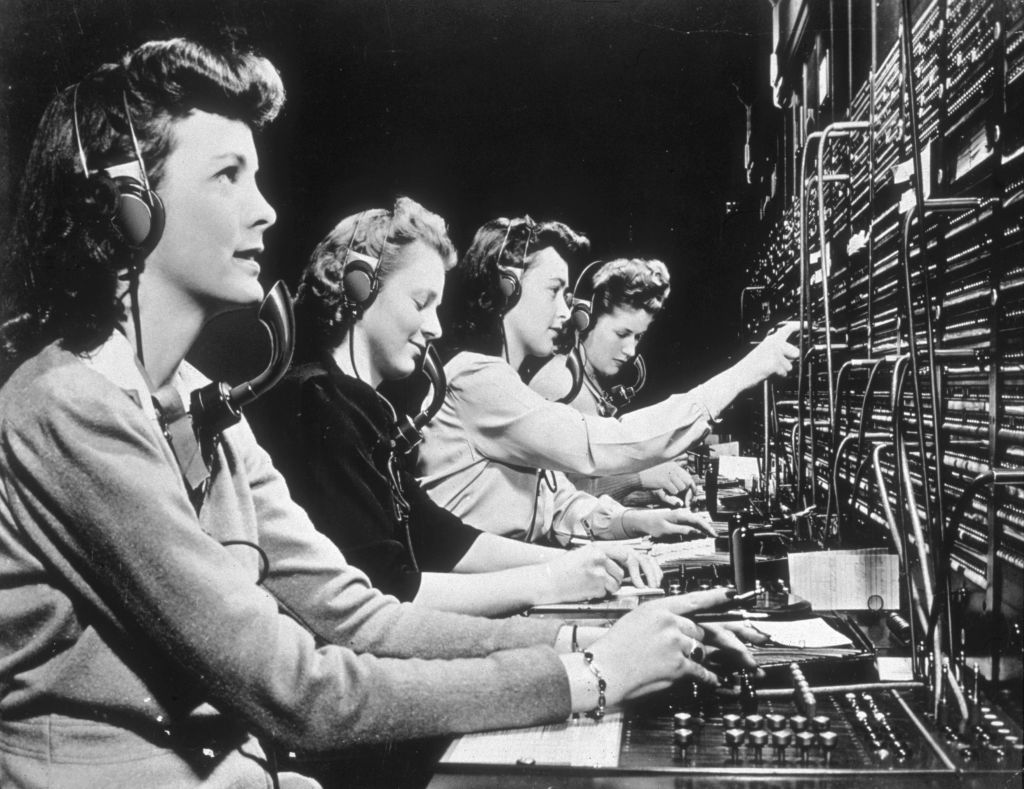
Photo by Hulton Archive/Getty Images
On a February night in 1975, a fire broke out in a telephone switching center in lower Manhattan, disrupting service for 175,000 New Yorkers.
For 23 days, while technicians worked feverishly to restore service, a swath of the city was thrust back into the 19th century. Funeral parlors, photography studios, florists, and delis had to find alternative ways to schedule appointments, take orders, and verify credit cards. Lovers had to knock on one another’s doors like their grandparents had.
“It really forced people back into patterns of living that belonged to a history that they had not experienced,” said James Gleick ’76, a technology writer and the author of the new book, “The Telephone: A New History.”
A New Yorker by birth, Gleick wasn’t in the city at the time of the weekslong phone blackout. He was at Harvard, studying English and linguistics and writing for The Crimson. But the incident intrigued him. One reason: The fire had made visible a technology that was so ubiquitous it hardly bore mentioning. People didn’t talk about telephones, Gleick writes in his book: They talked on them.
Gleick traces the story of the telephone to the late 1800s, when most Americans had not sent or received a telegraph themselves but had gotten used to news arriving lickety-split across the wires — when the idea of transmitting the human voice across great distances was as mystical as communing with the dead.
The book’s lack of a protagonist is intentional. Gleick tells the complicated story that anointed Alexander Graham Bell the inventor of the telephone. In fact, Gleick writes, prototypes for a device that transmitted sound were invented many times over by a series of tinkerers working with wood, wax, and wires in their attics or workrooms. It was only through some ethically questionable behavior on the part of Bell’s lawyers that he got the patent for what became the telephone, despite not entirely understanding what it was he had patented.
What Bell did understand, though, was that the telephone would usher in a world of expanded colleagues, friends, and lovers united across distance — in other words, Bell was building a social network. And Americans were hungry for it. By 1880, just four years after the telephone was patented, Bell was shipping 5,000 of them per month and had contracts for exchanges in 988 municipalities. By 1905, New York City alone had 200,000 connected households and businesses.
Within decades, Gleick writes, the telephone transformed every sphere of life. It generated a new cultural vocabulary: the phone book, the answering machine, the wiretap, the dial tone. It spawned new memes: the teen up past her bedtime flirting and gossiping into a phone’s handset, stage actors in comedy sketches answering “calls” on a stethoscope or a banana. But more than that, the telephone disassembled solitude and put it back together as something “pregnant, provisional, breakable at any instant.” Like Chekhov’s gun, a silent phone might ring at any time.
Gleick lingers on the phone as a gendered object. As cultural critics wrung their hands about whether a woman could call up a man or if she’d better let him call her first, waiting for the phone to ring took on a feminine hue.
The first telephone operators — those tasked with manually connecting wires at a central hub like the one that burned in Manhattan in 1975 — were teenage boys. But many of the boys couldn’t sit still or pay attention. Phone companies began hiring young women instead. It was one of a very few professional opportunities available to women.
Expected to be unfailingly accommodating, pleasant-voiced, and knowledgeable, operators were a kind of proto-Siri.
“The weird universal decision that operators were all women, a huge part of that was they were meant to be docile,” Gleick said. “You were meant to have somebody on the other end of the phone who, if you were a man — and the assumption by marketers was that you were a man — was there to serve you, and that was going to be a woman.”
Contemporaneously, these professionals were understood as half human, half machine. Strapped into metal headpieces, their eyes roved over rows of flickering lights, their arms constantly in repetitive motion. Gleick cites an operator who described herself as a “human spider in a mysterious web of talking wires.” “Hello girls,” as they were sometimes called, often left their shifts wild-eyed, in sensory overload. It’s a familiar feeling for many of us in the 21st century who feel plugged into our own version of the network.
Gleick first wanted to write a history of the telephone in the 1980s. “My initial idea was that this device, which everybody took for granted, had altered society and altered people’s psyches in a way that no one was conscious of.”
But as he worked on the project through the ’90s, he found the thing he was writing about becoming increasingly passé. The phone was going mobile, and the internet was emerging. It was a time of unbridled optimism about a high-tech future.
It was only now, Gleick said, with smartphones as embedded in our lives as the wired telephone once was, that it made sense to look back.
“A new generation of people has no memories of phone booths and busy signals and all that, but the way we live now is impossible without this history,” he said. “That’s a story worth telling.”