Featured series


Tag: Event Horizon Telescope
-
Science & Tech
After capturing image of black hole, what’s next?
New Center for Astrophysics mission aims for closer look at photon rings and insight into nature of space and time.

-
Science & Tech
First image of black hole at the heart of Milky Way
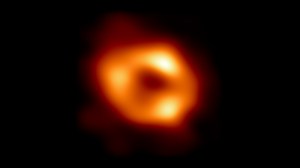
Pioneering Harvard-led global collaborative unveils latest portrait, bolstering understanding of relativity, gravity.
-
Campus & Community
Black hole project nets Breakthrough Prize
The nearly 350 astronomers, postdoctoral fellows, graduate students, and undergraduates who worked for more than a decade to capture the first-ever image of a black hole have been named the recipients of the 2020 Breakthrough Prize in Fundamental Physics.

-
Science & Tech
‘Seeing the unseeable’
A years-long effort by dozens of researchers at the Harvard-Smithsonian Center for Astrophysics reveals the first-ever image of a supermassive black hole.

-
Science & Tech
A black hole, revealed
Researchers at the Event Horizon Telescope (EHT) just unveiled the first-ever image of a black hole, which captures what EHT Director Sheperd Doeleman called “a one-way door from our universe.”

-
Science & Tech
Making the ultimate darkness visible
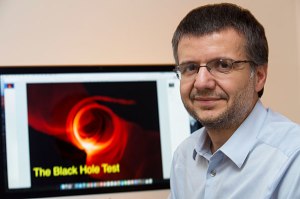
University of Arizona physicist Dimitrios Psaltis has devoted his Radcliffe fellowship to black hole imaging linked to the Event Horizon Telescope project.
-
Science & Tech
‘Point of no return’ found
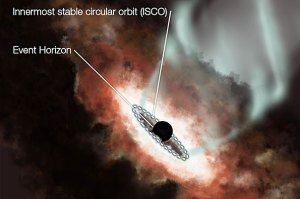
Using a continent-spanning telescope, an international team of astronomers has peered to the edge of a black hole at the center of a distant galaxy. For the first time, they have measured the black hole’s “point of no return” — the closest distance that matter can approach before being irretrievably pulled into the black hole.