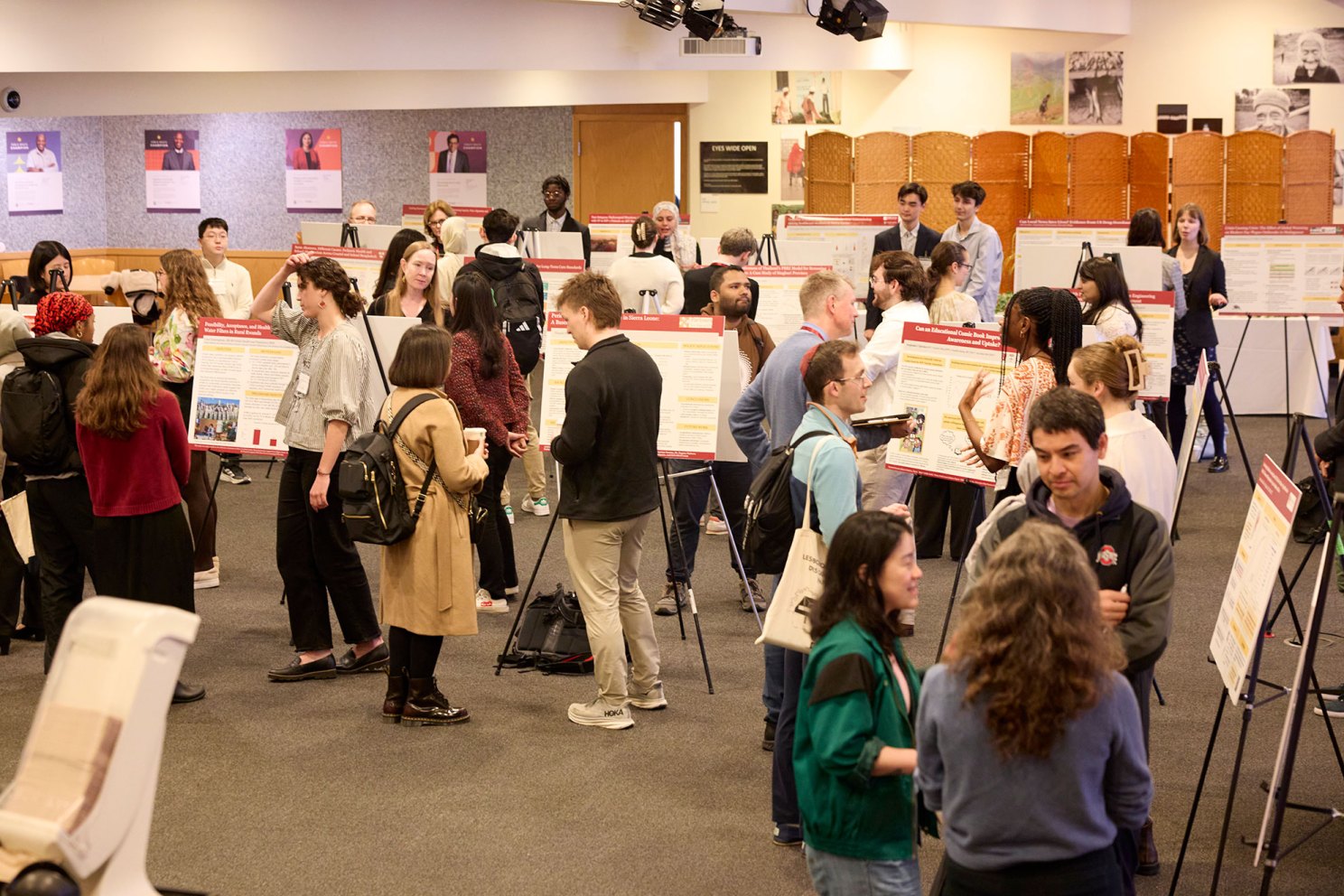
The 2026 Harvard Global Health Student Research Showcase, held in partnership with the Department of Global Health and Population at the Harvard T.H. Chan School of Public Health, brought together an interdisciplinary community of students, researchers, and faculty committed to addressing some of the world’s most pressing health challenges. This year’s event highlighted innovative, data-driven, and globally engaged research spanning infectious disease, health communication, and predictive modeling.
This year’s winners are:
Anika Christensen (Undergraduate winner) Human Biology, Behavior, and Evolution, Harvard College Poster Title: “Crisis Causing Crisis: The Effect of Global Warming on Modern Day Plague Outbreaks in Madagascar”
Anika Christensen’s research challenges the notion of plague as a disease of the past, instead positioning it as an evolving global health concern shaped by climate change. Focusing on Yersinia pestis, the bacterium responsible for plague, her study examines how rising temperatures may influence genetic mutations in the pathogen’s pCD1 virulence plasmid.
Drawing on temperature data and genomic analyses, her findings suggest that increases in mean annual temperature are associated with higher rates of substitutions and transition SNP mutations — genetic changes that correlate with increased annual plague case counts. In contrast, transversion SNPs were associated with lower case numbers and decreased as temperatures rose.
Her work highlights the ecological sensitivity of Y. pestis, which depends on arthropod hosts and mammalian vectors, and raises important questions about how climate-driven environmental changes may accelerate the evolution of more virulent strains. By linking genetic variation to epidemiological outcomes, this research contributes to a deeper understanding of how temperature may serve as a predictive factor in future outbreaks, particularly in endemic regions such as Madagascar.
Anil Cacodcar (Undergraduate winner) A.B. in Economics; A.B. in Human Developmental and Regenerative Biology, Harvard College Poster Title: “Can Local News Save Lives? Evidence from US Drug Overdoses”
Anil Cacodcar’s project explores the intersection of media, behavior, and public health in the context of the ongoing opioid crisis in the United States. Motivated by the significant 26 percent decline in overdose deaths in 2024 — the first major national decrease in decades—his research investigates whether local news coverage of fentanyl-related deaths influences subsequent overdose outcomes.
Using a novel dataset of 561 fentanyl deaths reported in local news outlets between March and October 2024, combined with national mortality data, Cacodcar examines how high-salience reporting functions as an “information shock.” His findings indicate that such coverage can reduce overdose mortality rates by approximately 5 percent in the short term, suggesting that increased public awareness may prompt behavioral changes, including greater caution or increased engagement with addiction treatment services.
By applying an economic lens to public health behavior, this work underscores the potential of information dissemination as a low-cost, scalable intervention in addressing substance use crises.
Annisa Salsabilla Dwi Nugrahani (Graduate winner) Master of Medical Science in Clinical Investigation, Harvard Medical School Poster Title: “Developing Machine Learning-Based HIV Risk Prediction Algorithms for 40,361 Women of Reproductive Age in Southern Africa”
Annisa Nugrahani’s research addresses a critical gap in HIV prevention: accurately identifying individuals at highest risk in regions with a high disease burden. Focusing on five Southern African countries — Zimbabwe, Lesotho, Mozambique, Zambia, and Malawi — her study applies machine learning (ML) techniques to improve HIV risk prediction among women aged 15–49.
Analyzing data from over 40,000 individuals, Nugrahani evaluated five ML models, with Gradient Boosting achieving the strongest performance (AUC: 76.2 percent). Her findings highlight key determinants of HIV risk, including age group, country, condom use, place of residence, marital status, and education level.
Importantly, her use of interpretable ML tools, such as SHAP analysis, enables clearer understanding of how these factors interact, offering actionable insights for policymakers. The study emphasizes the potential of advanced analytical approaches to guide targeted interventions — such as expanding education access and promoting preventive behaviors — in resource-limited settings.
To learn more about the Harvard Global Health Student Research Showcase, please visit the following link to the full webpage.

 Featured series