While Jessica Whited’s decision to specialize in uncovering the molecular and cellular mechanisms behind limb regeneration was rooted in her fascination of the natural world, it was also deeply personal. Her grandfather was an amputee and a formative influence who shaped her career path.
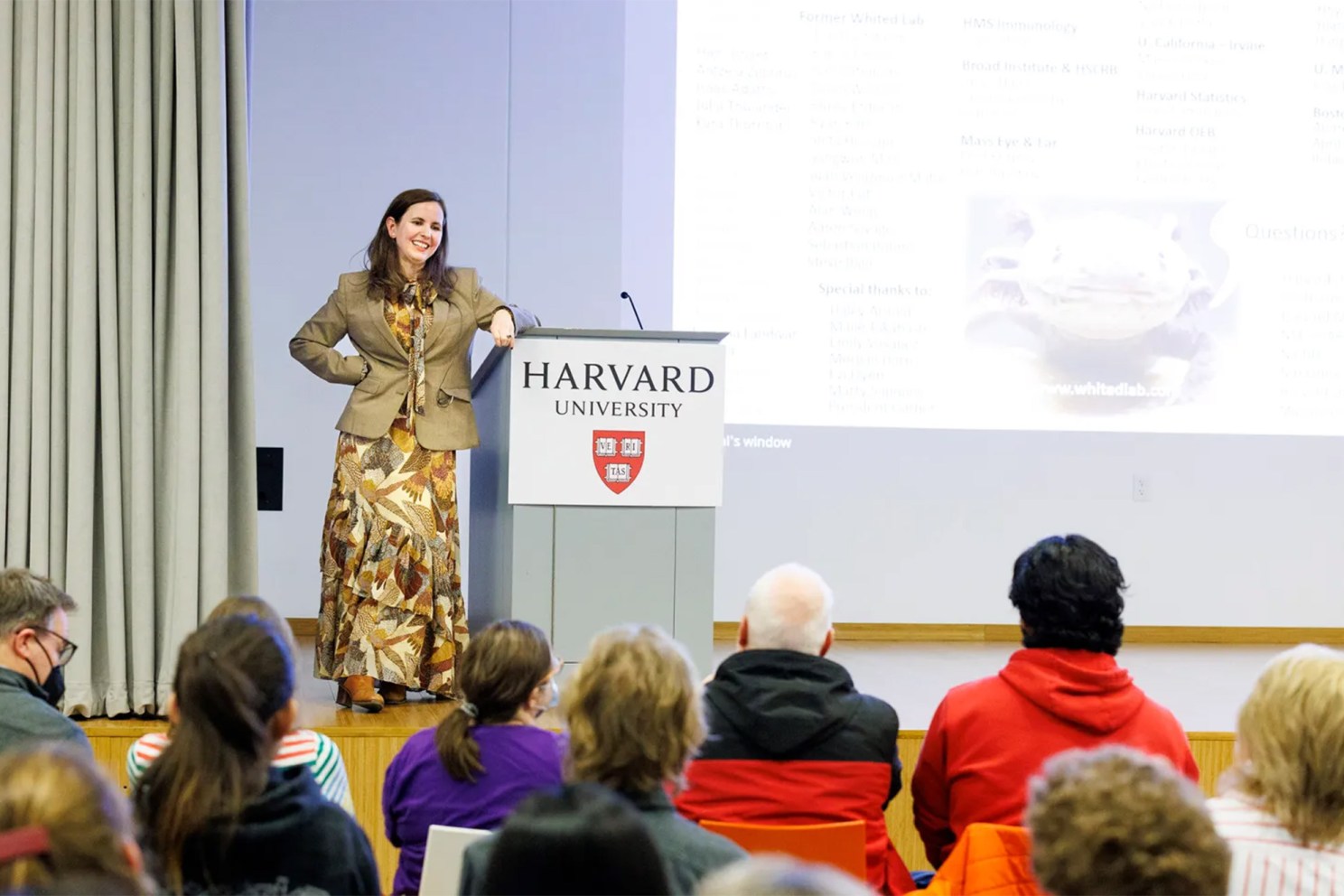
At the third annual Rob Lue Memorial Lecture at the Harvard Ed Portal, Whited, an associate professor of stem cell and regenerative biology at Harvard University, and principal investigator at the Whited Lab in Cambridge, spoke to a crowded room about how the “world’s favorite salamander,” the axolotl, is poised to decode nature’s blueprint for regrowth with the goal of helping human patients.
In his welcome remarks, Harvard President Alan M. Garber reflected on the critical importance of basic scientific research like Whited’s, noting how such work lays the foundation for entirely new understandings of human biology and eventually dramatic new therapies, such as GLP-1 drugs. “One of the wonderful things about the science that goes on in our research universities is that, what starts out as just a matter of curiosity turns into a question, which turns into more and more questions, which turns into a research project, which results in findings whose significance we may have hints of in the beginning, but we may not fully appreciate for a long, long time,” said Garber.
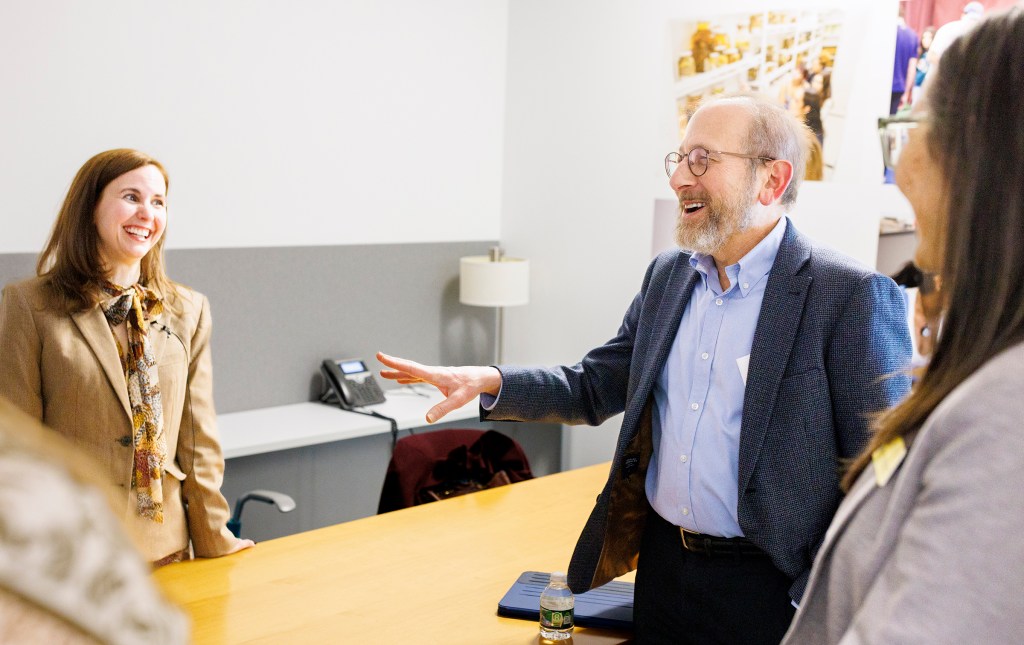
Whited with Harvard President Alan Garber, who introduced her.
The Rob Lue Memorial Lecture was established in 2023 to honor the late Professor Rob Lue, the founding Faculty Director of the Harvard Ed Portal, who passed away in 2020. Lue’s legacy for championing lifelong learning by bringing Harvard faculty from across the University to engage the public in their fields of study is the foundation on which the Harvard Ed Portal was created.
“Professor Lue would have been thrilled to see so many people here tonight for Dr. Whited’s presentation as he was passionate about creating opportunities for people of all ages to come together to explore, to understand science and to love learning,” said Maile Takashi, director of the Harvard Ed Portal.
“It is a profound honor for me to deliver the 2026 Professor Rob Lue Memorial Lecture,” said Whited. “He embodied so much of what is good about science, and not just doing science, but especially sharing science, and sharing education more broadly.”
Whited’s talk explored the unique biology of the axolotl, an unassuming creature capable of regenerating entire limbs throughout its life. Central to this process is a structure called a blastema, which forms at the site of injury. The blastema serves as a hub where progenitor cells assemble, communicate, and coordinate the complex rebuilding of a limb. When regeneration is complete, there is no visible trace of injury, no scar, and no indication that it is a regrown limb.
Whited also fielded questions about the broader implications of her work, including potential human applications in cancer, phantom limb pain, aging, cell replenishment, and resilience to injury. She underscored the critical importance of sustained investment in basic research and expressed gratitude for the support that has enabled her lab to become a leader in axolotl research. While many audience members were familiar with major funders such as the National Institutes of Health and the National Science Foundation, Whited highlighted another donor, 7-year-old Marianne Cullen. Cullen became interested in axolotls after learning about them in school. Like Whited, Cullen has a personal connection to the importance of this research as her younger sister has faced long-term health issues.
In the spirit of Rob Lue’s enduring commitment to community building and lifelong learning, Whited concluded with a call to action to her fellow researchers to share their work directly with the public so people of all ages can better understand how research develops from the lab bench to the bedside. “While having journalists cover exciting science and help explain it to a broad audience is great, there will always be intrinsic value to the scientists themselves sharing their work,” said Whited.

 Featured series