Featured series


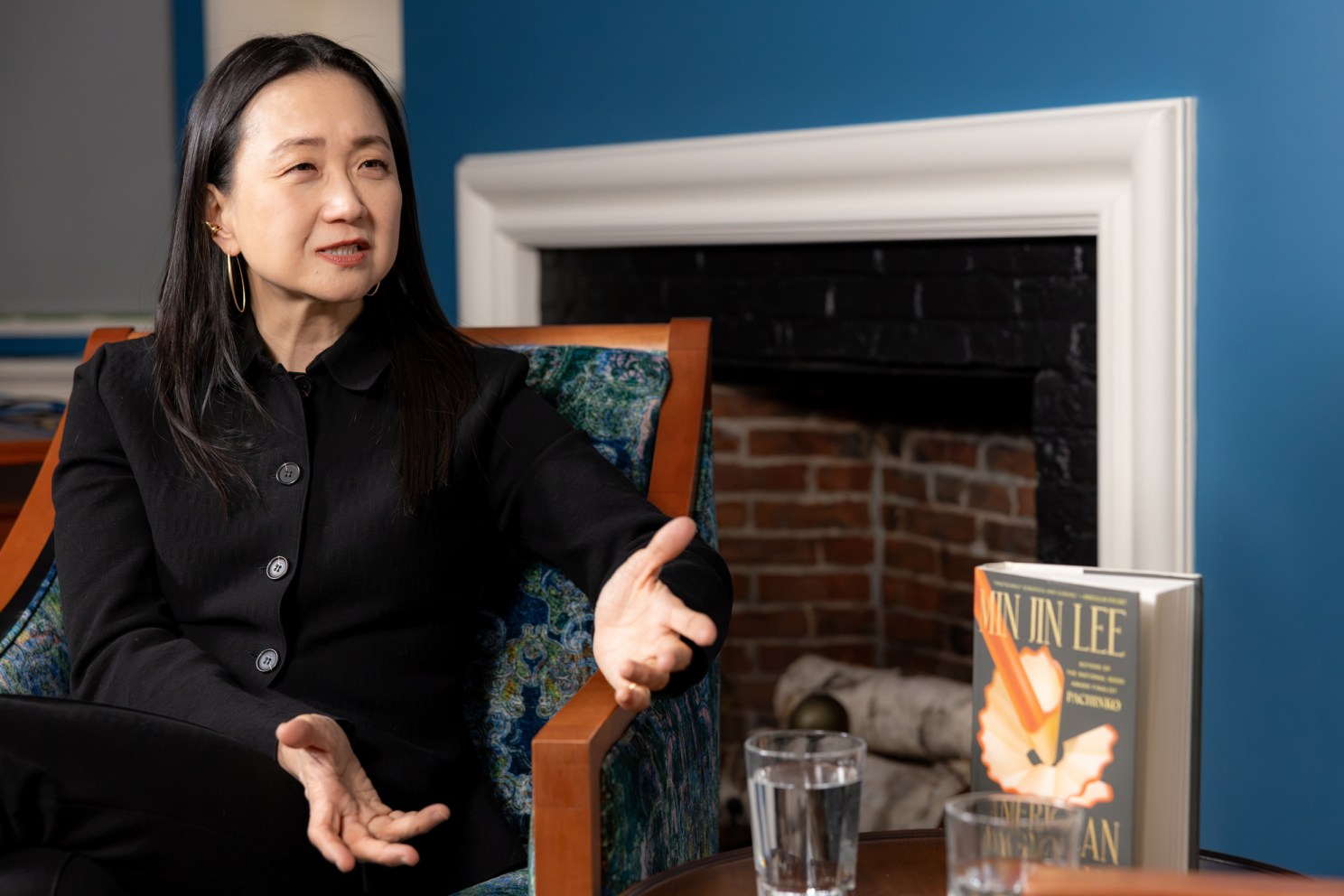
Min Jin Lee.
Photos by Melissa Blackall
Nation & World
‘Rules of engagement have changed’
Min Jin Lee details her new novel ‘American Hagwon’ about migrant South Korean family’s battered faith in education amid global uncertainty
Award-winning novelist Min Jin Lee says every book she’s written begins with a thesis statement, a sentence that serves as a kind of guiding light for her unfolding saga.
At an event last week at Harvard Radcliffe Institute, Lee said her latest novel, “American Hagwon,” turns its focus on one South Korean family’s battered belief in the promise of education to ensure success and upward mobility.
“The rules of engagement have changed already,” reads the first line of the novel.
“When you feel unprepared, very often you feel on the back foot. And if you can’t figure out how to fix yourself, you wonder about the next generation and how you can help them.”
Min Jin Lee
“American Hagwon” follows the Koh family, who lose their solidly white-collar lives in their homeland and end up part of the South Korean diaspora, economic migrants in foreign countries where their credentials hold less currency and the rules are less clear.
They spend years under enormous emotional and financial pressures scrambling to regain a solid foothold, rocked over decades by an act of betrayal at work, family tragedy, and global downturns.
“When you feel unprepared, very often you feel on the back foot. And if you can’t figure out how to fix yourself, you wonder about the next generation and how you can help them,” Lee said. “That’s the reason why I focus on education, as something that all of us feel responsible for — for ourselves as lifelong learners, but also for kids.”
Lee, the Catherine A. and Mary C. Gellert Fellow at Harvard Radcliffe Institute in 2018-2019, returned to Radcliffe for a conversation with Jared Bowen, WGBH executive arts editor and host of “The Culture Show.” The two discussed the novel, which serves as the third book in Lee’s The Diaspora Quartet, which also includes “Free Food for Millionaires” and National Book Award for Fiction finalist “Pachinko.”
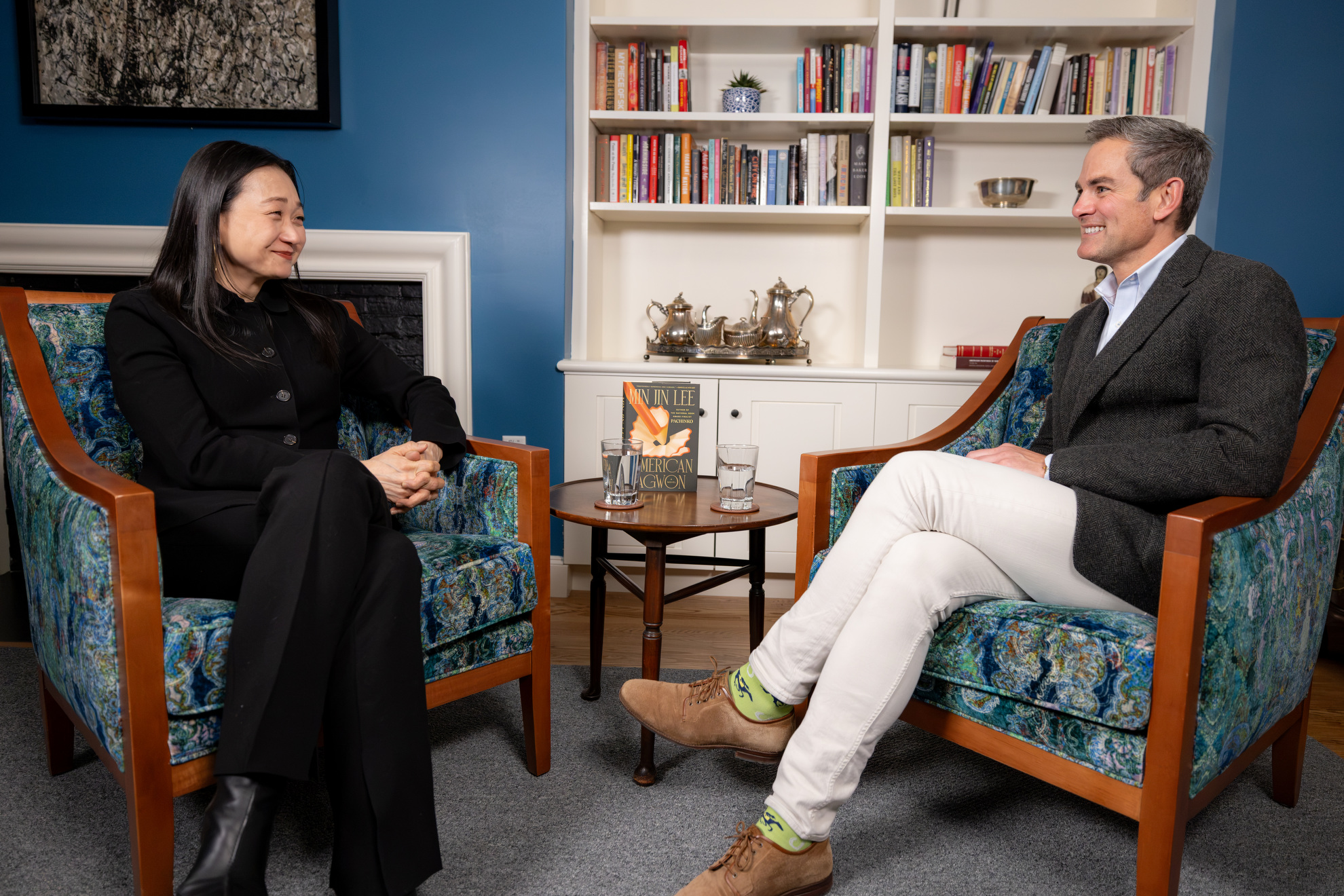
The Kohs ultimately end up in Southern California, where they continue to face hardship even as the children attempt to navigate the demands of a foreign education system and pressure from their parents to achieve.
Lee intentionally bracketed the novel between two different economic crises, the 1997 Asian financial crisis and the global financial crisis of 2008.
“Whenever you have economic shocks, there are winners and losers, and most people do not win,” she explained. “What do you do with that feeling? Very often, you say, well, I’m going to make sure that my kids aren’t left out this way.”
The Kohs have to wrestle with the question of how to remain a good person as they navigate their uncertain circumstances and strive to have their children achieve an elite U.S. education.
In America, the parents worry, “What will they do? How do they stay decent when terrible things happen to them?” Lee reflected during the event.
Hagwon is a Korean word for a learning center, where parents pay to send children as young as 4 or 5 to study in the hours after school, Lee said.
While they can offer lessons in many subjects, most hagwons focus on preparing their students to qualify for the nation’s top universities, or the best overseas schools — hopefully setting them up for a bright future of the sort they hope to achieve in the U.S.
During the event, Bowen asked Lee about her process for novel writing. Lee answered that she interviewed a number of South Koreans, both living inside and outside of the country, to learn the specifics of their experiences, an exercise that also left her with a deeper sense of responsibility for sharing their stories.
She then pushed the details to the back of her mind so she could focus on character.
Lee, a graduate of Yale College and Georgetown Law School and a writer-in-residence at Amherst College, is working on the final book of her series.
Currently titled “Marshall Plan,” it explores remittances and reconstruction through the stories of miners and nurses in West Germany, Koreans who traveled to Europe to become artists, and Koreans who married U.S. military men.
The book will span the 1960s to the fall of the Berlin Wall.
Bowen asked Lee about what she thinks it will take for families and individuals in difficult circumstances to navigate the challenges of modern times, including but not limited to education. She said that we need each other.
“I think, without a shadow of doubt, that we are living in times in which, if we are not invested in other human beings and sacrificing, we’re not going to make it,” she said. “If we have just more self-centered, hyper-educated people trying to get what [they] want, then most people are really going to suffer.”