 Featured series

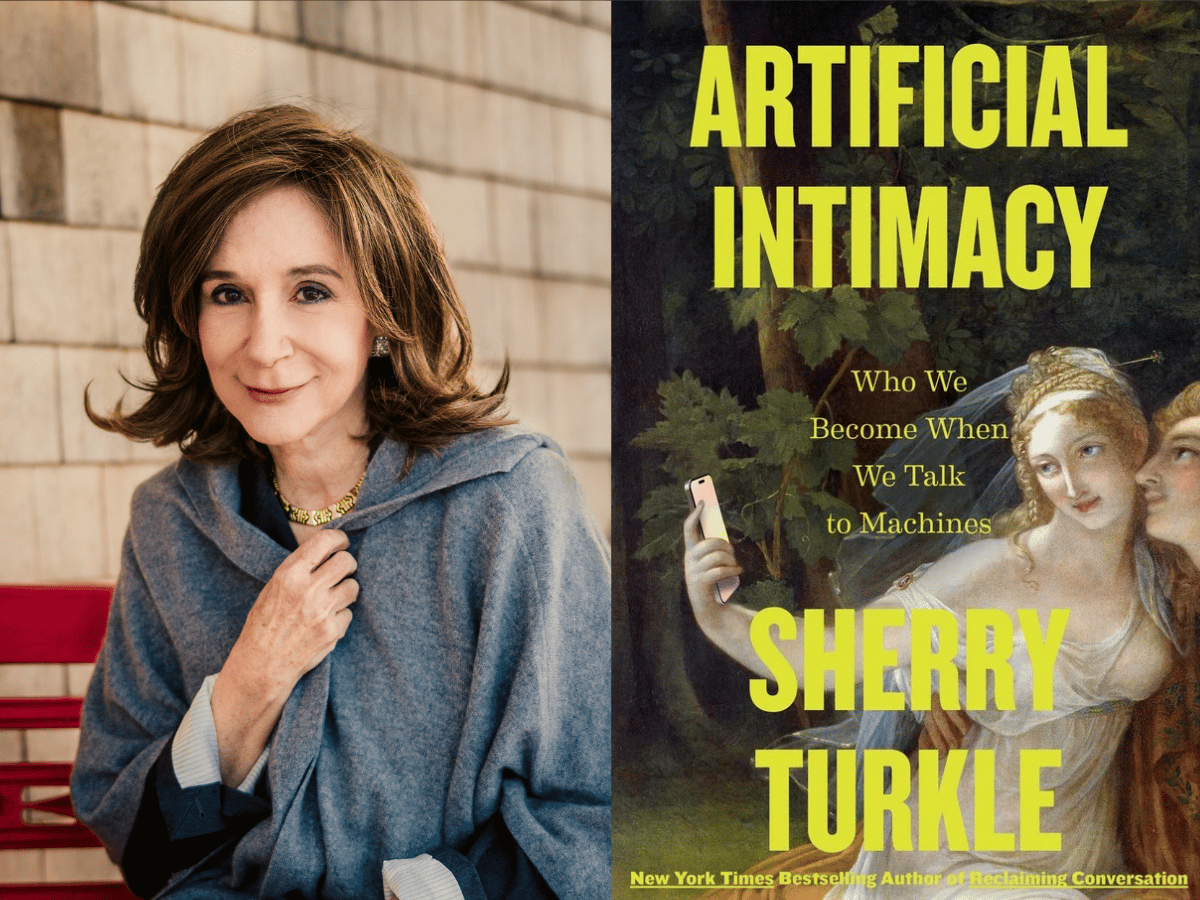
Sherry Turkle.
Photo by Justin Kaneps
Science & Tech
My chatbot is my boyfriend. What’s the harm?
Sherry Turkle’s ‘Artificial Intimacy’ is a book-length response to ‘fundamental lie we’re telling ourselves’
What happens when we replace humans with machines in our deepest relationships?
That’s the driving question behind MIT sociologist Sherry Turkle’s new book, “Artificial Intimacy: Who We Become When We Talk to Machines.” In an age in which more people are treating chatbots as close friends, even romantic partners, the Harvard alumna — A.B. ’69, Ph.D. ’76 in sociology — sees a troubling reality deficit not only in our individual lives but in a society whose problems demand human ingenuity and collaboration. She talked about the consequences in a recent conversation with the Gazette.
This interview has been edited for clarity and length.
Gazette: In your book you say that we’re primed at a young age to turn to machines for companionship. How so?
Sherry Turkle: Over the last few decades, we’ve been introduced to Tamagotchis, Furbies, Aibos, and PAROs, these robotic toys that helped me see just how powerful this psychology is: We nurture what we love, and we love what we nurture. This first generation of objects made people think, “Oh, an object who loves me and I love it.” It showed how ready we were for that kind of engagement. Then came social media, the gateway drug to artificial intimacy. We got used to spending our time on screens, turning to social media when we felt sad or bored. And now, those initial objects have been reanimated by the generative AI revolution. I like to say first we talked to each other, then we talked to each other through machines, and now we just talk to machines.
What is the problem with machines tapping into our human desire for connection?
Using the first person is the original sin of chatbots. They’re not offering connection; that’s the fundamental deceit. There is no “I” there, and we’re biologically wired to respond to this. We’re tempted to accept these objects as kin, but they’re not. You could be having the greatest, best conversation with your ChatGPT, but when you get up, it doesn’t care if you cook pasta or kill yourself. There is nobody there who cares about you.
Industries like healthcare, education, and science have touted chatbots as cost-effective solutions to overwhelmed systems. What do you think is missing from those conversations?
“I think we have a lack of imagination and political will to solve the real problems. Technology exacerbates the problem and then says only technology can solve it. It’s the oldest game in the technology industry playbook.”
Sherry Turkle
I think we have a lack of imagination and political will to solve the real problems. Technology exacerbates the problem and then says only technology can solve it. It’s the oldest game in the technology industry playbook. Right now, we have social breakdown. And at the same time, we are defunding programs for therapy, social support, and social work. Then technology makes it worse. Everybody’s at a screen, there’s a loneliness crisis. And then, oh, my goodness! Our social media platforms will give you 12 new chatbot friends plus an artificial therapist. It reveals a cowardice — an unwillingness to face what our real problems are.
People like to say there aren’t enough people in these industries. Well, yeah, if you take away all the funding and turn your resources to building data centers, there won’t be. My work is a wake-up call: What’s your end game when there’s no community resources for you and all you have is to sit alone talking to something that really isn’t there? I don’t find that dignified for the people we love and the people we’re going to become. People may be smitten now, but in the long run, this is not a good path.
A question you get asked is, “If people are reporting feeling happier, less lonely, and more fulfilled in their chatbot relationship, what’s the problem?” How do you respond to that?
The problem is that there’s something wonderful and sustaining about what people can offer people.
I believe that reality really needs us right now. It needs us in our families. It needs us to raise children in a very challenging time. The garbage still needs to be picked up, there’s an ecological crisis that needs immediate attention, there’s a political system that’s shredding democratic values. Reality needs us.
Chatbots have undergone a transition: At first, they were seen as better than nothing, but nowadays some people prefer them to humans. What’s the attraction?
People often say to me about their chatbots, “I feel so heard.” But you’re not being heard at all. The bot can pretend that there’s somebody there who loves you, and no human being can do that in this friction-free way. People are difficult. But we have to get back into what people can offer and the chatbots cannot.
Having a “relationship” with a chatbot is a fundamental lie we’re telling ourselves. But another danger is that you start to think empathy is what’s coming out of the machine. You start to look at the people in your life and say, “Well, this friction-free, always-accepting-me chatbot — my people are not doing that for me.” That’s dangerous.