Featured series
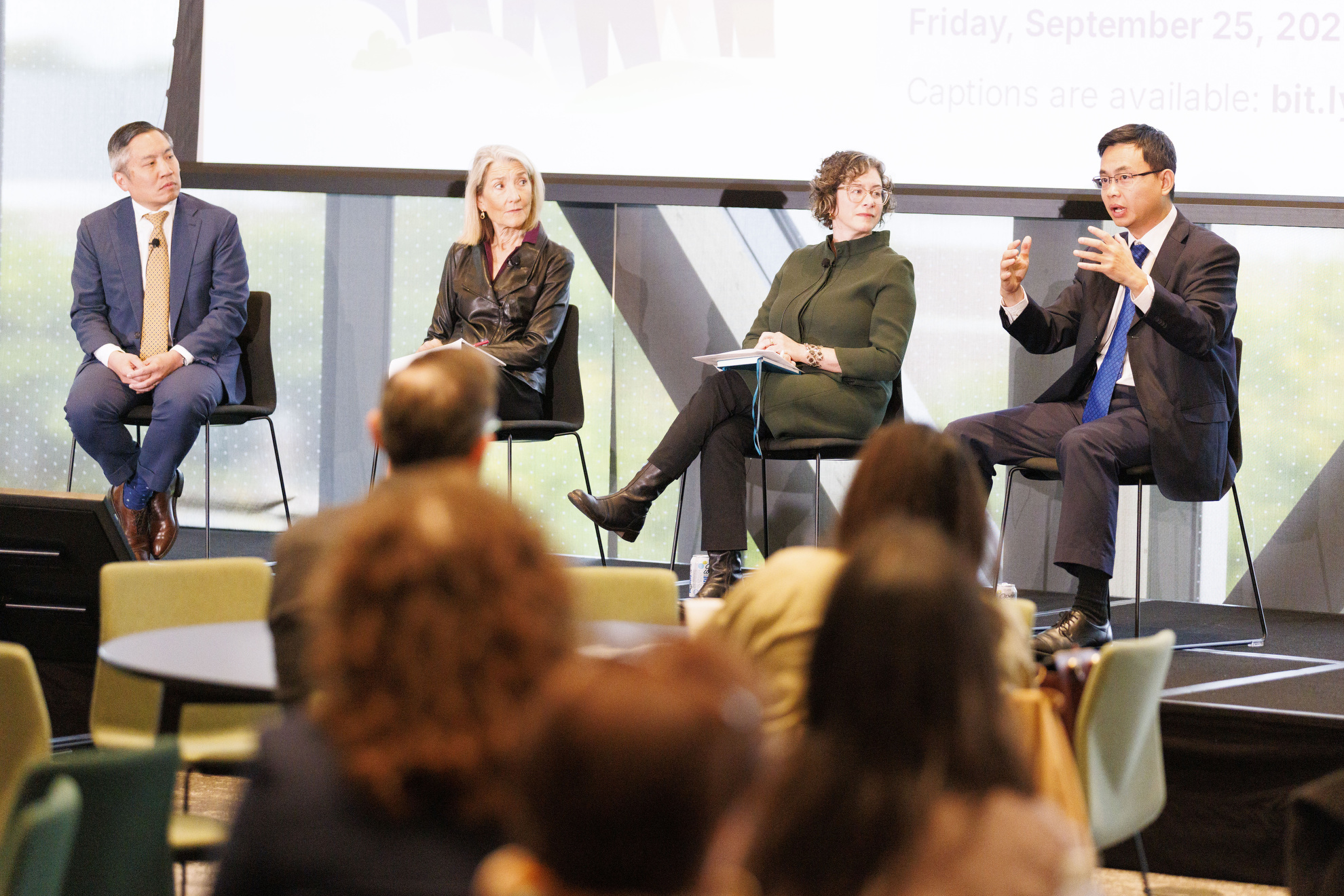
Bernard Chang (from left), Amy Edmondson, Rachel Weber, and Le Xie.
Veasey Conway/Harvard Staff Photographer
Nation & World
How to teach in era of AI, grade inflation
Professors detail assignments that require analytic skills, make it hard to use tech as crutch
As midterms rapidly approach, faculty across the University continue to grapple with how to assess students amid widespread use of AI and concerns of grade inflation.
Those were among the topics discussed at the Harvard Initiative for Learning and Teaching’s 15th annual conference, “The Weight of the Degree: Rigor, Responsibility, and the Modern Campus.”
To kick off the day, a panel discussion focused on “recentering academic rigor in service of society” in a new technological era brought together scholars from the Business School (HBS), John A. Paulson School of Engineering and Applied Sciences (SEAS), and Graduate School of Design (GSD).
Amy Edmondson, Novartis Professor of Leadership and Management at HBS, said a good illustration of how things are changing is the time-honored case method, which calls for students to analyze real-life business problems and propose solutions.
“The case method, which we have loved for 100 years, is suffering from the fact that our students are just putting the cases through ChatGPT and getting CliffsNotes and coming in with accurate but superficial and unhelpful knowledge and then we have a lower-quality conversation, which doesn’t have any of the dynamism of old,” she said.
So how to ensure students develop the analytic skills formerly honed by the case method?
“Giving them a short in-person case, a page or two, and then they’re on the spot,” Edmondson said. “There’s no technology in the classroom, and they have to respond to it, then I assign things to read later.”
“Our job is to make our students’ lives harder, and I think we have to take that job very seriously. … I think we’re going to need some dramatically different ways.”
Amy Edmondson
Rachel Weber, Emma Bloomberg Professor of Urban Planning and chair of the Department of Urban Planning and Design, said homework still has a place — even if it only serves as a way to show students what they’re missing if they lean on AI for lessons.
“There are certain things that can be done at home, and if you’re going to be doing it with AI, then you’re going to come to class, where you create ways of building on what you’ve done at home, and you can’t rely on AI, and it becomes apparent who struggled at home,” she said. “If you didn’t struggle, then your ability to engage in the classroom work is impacted.”
Finding ways to surmount challenges, added Edmondson, is a vital part of the university experience. It’s what makes students successful once they graduate and are handed real problems without ready solutions.
“Our job is to make our students’ lives harder, and I think we have to take that job very seriously,” she said. “And it isn’t going to be doing what we used to do, just in slightly different ways. I think we’re going to need some dramatically different ways.”
Another key puzzle piece in ensuring students are grasping the core concepts of their education, the panel said, is assessing their progress. But with grade inflation, educators wonder how best to capture the quality of the work.
“Grades are feedback, and if grades are taken off the table, you can almost assume an A,” Edmondson said. “These are competitive and bright young people, professional and undergraduate, and they will find other ways to compete and distinguish themselves that are not in the academics. So I think I think we absolutely need and want them to prioritize the academics while they’re here.”
At the GSD, Weber said they are borrowing from an architect’s workflow.
“A process of review,” she said. “So we invite external stakeholders and other experts from the field to our midterm evaluations and final evaluations, and so it’s nice in some ways that some of that responsibility for assessment is taken off of the individual instructor’s shoulders.”
Le Xie, the Gordon McKay Professor of Electrical Engineering at SEAS, said he and his colleagues are trying to implement more team-based projects, where students have an opportunity to evaluate each other.
“We need to combine both what we traditionally would have taught in class, which are these core disciplines, with a sense of does your solution actually have a possibility of shaping the society?” Xie said. “And in the classroom that is translated into team-based project evaluations and presentations, and that becomes part of the evaluation that we do.”
One shining example of this new approach, Xie said, is the ENCE program — Energy, Climate and the Environment — a degree that combines SEAS courses with courses from the Divisions of Arts & Humanities, Social Science, and Science. Students in the ENCE program participate in active learning labs, giving them hands-on mechanical, electrical, computational, biological, and environmental experience.
“We try to keep them together as a cohort … doing team-based projects at the end of the undergraduate journey,” Xie said. “You have to struggle with the idea of coming up with the topic of your project, right, and then trying to define and then work together with the professor and teaching fellows and staff members.”
Even though these project-based curricula promote collaboration and active learning, Weber adds that AI can still have a place in student learning. For her students, who often are faced with presenting their ideas to stakeholders outside of the classroom, AI can help mimic feedback situations. “All of the graduates are involved in shaping the built and natural environment and therefore shaping people’s lives and the future of our planet,” she said. “You can train AI to simulate the environment of a contested community hearing, and you can assign different roles. You can have the small-business owner who really cares about parking, and you can have the housing activist who really cares about affordable housing, and you can test out your ideas before you actually have to go into the real world.”