Featured series


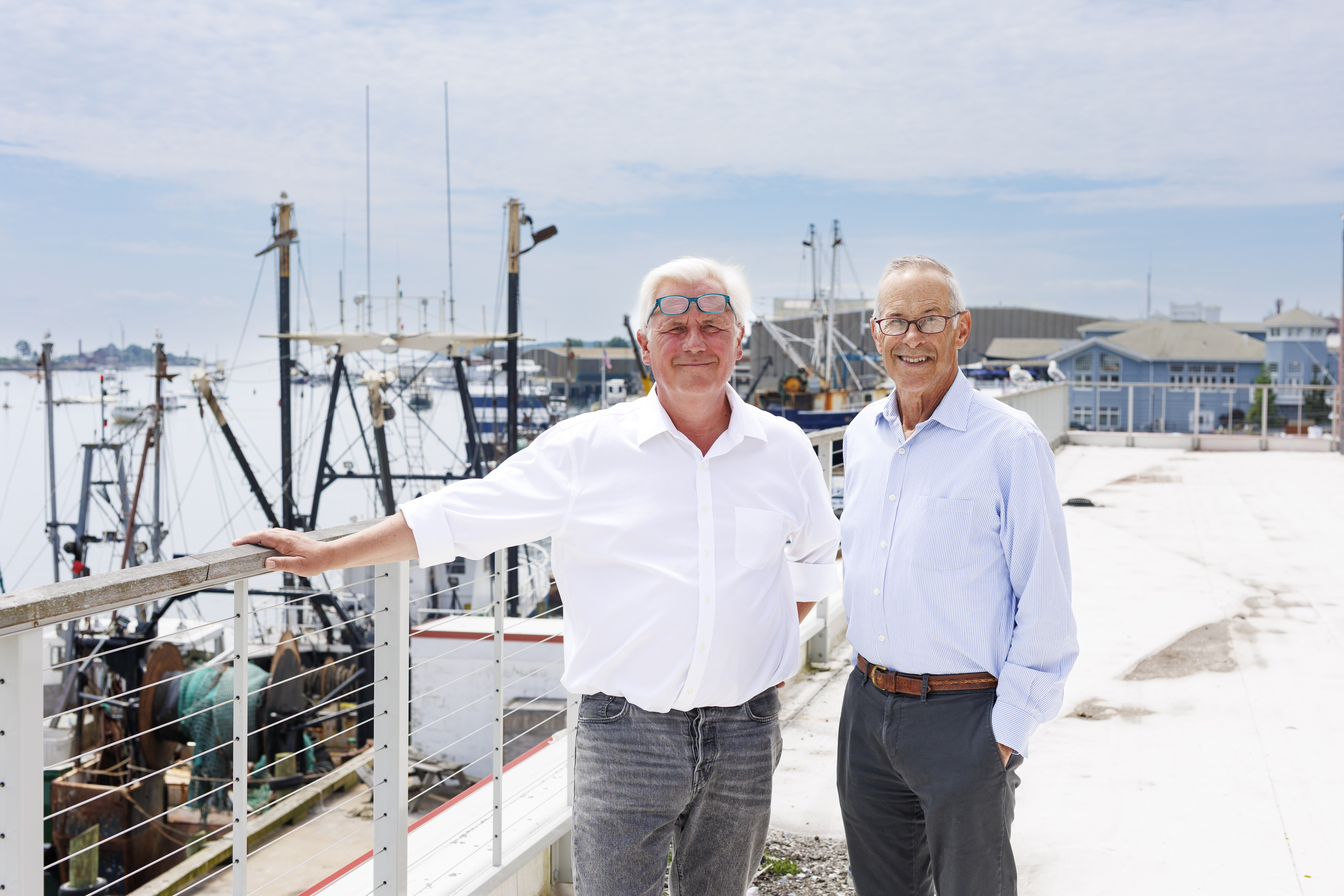
Marc Vidal (left) and David Walt.
Photos by Niles Singer/Harvard Staff Photographer
Science & Tech
How Harvard scientists built genomics outpost on Gloucester harbor
It started with idea to help beleaguered fishermen. Now marine science lab promotes healthy fisheries, trains local workforce, seeks clues to longevity
The year was 2012, and Massachusetts state Rep. Ann-Margaret Ferrante had an idea that might help fishermen in her hometown of Gloucester.
The Atlantic cod population had been in decline for decades, partly due to overfishing. Regulation to try to bring about a rebound was in everyone’s best interest, but there were problems — and some distrust of regulators by fishermen.
The cod in two offshore regions, the Gulf of Maine and Georges Bank, were managed as separate populations, but there were gaps in what was known about the groups’ geographic boundaries and genetic relationships. Ferrante wondered whether genomic sequencing could help track the stock more accurately and approached David Walt, then a professor at Tufts, to ask.
“I said, ‘Yeah, I think that’s a pretty viable idea,’” said Walt, now the Hansjörg Wyss Professor of Bioinspired Engineering at Harvard Medical School. So Ferrante secured state funding, and Walt ran tests and found genetically distinct spawning groups within both regions, information that has helped fisheries managers get a better read on the health of the groups.
That project would eventually grow into the Gloucester Marine Genomics Institute, a small but growing nonprofit that supports healthy fisheries, investigates what marine life can teach us about human health, and trains a new generation of STEM technicians.
The Marine Genomics Institute’s connections to Harvard run deep. Among its other founders are former Harvard and Dana-Farber Cancer Institute (DFCI) Professor of Chemistry Greg Verdine and HMS and DFCI Professor of Genetics Marc Vidal. (Sheree O’Reilly, a Gloucester-area developer, was a fourth co-founder.) Walt and Vidal, along with HMS Professor of Pediatrics Stuart Orkin, sit on GMGI’s science advisory board.
“It’s kind of like we’re taking Harvard up north and trying to apply the best that we learn at Harvard to help another community.”
David Walt
“Three of the four co-founders have Harvard faculty appointments, and we’re all committed not just to our own research, but to broadening research opportunities for everyone,” said Walt, who is also an HMS professor of pathology at Brigham and Women’s Hospital. “It’s kind of like we’re taking Harvard up north and trying to apply the best that we learn at Harvard to help another community.”
A lab on the waterfront
Forty miles north of Harvard Yard, the Marine Genomics Institute occupies a former eel processing plant that was redeveloped into a compact two-story lab. Its neighbors are a marine supply store and a whale-watch tour agency. Its parking lot ends in an abrupt drop-off into the harbor, allowing fishing boats to sidle up beside researchers’ cars.
“[Fishermen] pull their boats up to the dock and bring us things, saying, ‘We just caught this thing; what is it?’” said Walt.
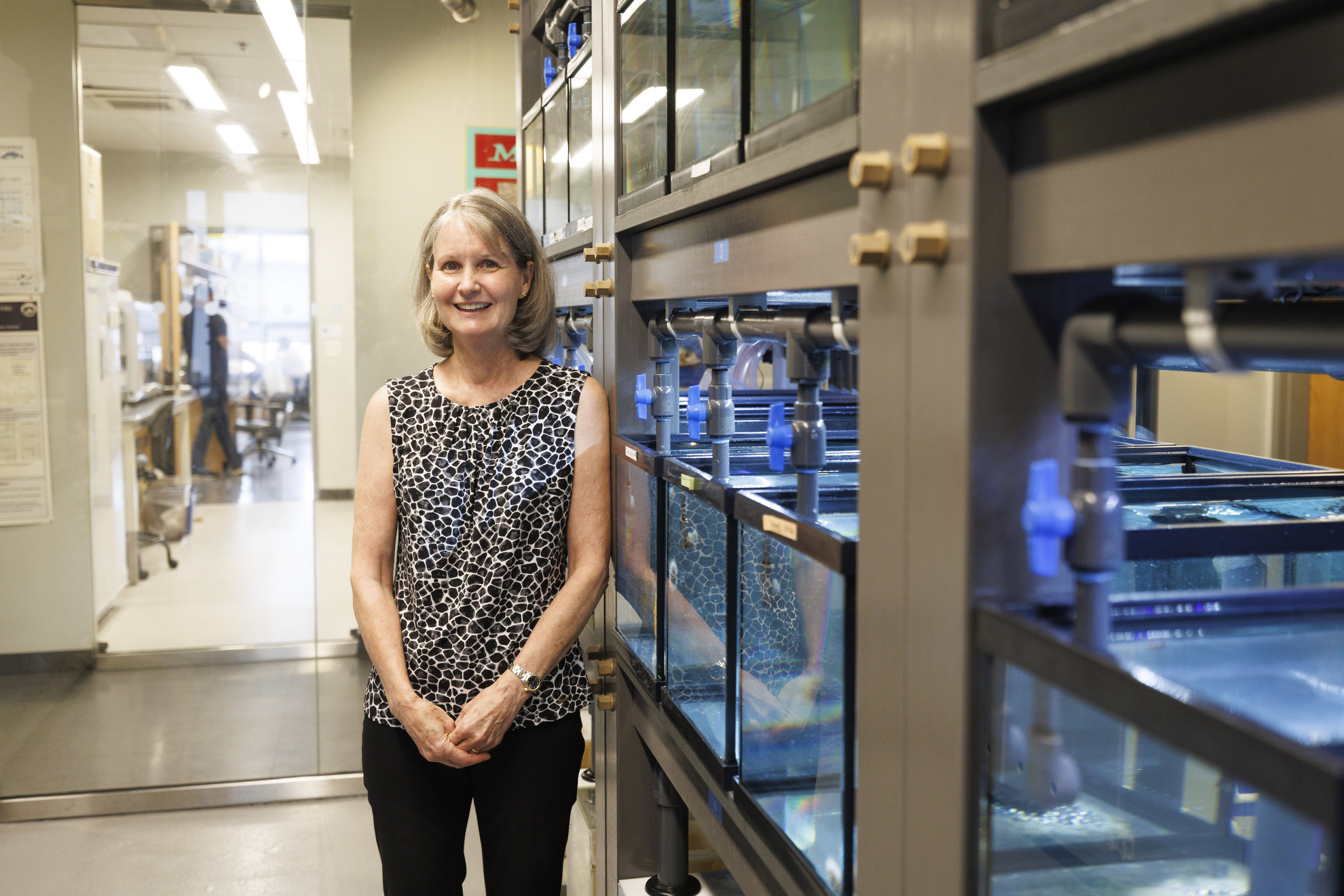
Past a lobby hung with fish-themed artwork lies the lab space of Science Director Andrea Bodnar.
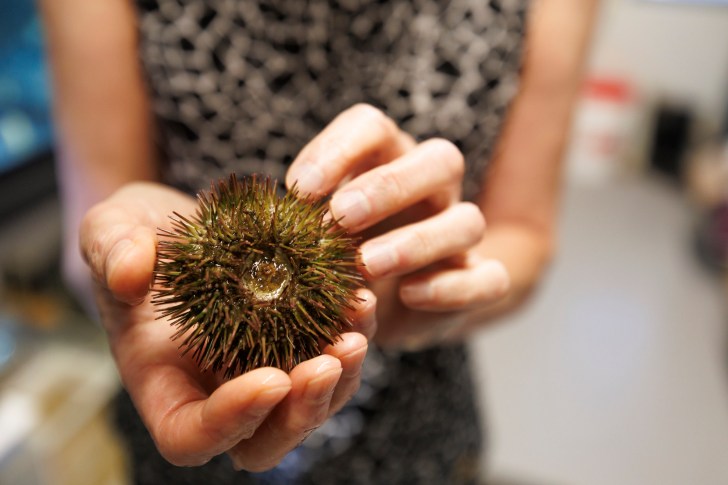
Here, her team is examining the sea urchin genome to figure out how the spiny little creatures live upward of 100 years without showing signs of aging. The hope is to translate those findings into treatments that can help humans live better, longer.
Researchers here must exercise significant self-discipline. Along one wall of their workspaces are grand windows offering panoramic views of the harbor, where fishing boats unload their catch and crowds of seals clamor for whatever is tossed back into the waves.
“I would walk into the lab sometimes, and everybody would be looking out the windows, watching all this amazing activity,” Bodnar reminisced about the early days in the space. “I think we all take it a little bit for granted now, but there’s always something interesting going on in the harbor.”
While still active, the harbor is much quieter than it was in Gloucester’s fishing heyday.
In the 19th century, Gloucester was the largest fishing hub in the U.S. More than 450 schooners once called the city their home port. In 1880, fishermen brought in a record 294 million pounds of cod from Georges Bank alone. Fish processing plants and associated industries sprouted up.
But overfishing, new technologies, and an increasingly global seafood market cratered the local economy, leaving empty factories and idle docks behind. Today, many independently owned fishing boats have been replaced by corporate fleets.
“There’s this expression of third-generation unemployment,” explained Vidal. “Maybe your grandfather lost his job in the ’70s, and two generations later you’re still not finding jobs.”
A self-described farm boy from Belgium who has made his home in Gloucester, Vidal sees similarities between the hollowed-out rural communities of his youth and the economic struggles facing fishing communities. Now he’s looking to bolster his adopted hometown and its people.
“All these kids growing up in fishermen’s families, they don’t necessarily think of themselves as college material. But when you meet them and talk to them, they’re very smart. We realized, maybe we can build our own workforce,” Vidal said.
In 2016, the Marine Genomics Institute launched Gloucester Biotechnology Academy to train young adults for jobs as entry-level laboratory technicians. Students learn practical skills — pipetting, operating lab instruments — as well as time management, critical thinking, and communication skills and the social norms of life in a lab.
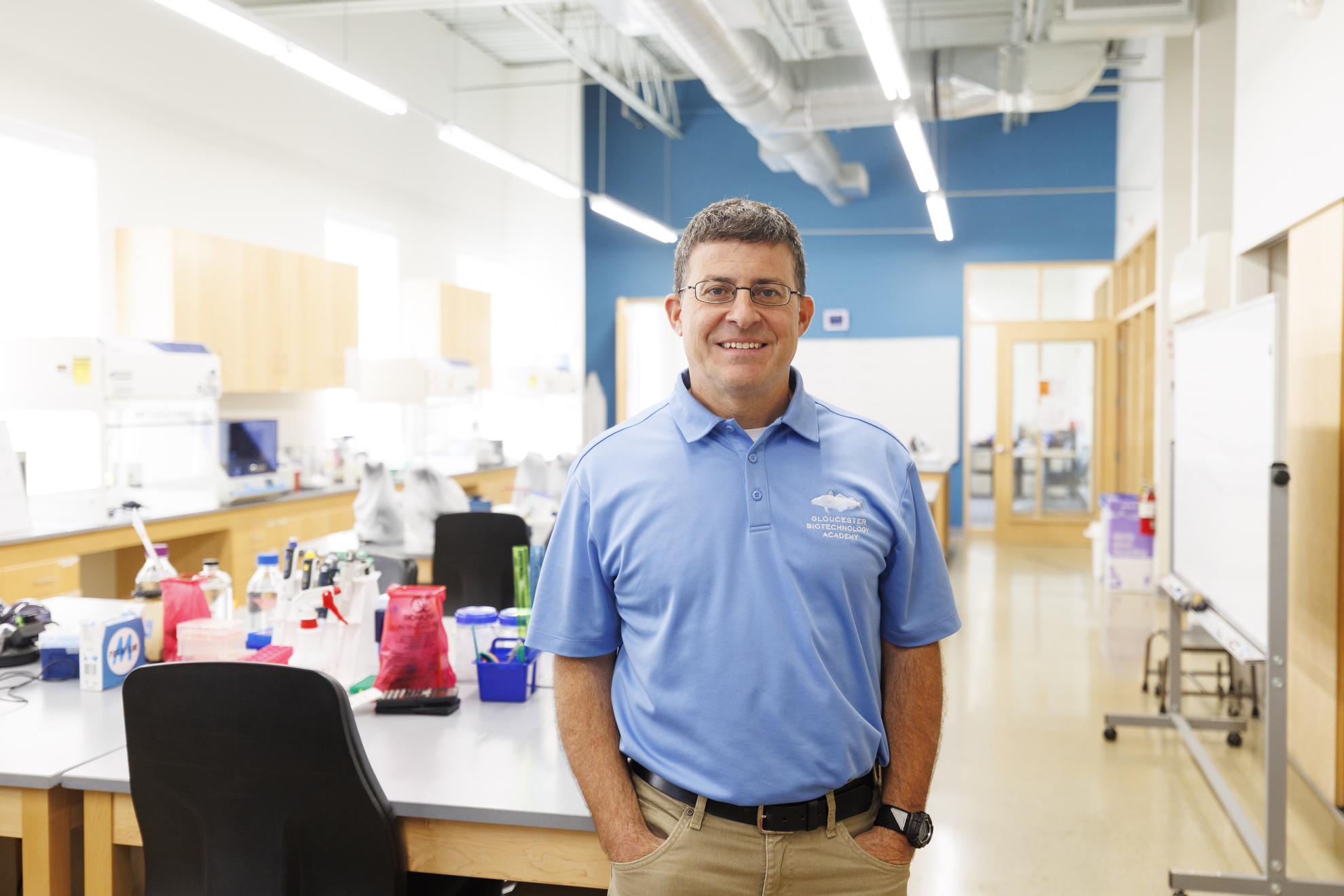
“Many of our students come from the gig economy. They’re working in malls, they’re in kitchens,” said Academy Senior Director John Doyle. “They don’t know how to access professional careers. We can break the cycle. That’s what we’re trying to do.”
Some Academy graduates go on to work at the Marine Genomics Institute — not catching marine life like their fathers might have, but analyzing it instead. Others decide to pursue four-year degrees in hopes of increasing their opportunities in the field. The Academy is planning to expand to a location in Boston’s Seaport in 2027.
Pulling up science from the seafloor
Stephen Treaster becomes animated when talking about prospects of pushing out the boundaries of lifespans.
“People really take lifespans for granted that, yeah, a mouse can live for three years in a lab, dogs live about 10 years, and humans live to 80ish. That’s just the way it is,” he said in an institute conference room overlooking the harbor. “But it’s hiding a fascinating question: Why has a mouse never lived to 80? No one knows.”
Treaster, who completed postdoctoral work at the Harris Lab at Boston Children’s Hospital and HMS, now studies marine-animal longevity at the Marine Genomics Institute.
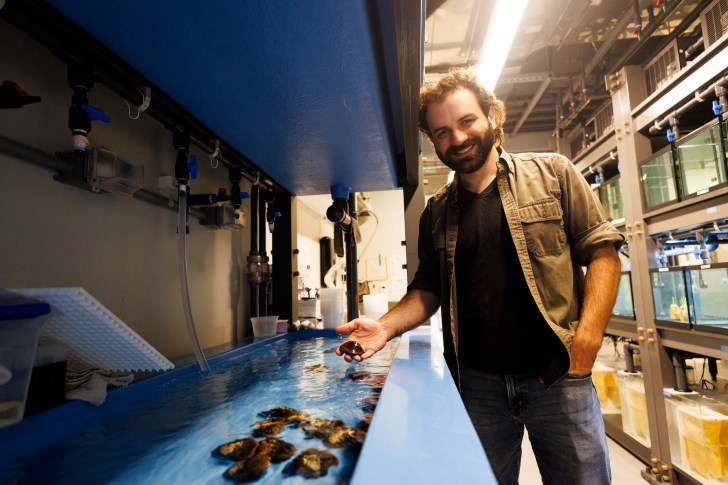
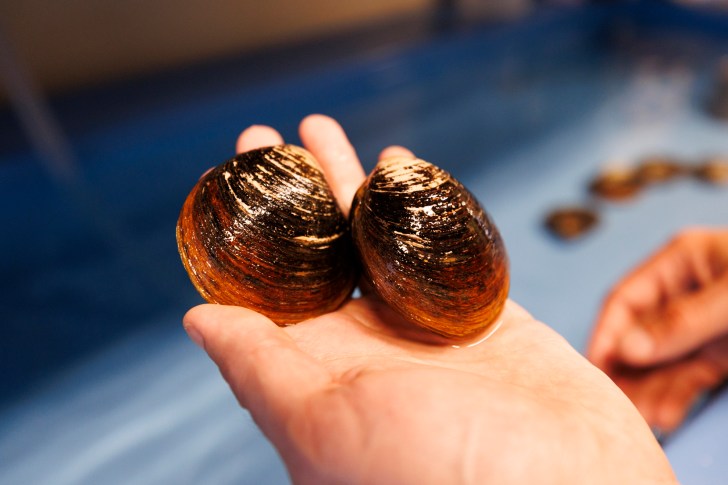
The ocean is home to both the longest-lived noncolonial animal (the ocean quahog, a type of clam) and the shortest-lived vertebrate (the dwarf goby, a type of fish).
Treaster studies them both. He wants to understand the genetic variations that allow some quahogs to survive for half a millennium while senescence snags the goby in a matter of weeks.
Treaster’s clam specimens, diverted from Gloucester clam boats and their presumed fate as chowder, sit in bare tanks in a specimen room shared with Bodnar’s sea urchins, which occupy livelier digs.
Quahogs, evidently, don’t care much for interior decorating. But the sea urchins’ tanks include shells to hide under and, in one case, a plastic replica of SpongeBob SquarePants’ pineapple house. For enrichment, Bodnar explained.
The room hums and burbles with the machinery that keeps the specimens alive and healthy.
It all appears very polished and high-tech — most of it, anyway.
Down the hall, a homemade filtration system filters seawater and silt through about $20 of PVC pipe. It’s part of the Marine Genomics Institute’s work on environmental DNA, or eDNA for short.
A specially outfitted lobster boat pulls up samples from the ocean floor, and researchers extract genetic evidence from the traces of scales, urine, feces, and mucus that sea creatures leave behind. It’s the marine equivalent of a criminologist identifying a suspect by hair or skin at the scene of a crime.
Environmental DNA has become an increasingly accepted tool to help fisheries managers assess populations — a validation of the novel proposition that brought Ferrante to Walt’s office more than a decade ago. (Ferrante, who received a master’s in public administration from the Harvard Kennedy School in 2018, died in 2025 after a long illness.)
“We’ve never been political,” Vidal said. “We want to do science and provide information for others. This is what we tell the fishers and the regulators: We’re not policy players; we’re just going to give you the best data possible.”
Unfortunately eDNA won’t be enough to rebuild Gloucester’s fishing industry. But Walt and Vidal hope that it can help turn the city into a hub for people who care about science, marine sustainability, and the weird stuff that gets pulled out of the ocean.
“We’re not very far away,” said Vidal. “Reach out to us.”