Featured series
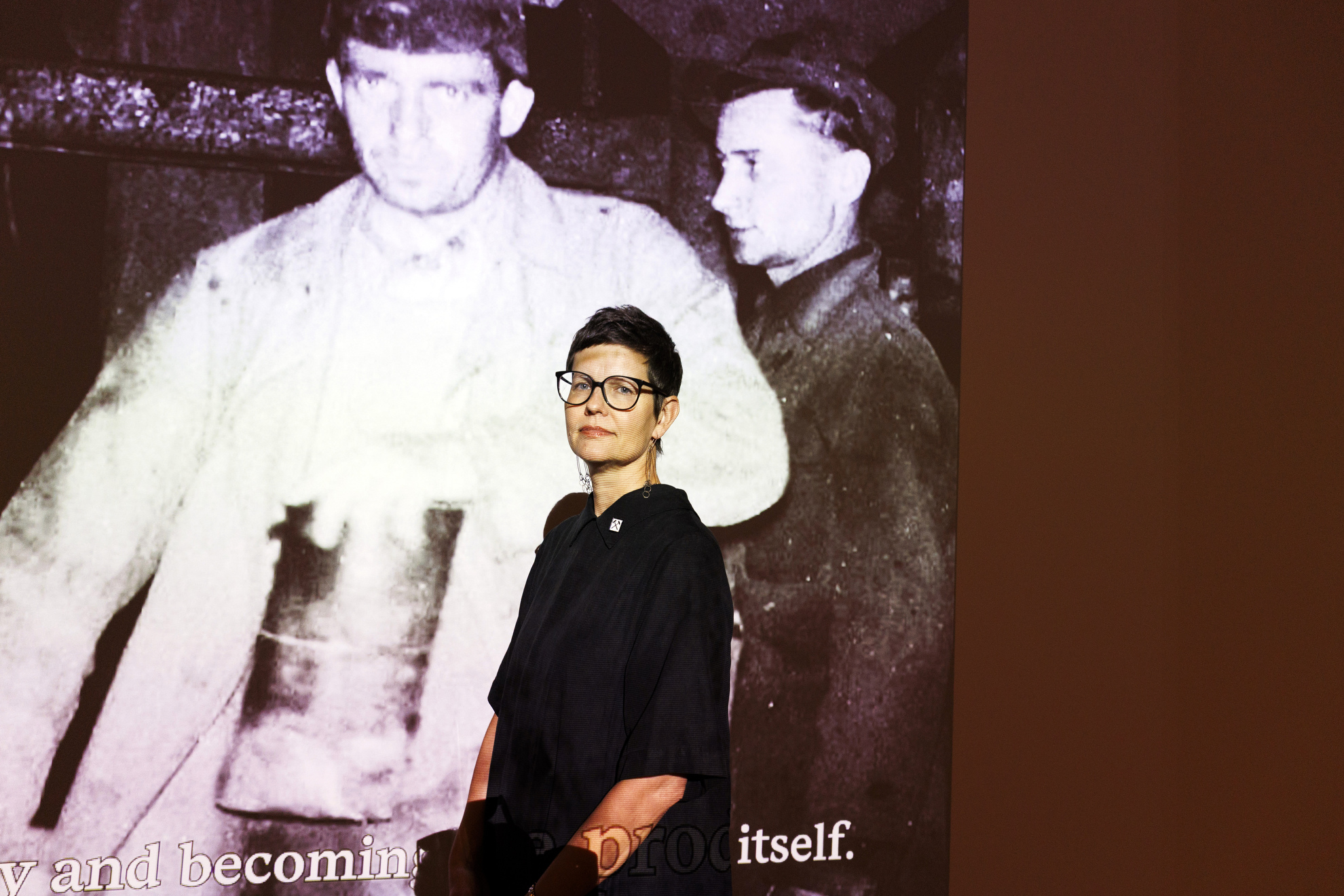
Lynette Roth.
Photos by Stephanie Mitchell/Harvard Staff Photographer
Arts & Culture
What ‘good luck’ means to a coal miner
Berlin artist explores labor, pride, and unsung heroes of Germany’s ‘economic miracle’ in Harvard exhibit
Following the economic and political fallout from World War II, West Germany underwent what scholars call the “wirtschaftswunder” or “economic miracle” during which industry boomed and rapid reconstruction led to increased prosperity. But who was responsible for creating the miracle, and what happened when they were no longer needed?
That’s what Kurdistan-born artist and Berliner Pinar Öğrenci asks in her work currently on display at Harvard Art Museums in the exhibition “Glück auf in Deutschland,” or “Good Luck in Germany.” The exhibition includes the 2024 film of the same name by Öğrenci, as well as five related collages that integrate stark images of the country’s coal miners and their families — a major source of that economic growth for post-war Germany — into the country’s Ruhr region landscape and industrial architecture.
“Öğrenci’s work aims to capture the all-encompassing nature of the industry and highlight the people behind the economic growth,” said Lynette Roth, Harvard’s Daimler Curator of the Busch-Reisinger Museum.
And glück auf, Roth said, is not just a friendly greeting in Germany but is specific to the mining industry and to miners who would wish each other good luck before they went down into dangerous mines.
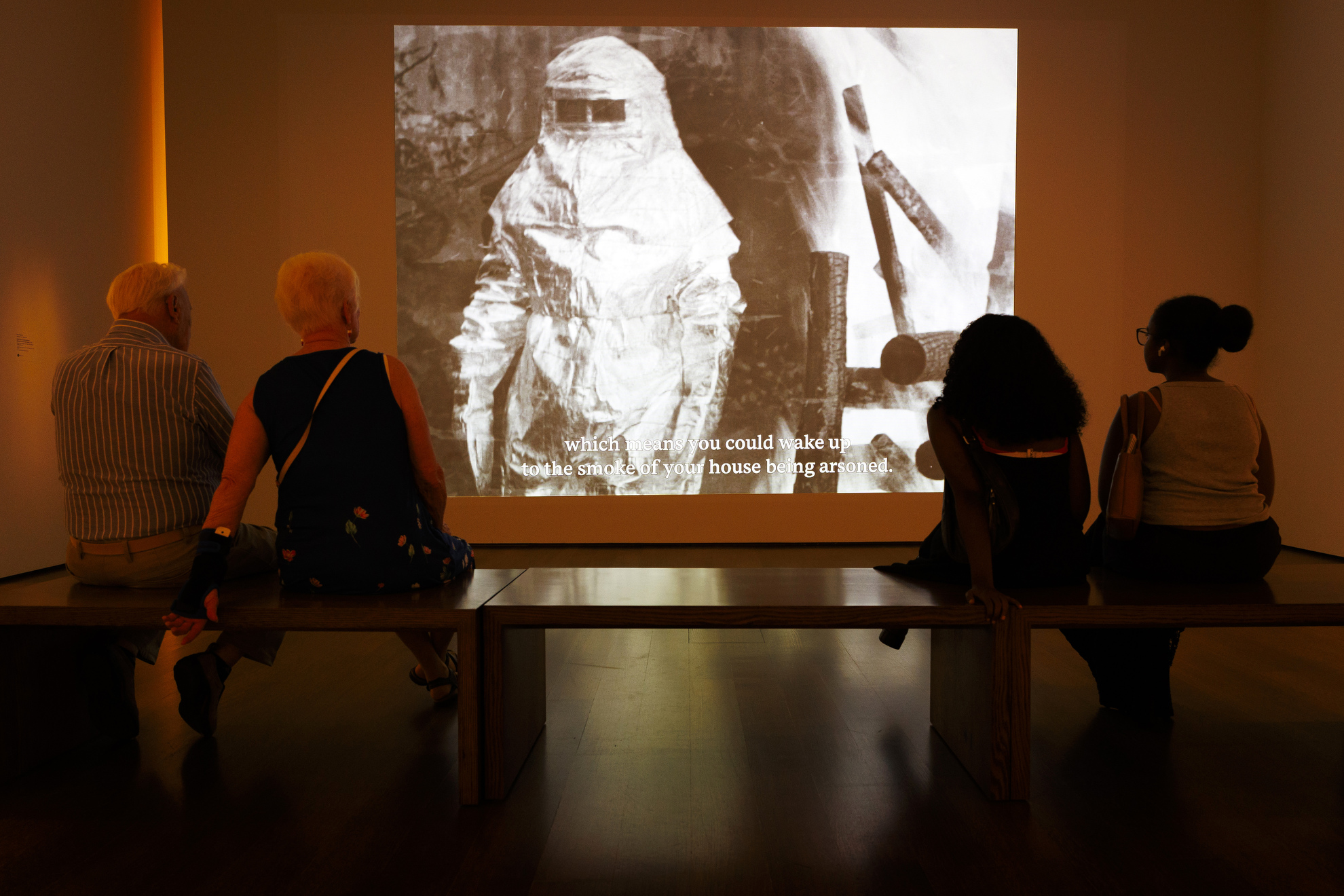
The film, which runs roughly 44 minutes in total, includes black-and-white archival photos from the 1950s and 1960s of miners covered in soot, alongside images of their families and communities in the surrounding region. These images, some of which are collaged and some of which stand alone, are paired with interviews Öğrenci conducted with scholars and experts in conjunction with poetry and personal anecdotes.
You see the laundry drying, with factories looming in the background, or children playing on the street in housing complexes built for workers. There are images of religious ceremonies, and neighborhood parties paired with images of heaping piles of coal and mining equipment.
“The mines themselves really cultivated a kind of identity, and so as the film goes on, you see parades and celebrations and sports activities and the ways in which the women were brought together as a community,” Roth said. “[Being a miner] bound those workers to this intensive labor and kept them from leaving the area or looking for work that maybe wasn’t quite as dangerous or as, you know, bad for their health.”
“[Being a miner] bound those workers to this intensive labor and kept them from leaving the area or looking for work that maybe wasn’t quite as dangerous or as, you know, bad for their health.”
Lynette Roth
Women in Germany’s coal mining communities stand out in Öğrenci’s work as some of the unsung heroes of the wirtschaftswunder. For one, their fashion choices are visually striking in the images included in the film.
“Women would often dress themselves and their families in white, which is counterintuitive if you live in a very sooty environment that has a lot of air pollution,” Roth said. “It was kind of a protest, because there were stereotypes about that area. It’s dirty. It’s dark. And so it was a pride that women took in saying, ‘Actually, no, we are very clean. We take care of our families.’”
In the film, lines of clothing drying outside factories are set against a backdrop of active smokestacks. Laundering the light clothes became a massive act of labor for women in the community.
“So she’s also saying, ‘Let’s not forget the role that women play in the so-called economic miracle,’” Roth said.
The other forgotten players in the economic miracle highlighted in Öğrenci’s work are the migrant workers who sustained the industry from its beginning in the late 19th century and saw a massive increase after the war.
“After the Second World War, West Germany was able to recover from the devastation of the war only because of its migration program that brings labor migrants, starting in the 1950s, from Italy, Spain, and then eventually from Türkiye,” also known as Turkey, said Roth. “And so Pinar comes to this project as someone who was coming from Türkiye with these labor migrants in mind.”
Roth acquired several of Öğrenci’s physical collages for the exhibition that show Turkish labor migrants and their families intertwined with the mining infrastructure and the Ruhr community spaces.
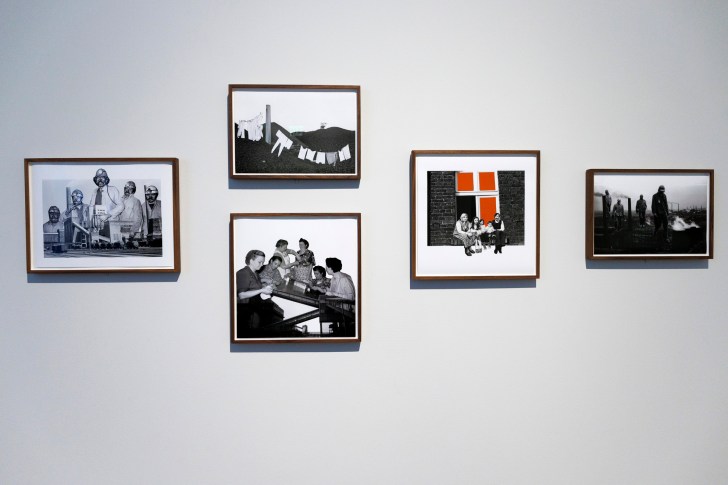
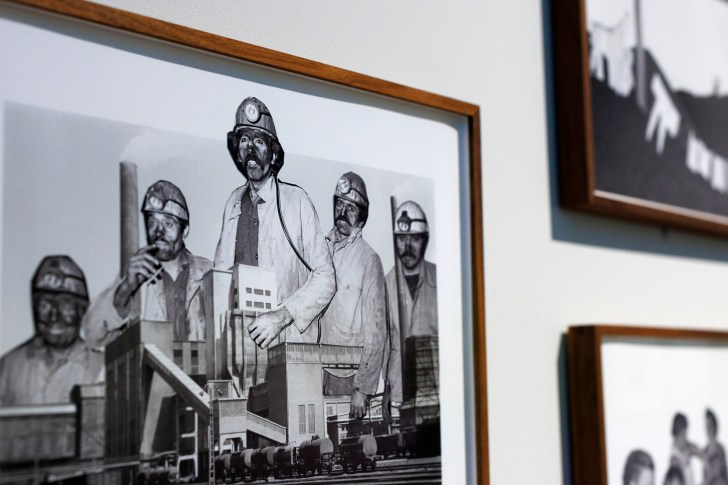
“She’s actually kind of wrapped a photo [of workers] around an architectural photo,” Roth said. “Kind of like they’re taking possession of the factory, in a way that they were not given that kind of agency at the time.”
In “Glück auf in Deutschland,” Öğrenci is also partially examining the people in power in Germany’s coal industry, including footage of a Krupp company factory that was actively used for forced labor during WWII and continued afterward as a private endeavor.
“We know German industry was about the war machine, and there wasn’t a zero hour or a clean slate,” Roth said. “Industries continued on, and people who were affiliated with the Nazi Party also often continued to work in major roles in German business and industry.”
Öğrenci leaves viewers with an understanding of mining’s complicated legacy. At the turn of the 21st century, Germany began undergoing what is known as the “energiewende” — a shift to new forms of energy such as solar and wind. As such, they’ve ended underground mining completely, leaving former mining towns in economic freefall — comparable to that of the American rustbelt.
The exhibit examines the breakdown of the once close-knit mining communities, as well as the ways in which the mining industry’s legacy is alive and well — including using migrant labor in other forms across the country.
“At the end, she’s expanding outward,” Roth said. “She’s opening up and offering hope for a world where there’s justice for laborers, where profit isn’t the primary driver, where the labor of women or migrants is held in high esteem.”
“Pınar Öğrenci: Glück auf in Deutschland” will be on display at Harvard Art Museums through Oct. 18. Öğrenci will be on campus for a lecture on Oct. 13 to discuss the work.