Featured series

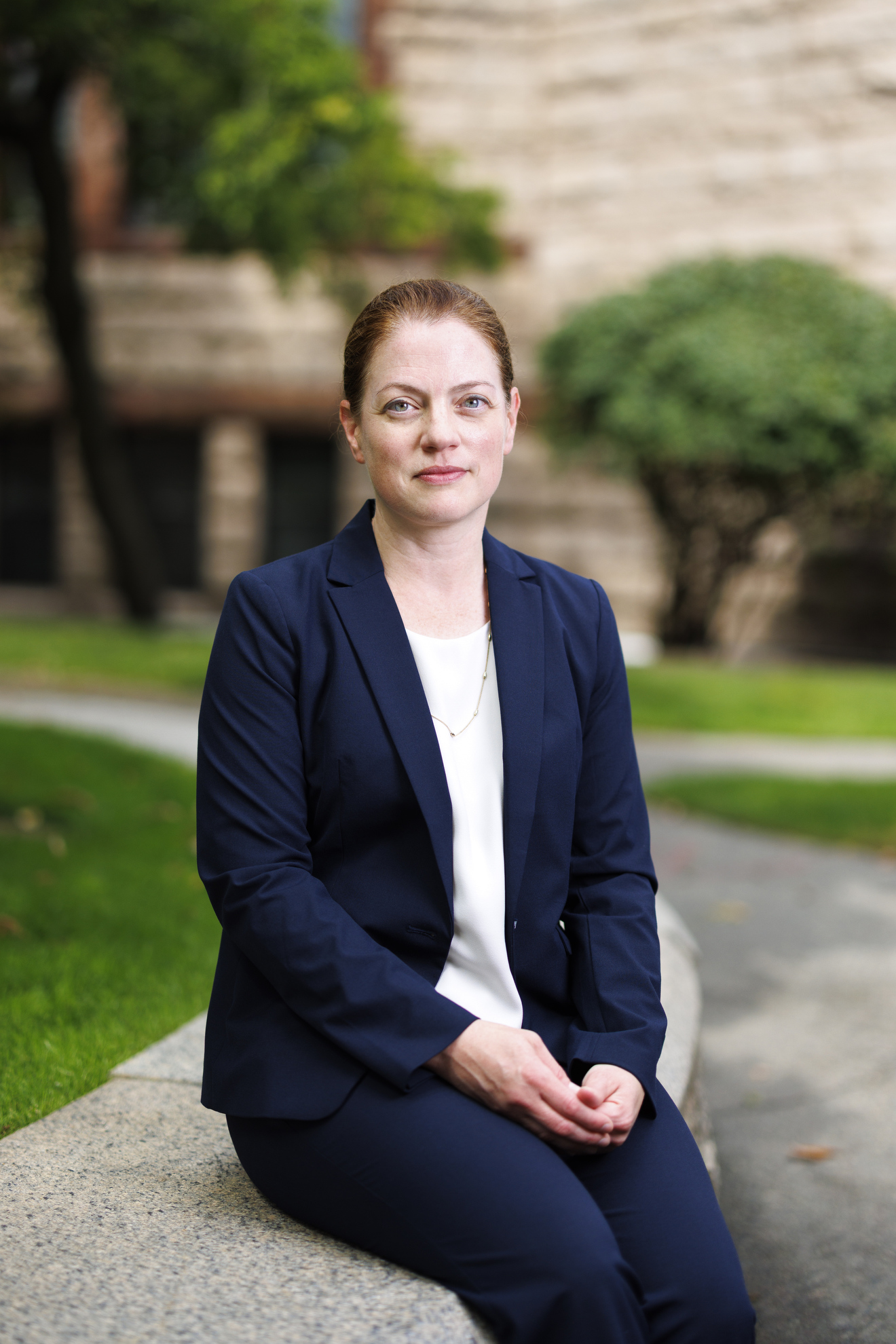
Kristen Eichensehr.
Veasey Conway/Harvard Staff Photographer
Nation & World
Old global order has been ‘ruptured.’ What will new one look like?
Law School initiative examines U.S. national security, role of Congress, emergence of AI in bid to prepare future leaders amid seismic shifts
Early this year, in remarks at the World Economic Forum in Davos, Switzerland, Prime Minister Mark Carney of Canada declared that there had been a “rupture” in the rules-based global system of military, economic, and diplomatic alliances by the West, an arrangement that has helped preserve peace for more than 80 years.
Carney’s speech arrived in response to recent major shifts in national security and trade policies by the U.S., long viewed as a linchpin of the system. The talk drew a standing ovation and widespread support from international political and corporate leaders at the forum.
In order to prepare future leaders amid rapid, widespread changes, the Harvard Law School recently launched the National Security Law & Policy Initiative. An expert in foreign relations and national security law, Kristen Eichensehr, Balthrop Cassidy Professor of Law, will serve as the initiative’s faculty director.
In this edited conversation with the Gazette, Eichensehr explains the initiative’s goals and the need to think about what comes next.
Gazette: Why has the Law School decided to launch this initiative now?
Kristen Eichensehr: We are at an inflection point in national security. This is a time when things feel very unsettled domestically and internationally, and those two are not separate. What the United States chooses to do as part of its domestic policy has tremendous consequences internationally for individuals, for countries, and for the international order.
Harvard Law School has longstanding strengths in national security law, both at the faculty and the student levels.
On the faculty level, Harvard professors have been involved for decades in constructing the international order and working on national security policy in the United States. Among them are Manley Hudson, who was a U.S. delegate to the Peace Conference after World War I and became a judge in the Permanent Court of International Justice; Abram Chayes, who shaped the law during the Cold War; and Philip Heymann, who worked on the need to balance security and liberty in response to terrorist threats.
At the student level, we have incredible student organizations on national security, a leading national security law journal, and a national security law association. But what was really missing from that was an intellectual home for national security at the faculty level.
What are the initiative’s goals?
We’re hoping to use Harvard’s convening power to bring people together at a moment where national security is in a tremendous period of flux, both domestically and internationally. Part of the initiative’s goal is to marry together the domestic law piece and the international side.
“We’re hoping to use Harvard’s convening power to bring people together at a moment where national security is in a tremendous period of flux, both domestically and internationally.”
The first year of the initiative is going to focus on the domestic aspect, including separation of powers and the role of Congress, in particular in national security policymaking.
The second year is going to tackle this question: Where is the international order headed? Canadian Prime Minister Mark Carney said that we are at a point of rupture in the international order, and I think that’s right. The question is: After the rupture, what comes next?
What are the most pressing national security issues on which the initiative will focus?
Since the 1970s, we have seen a tremendous expansion in executive power in presidential administrations of both parties, and we’ve reached a point where people sort of assume Congress isn’t going to push back against the president. It’s important to think about ways that Congress could reassert its prerogatives in national security.
We have seen moments before where the presidency and the executive branch expand power in ways that do finally prompt Congress to push back. The mid-1970s was a pivotal time for that. In the wake of the Nixon administration and the Vietnam War, Congress enacted the War Powers Resolution, the International Emergency Economic Powers Act, and the National Emergencies Act.
Part of what we want to work on over the course of the next year is: Are we headed toward a moment where that might be possible and desirable? And then more concretely, what does that actually look like?
For the purposes of the initiative, we’re going to convene a conference next spring to bring together academics, policymakers, and students to think through some of those questions, and we’re also going to convene a seminar that will bring students directly into conversation with thought leaders on these questions.
You said that the initiative will also tackle issues related to the post-World War II international order. How so?
I’ve been thinking about this quite a lot, in connection with the 25th anniversary of 9/11. It’s striking to me to think how different the world is now.
The only time NATO has invoked its Article Five, its collective self-defense provision, was to support the United States in the wake of 9/11. We’re now living in a world where NATO is at risk because the United States is putting the alliance into question, and where the U.S. president has threatened to seize territory from a NATO ally, in the case of Greenland and Denmark.
The world surely looks very different now.
In addition, the paradigmatic prohibitions in the international order are increasingly under challenge, including from so-called great powers such as the United States, which has been one of the greatest champions of post-World War II international order.
This is not a world where the United States is a totally dominant global hegemon. Even if the U.S. wanted to impose its views on the world, it’s not at all clear that it could, or that other countries would go along with that.
The scope of countries with which the United States will get its way or that it could persuade is narrowing. We are now in a trade war with Canada, one of our traditionally closest allies.
I don’t think the world is going to snap back to before 2016 or before 2024. We’re going to be somewhere fundamentally different, and we need to think carefully about what the U.S. national and international security policies should be.
New technologies and artificial intelligence are on many people’s minds when it comes to national security issues. How will the initiative address this subject?
Concern about and competition for new technologies, especially AI, are driving many national security decisions today. The U.S.-China tech competition is perhaps the biggest example.
I see these issues as deeply intertwined with questions about the future of the international legal order. Where interdependence and globalization used to be seen as stabilizing forces internationally, they are now viewed through the lens of security risk.
Tech competition is prompting the turn away from some international institutions, like the World Trade Organization, and toward nascent efforts to build new alliances among smaller groups to address issues like access to rare earths and critical minerals.
Finally, what do you hope this initiative will achieve?
A fundamental goal that I have for the initiative is to think about how we can best educate the next generation of national security leaders and hopefully draw on their ideas even before they become national security leaders.
We are at a moment when innovative ideas and new thinking, some of which can come from students, would be helpful to the country and to the world. I’m hoping we can foster the school’s educational mission, help shape the next generation of leaders, and draw on the Law School’s convening power to bring people together and have some of these difficult conversations.
We’ve recruited an advisory board that is bipartisan. The board members have served in every presidential administration of the past several decades. I’m hoping we can bring people together in a way that will help to build some bipartisan support for particular ideas and hopefully some consensus to tackle the most pressing issues in national security law and policy.