Featured series

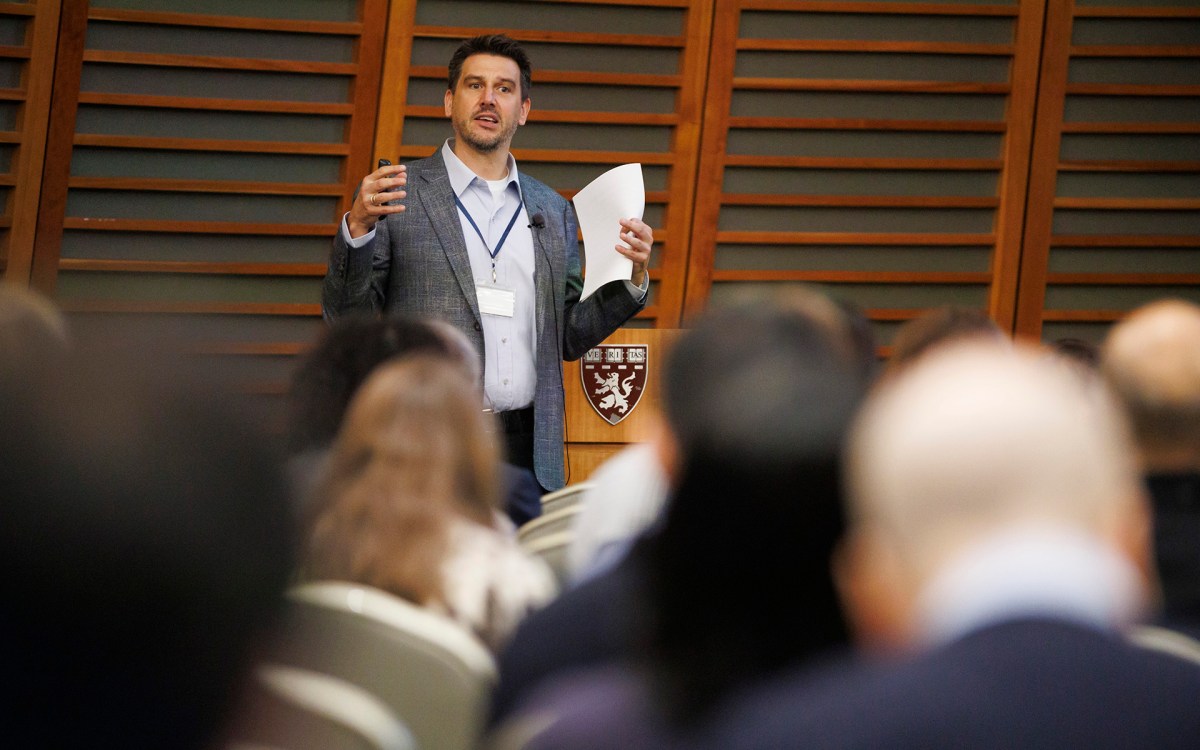
Mark Czeisler.
Veasey Conway/Harvard Staff Photographer
Health
More evidence that mass shootings are suicidal acts
New research finds national peaks for suicides, gun rampages take place within days of each other in summer
Research suggests that most mass shootings are at their core suicidal acts, and new findings linking gun violence, suicide, and seasonality add support to that theory.
The new study led by a Harvard Medical School clinical fellow in medicine at Brigham and Women’s Hospital shows that annual peaks for mass shootings and suicide occur within days of each other in late June and July. Annual low points for both occur in the winter months, between December and February.
Mark Czeisler, lead author of the paper and also a resident physician at the hospital, said the link described by the study can inform medical and public health efforts. For instance, screening for suicide and gun violence can be enhanced as summer approaches, along with preparations to ensure health systems are ready to respond to violent events.
The findings, published in the Journal of Biological Rhythms, also raise questions about the nature of the connection between suicide, mass shootings, and seasons, especially as they mirror seasonal variation in depression, which has long been shown to peak in winter months.
What the work does not do, Czeisler said, is establish causation. Just because two variables peak at the same time is no guarantee that they are linked, he pointed out.
“We want to be very clear that the temporal alignment does not prove that there is causation between the two variables,” Czeisler said. “There are a lot of things that vary with the seasons: temperature, daylight/photo period, and social routines and the social exposure that people experience. In the case of school shootings, there’s the additional element that a lot of schools are closed over the summer.”
Czeisler said he became interested in the topic during the pandemic, as mass shootings rose along with concerns about mental health and suicide.
When he looked into the subject, he saw that studies of mass shootings were often focused on the individual characteristics and life histories of shooters, he said.
One such study, published in 2021, focused on mass shootings since 1966 and suggested that in addition to the desire to hurt others, many mass shooters were also suicidal, with a plan to kill themselves or be killed during the event.
Another study, published in 2024, indicated that the percentage of shooters who died during shootings had doubled over the prior 20 years.
Czeisler, whose Ph.D. research investigated circadian rhythms and their disruption during the pandemic, wondered whether another biological rhythm — seasonality — might be important in exploring the question, allowing a broader view than prior studies more tightly focused on the shooters themselves.
“Further research is really needed to look at each of these elements and additional potential elements that could account for why the seasonal patterns are so closely aligned.”
Mark Czeisler
In conducting the research, Czeisler used publicly available data from the Gun Violence Archive, the National Center for Health Statistics, and the Centers for Disease Control and Prevention, and analyzed 3,305 mass shootings and 360,827 suicide deaths between January 2014 and October 2021.
Mass shootings are significantly rarer than suicides in the U.S. and have a 613 percent difference between their summertime peak and winter valley. Suicides rose 12 percent between their valley and peak.
“Further research is really needed to look at each of these elements and additional potential elements that could account for why the seasonal patterns are so closely aligned,” Czeisler said. “But in the interim, we wanted raise awareness that these are temporally aligned and to advocate for both enhanced screening in the summer for suicidality and potential for gun violence and to ensure there are resources available from a healthcare perspective to respond to these extreme violence events.”
One potential follow-up study that might be illuminating can’t be done, Czeisler said. It would be instructive to look for similar patterns elsewhere, including nations in the Southern Hemisphere, to see whether annual patterns observed here are reversed, as would be expected if they are driven by seasonal variation.
The problem — though a good one to have — is that the large number of mass shootings seen in the U.S. is not replicated in other countries.
“It would be beneficial to have comparisons in other parts of the world where seasons are inverted, but fortunately, those data are not available because there aren’t enough mass shootings to study them,” Czeisler said.
If you are having thoughts of suicide, call or text 988 to reach the 988 Suicide and Crisis Lifeline.