Featured series


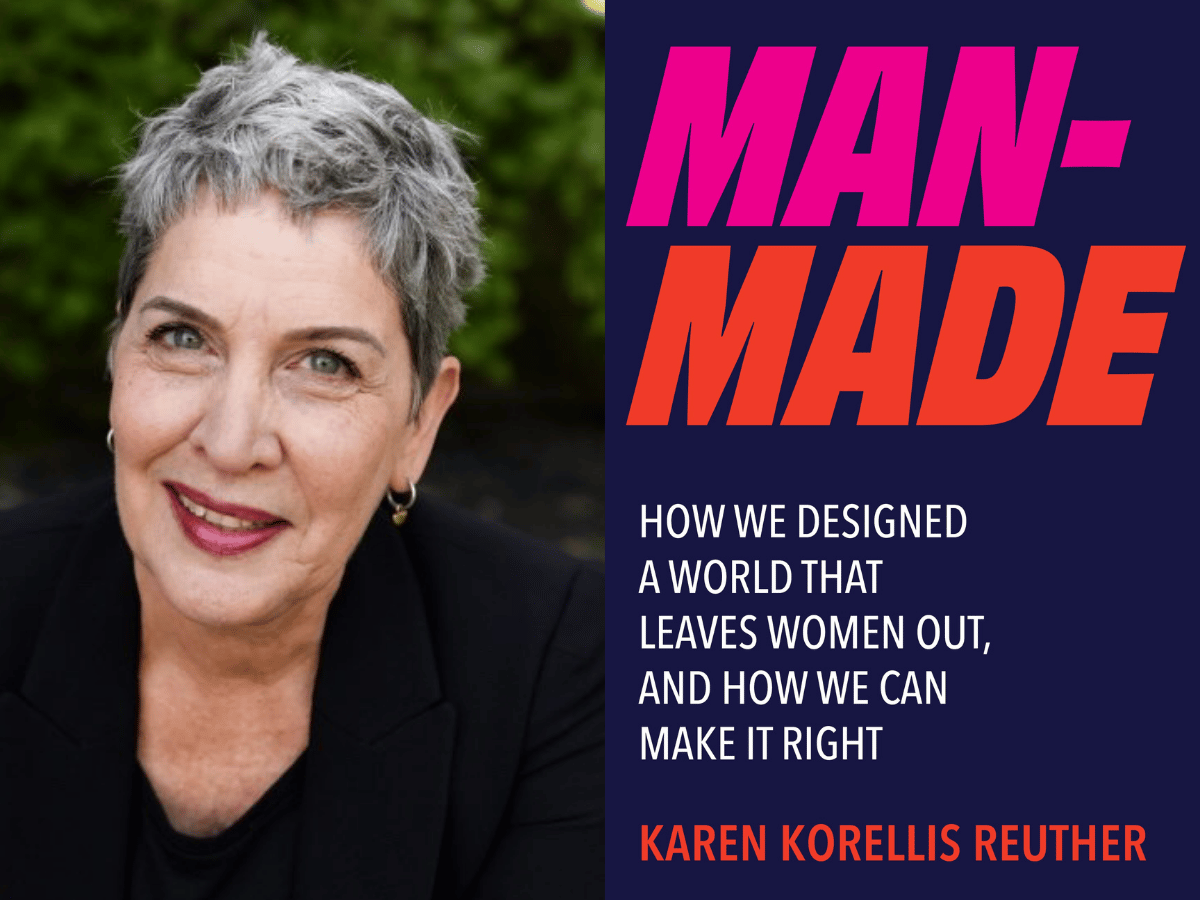
Karen Korellis Reuther.
Photo by Raya Al-Hashmi
Nation & World
World is designed by, for men. It shouldn’t be.
Karen Korellis Reuther explains why it’s a problem (dangerous, even) in products, how more inclusive design serves everyone
Did you know that most sneakers were designed around the male foot and those of women are different?
Karen Korellis Reuther does.
Reuther has worked in the design industry for more than 40 years. A former executive at the major apparel companies Reebok and Nike, she experienced firsthand the way the world has been designed and built largely by — and for — men.
Her new book, “MAN-MADE: How We Designed a World That Leaves Women Out, and How We Can Make It Right,” explores the ways that the old “shrink it and pink it” marketing strategy not only misses the mark but also fails — and even harms — women.
In an interview with the Gazette, which has been edited for clarity and length, Reuther discussed her book and how we can go about using design to improve the lives of all. Reuther is on the faculty of Harvard’s Graduate School of Design, where she teaches in the Master’s in Design Engineering program.
When did it strike you that the world is designed for men?
My eyes were really opened when I learned that only 18 percent of practicing product designers are women, only 25 percent of licensed architects are women, and probably closer to 12 percent of mechanical engineers are women.
I realized that these are the professions that actually design the built world, the objects that we put on our bodies, that our bodies use and interact with, or that surround us in our physical environments. There haven’t been enough female designers at the table. We are living in a world designed by men, for men.
One marketing strategy used by designers is to “shrink it or pink it.” Could you explain the concept?
I came across the phrase very early in my career and didn’t appreciate it. The idea is to take a men’s product and “shrink it,” make it smaller, then “pink it,” put it in a stereotypical female color.
There are a few things wrong with this.
I think the problem that many are now familiar with is the so-called pink tax. Women pay more for products designed for them when in reality they’re getting less. Think about razors or body wash: It’s a similar product, but it’s packaged in a way that offers less but charges more.
Another problem with “shrink it and pink it” is that our bodies are different. Our anatomy, biology, and biomechanics are different.
“Another problem with “shrink it and pink it” is that our bodies are different. Our anatomy, biology, and biomechanics are different.”
For example, most sneakers were designed for the anatomy of a male foot, which (in simple terms) is shaped like a rectangle. Female feet are more triangular, with a wider forefoot and narrower heel. When you scale down a male sneaker for a female foot, it doesn’t fit properly and can lead to injuries.
“Shrink it and pink it” is not just insulting, it can be deadly.
Crash test dummies are another example. They’ve taken a male dummy, made it the height of an average woman, and used that for crash testing. But it’s not just the height that’s different. Men have different neck musculature, breast bones, and hips. Not testing a woman’s different biomechanics is dangerous and deadly. Women are 73 percent more likely to be injured in a car crash than men.
Why does the belief that women are just smaller versions of men continue to show up in the way we design products?
Professor Cass Sunstein at Harvard Law School wrote a book called “Nudge,” and in this book he talks a lot about facts and norms. I think the idea that women are smaller versions of men has become a norm. Our definition of “average” is based on male measurements and standards from the 1970s. The data for so long has been based around these standards that the information we have today is still based on them. We have to end this idea of average, which never really included women in the first place.
How did we get here?
It’s a complex question. For a long time, even when female designers and architects were at the table, they often didn’t get credit for the work they did. In the book I give a few examples, like how female designers played a major role in the automotive industry.
But then after World War II, women went back to being homemakers. It reduced the number of professional women in these fields, and they were never recognized. We need to give credit where credit is due, and while we’ve made some progress in that area, the lack of acknowledgement set us back.
There’s this philosophy in engineering called a “leak before a break,” where you look at a system and notice where it starts leaking before it actually breaks. The reason we end up with so few women in leadership in these fields is that they are slowly trickling out at different points in their careers. How do we stop those leaks so more women get through?
How do we change the way we design?
I talk about universal design, but I think we can do better than universal design and embrace something I like to call intentional design.
“With our current technology and ability to measure bodies and create bespoke objects and places, I think we can design better.”
With our current technology and ability to measure bodies and create bespoke objects and places, I think we can design better. We can notice these things and insist on better. Document when something is wrong, when it’s not right for your body.
If you’re a designer, if you’re an architect, if you’re an engineer, you can invent. You can make things better. You can ensure that the design brief is inclusive.
And as leaders, you can invest in technologies that offer more intentional design. You don’t have to scale down men’s products to fit women.
What message would you give for young female designers who are early in their careers?
There are so many examples where young women are still going to be the first (or the only) in a room. It’s easy to get discouraged when your voice isn’t heard or when the status quo takes over the conversation. That’s the biggest enemy in the man-made world: the status quo. “We’ve always done it this way.” Everything that’s different goes against that.
So I would say to young women: Don’t get discouraged. Hang in there. Don’t disengage. Don’t get distracted, and continue to ask the right questions. Find advocates and find other women to be at the table. If we want to design for gender diversity, we need women in the design process.
For leaders, understand that those voices of diversity aren’t just going to help the products you’re designing for women. They’re going to help the products you’re designing for everybody.