Featured series

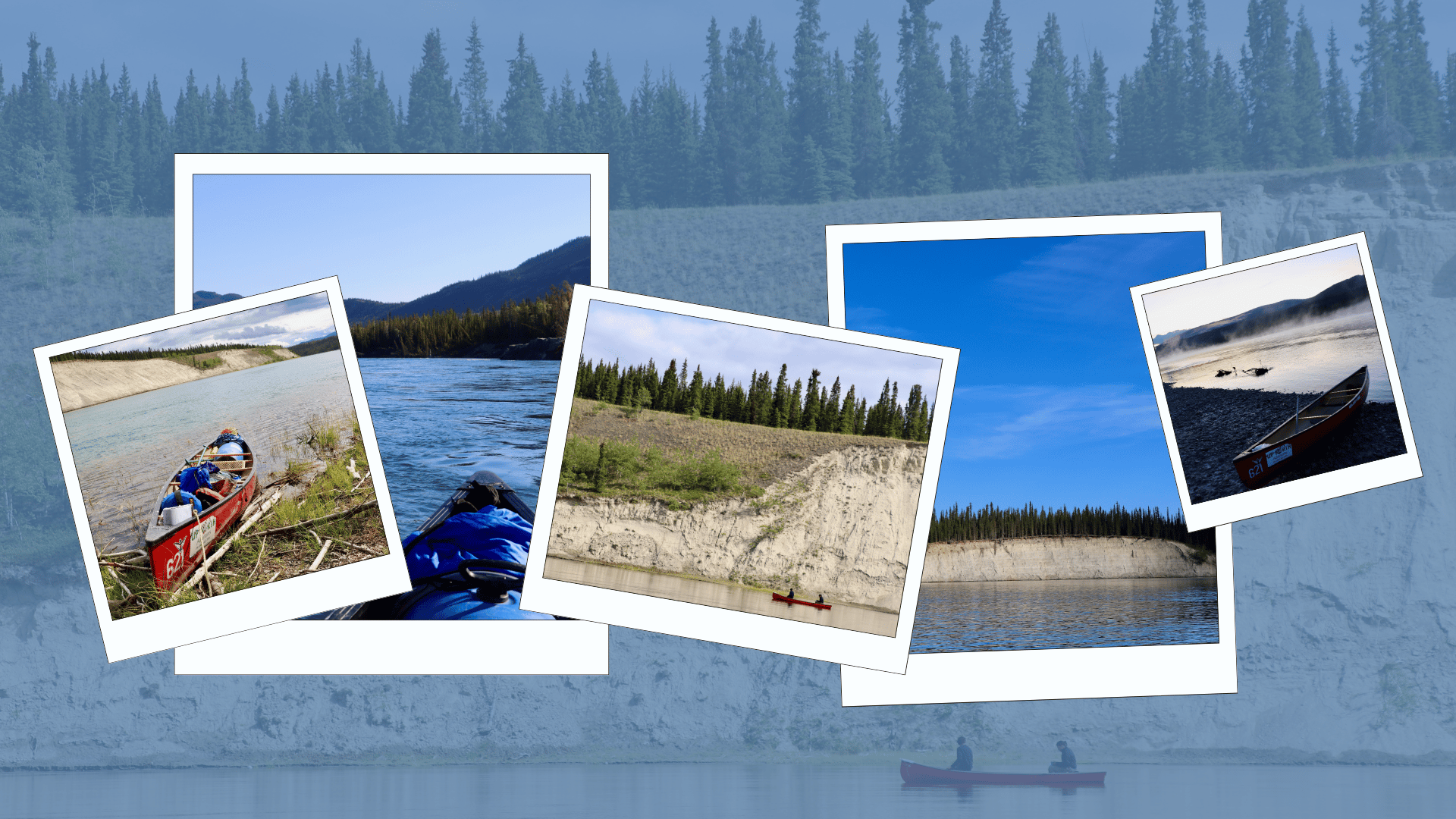
Images from Paul Firth’s canoeing trip on Yukon River.
Photos by Paul Firth
Campus & Community
The bear? Nonchalant. Me? More ‘chalant.’
Wooly visitor shakes up already challenging 460-mile summertime solo canoe trip through Yukon wilderness
When you’re in the wilderness and alone at your campsite, it turns out that there’s no such thing as a small bear.
That was one memorable lesson Paul Firth learned last summer, when he transformed an unexpected gift of time — two weeks’ vacation and plans that had fallen through — into a paddling trip on Canada’s Yukon River.
For Firth, a Harvard Medical School associate professor of anesthesia at Massachusetts General Hospital and lover of the outdoors, the choice of wilderness, solitude, and a bit of adventure was easy when faced with a suddenly blank calendar.
An experienced outdoorsman who has led an expedition to Mount Everest, Firth thought of a book he had read years earlier: “Reading the River: A Voyage Down the Yukon” by John Hildebrand. Published in 1988, the book details the author’s own trip down the 2,000-mile length of the waterway, which runs through northwest Canada and Alaska.
Firth trimmed the trip to fit the time he had and, with just three weeks to spare, began planning a 460-mile paddle from Whitehorse to Dawson City in Canada’s wild Yukon Territory.
“I wondered what to do, because that’s a substantial period of time, enough so you can go somewhere exciting,” Firth said. “I’d read this book and that sounded like quite an amazing trip in a wild part of the world, so I said, ‘Let’s just do it.’”
“I’d read this book and that sounded like quite an amazing trip in a wild part of the world, so I said, ‘Let’s just do it.’”
Paul Firth
There was, however, this one wrinkle: He’d never canoed before. But he didn’t let that deter him. The stretch of the river that he was considering, while remote, was relatively flat and considered passable for novices. One spot — Five Finger Rapids — about halfway to Dawson City was particularly challenging. There, the river branches into five different streams, tumbling down rapids before rejoining and resuming the river’s course.
While rapids in some of the watery fingers are dangerous, the easternmost finger had been dynamited in the 1920s so small riverboats could pass. If he stuck to that branch, he’d be fine.
Firth also figured that after the eight days of paddling it would take him to get there, he wouldn’t really be a novice anymore. After all, during the Klondike Gold Rush from 1896 to 1899, 100,000 people from all walks of life became prospectors and rafted down the region’s rivers in search of gold.
“I decided I’d learn on the river,” Firth said. “I guess a lot of the guys who rafted down the Klondike had never been rafting before, so I figured if they could do it, I could probably do it too.”
Before worrying about the rapid, he had to get there. Firth contacted a wilderness outfitter in his starting point, Whitehorse, whose 30,000 people made it the largest city in northern Canada. He owned camping gear but needed a canoe and some local knowledge. He arranged a canoe rental, a river map, and a ride back from Dawson City.
In late August, Firth packed up his sleeping bag, tent, and other gear, and hopped a plane to Whitehorse. After landing, he hit the grocery store, picked up the canoe, and headed onto the river.
The first day was easy going, and Firth got slowly acclimated to paddling a fully loaded canoe.
On the second day, the riverfront houses thinned out, and the Yukon passed into 30-mile Lake Laberge, which immediately proved its reputation for foul weather. High winds drove waves that tested his newfound skills.
As the waves grew into whitecaps, Firth grew alarmed and headed to shore. He was wearing a life jacket, but he knew that a wrong move would flip the canoe and end the trip, sending his gear and supplies to the bottom.
“Three feet with white caps is quite a lot when you’re in a heavily laden canoe by yourself,” Firth said. “I was quite worried. It only took me 15 minutes to get to shore, otherwise, between the wind and the waves and the swell, I would have been in a lot of trouble.”
As he neared shore, he maneuvered toward a break in the cliff face that dropped down to the lake. He hauled his canoe up over the rocks to a flat spot to watch the storm and, when it didn’t let up, pitched camp and lit a fire.
The next morning, conditions had improved enough for him to set out again, though the persistent north wind kept progress slow.
The wind lightened as the day wore on, and he was able to make better time.
But by nightfall, he realized he had only made 30 miles in his first three days. With a few days needed for travel from Boston to Yukon and back, he had burned nearly a third of his planned 11-day adventure. He’d have to pick up the pace to make Dawson City on time.
Firth’s lost time meant he didn’t have the luxury of just drifting with the current, and he fell into a pattern of days spent paddling down the river, at the end of which he’d pull onto one of the sandy beaches that dotted the river’s length, build a driftwood fire, and cook dinner.
After a few days, the luxury fare and fresh foods he’d packed — salmon and steak — gave out, and he was limited to canned food, oatmeal, and other typical camping cuisine.
Though there was one road crossing, Firth knew the Yukon largely flowed away from roads and civilization. If anything went seriously wrong far from the bridge, he’d have miles of wilderness to cross to reach help.
In addition, after a few days, his smartwatch and phone batteries died. Even if they hadn’t, he was so far from internet or Wi-Fi it didn’t really matter. He was disconnected.
“I was just navigating by the paper map and using the sun for the time of day. It was quite nice,” Firth said. “No internet, not even a watch.”
Beyond a few sentences or a wave at a passing canoeist, he had little contact with other people. He had brought a couple of books, including Hildebrand’s “Reading the River,” but after paddling all day, most nights he didn’t have to read himself to sleep.
“I had to paddle pretty aggressively or pretty consistently much of the way,” Firth said. “I slept pretty well at night. I put my head down and boom, I was out.”
Firth said his thoughts were full for a few days — he had packed, along with his gear, all the stresses from home. But he noticed a gradual quieting.
“After a couple of days, you have resolved all the things you were worried about, and you don’t think about them anymore. You start to think about the things around you and day-to-day life,” Firth said. “You’re living moment to moment, and it becomes a lot easier, a lot simpler, quite calming in a way.”
“After a couple of days, you have resolved all the things you were worried about, and you don’t think about them anymore. You start to think about the things around you and day-to-day life.”
Paul Firth
Firth fell into a daily rhythm: Wake up, make breakfast, load the canoe, and get going. After logging just 30 miles in the first three days, he had more than 400 to cover in the last eight. Even paddling with the current, 50 miles meant a long day on the water. Still, he said his biggest challenges were psychological.
“I was looking for a wilderness experience and self-sufficiency, but the biggest challenge was actually solitude, being by yourself and not seeing anybody, not speaking to anybody for two weeks, other than the occasional few sentences if you met someone on the river,” Firth said. “I’d never been by myself for that long.”
Only once did it really get to him. At about the midway point, on the day he paddled the rapids, it was rainy, windy, and cold. He handled the whitewater but still had to put miles under his keel.
It was getting dark and the guidebook said there was a large campsite ahead, at the site of an old fort from the gold rush days. As he approached, he thought he saw campfire smoke drifting across the river and found himself looking forward to meeting people.
When he arrived, he realized the smoke was an illusion, the fort was a ruin, and the campsite was empty.
“It was dark. I was tired and very cold because of the wind. I’d been expecting people to be there and instead I was alone under the trees, in the dark, at a ruined campsite,” Firth said. “I was on the wildest part of the trip, the farthest away from civilization.”
Firth felt deflated and acutely alone. He pulled himself out of it by getting busy. He changed into warm, dry clothes and got a fire going. Then put up his tent and had a good meal.
“That was halfway, and I had the much wilder and more remote section ahead of me,” Firth said. “I was behind schedule and had to push down the river. But I knew I was committed. I couldn’t go back up the rapids. There was no way except down the river, all the way to Dawson City.”
In the ensuing days, Firth regained his feeling of being in tune with his surroundings. The river was beautiful, with cliffs and forests, mountains and large earthen banks lining the route. Above were skies that, aside from a couple of days of rain, were clear and blue.
“You have this beautiful sky above you all the time, so you’re just canoeing down the river, looking at the sky and the weather, the scenery and the change of the day,” Firth said. “I got very much in tune with the slowness of time. Rolling down the river, you adjust to a different pace of life.”
That pace, of course, does not include a visit from a bear — like the one that strolled through his camp one evening, acting as if it owned the place.
“He was very nonchalant. I was definitely more ‘chalant,’” Firth said. “I turned around and there was this bear, which I hadn’t seen, walking past my camp. There’s no such thing as a small bear when you’re standing alone on a beach, and there’s nothing between you and the bear. He was very big.”
Firth was instantly on alert, but the bear seemed undisturbed.
“He just strolled past, ignored me, and went on his way,” Firth said.
By the time Firth arrived — on time — in Dawson City, the rhythm of life on the river had begun to feel natural enough that he says he could have carried on down the river, as Hildebrand did, 1,500 miles as it bent west and crossed Alaska, to the Yukon’s mouth on the Bering Sea.
Firth also admitted, however, that he didn’t mind his first restaurant meal in Dawson City. And it was nice to see people again. Plus, his work as an anesthesiologist was waiting for his return to Boston.
“It was quite an experience,” Firth said. “I had never been by myself for that long, I think that was the wildest thing. But once you got into the swing of it, once you stopped being stressed, worrying about whether you could cope, worrying about things in the past, the stress of the outside world, and you were just living day to day in beautiful surroundings, it was quite relaxing and, in some ways, very meditative.”