Featured series


Photo by Lisa Vollmer Photography
Nation & World
How liberal Law School professors fueled rise of Federalist Society
New book traces broad campaign to combat what organizers viewed as takeover of nation’s legal system by forces of ‘radical’ liberalism
The Supreme Court’s landmark 2022 decision in Dobbs v. Jackson Women’s Health Organization dealt a seismic blow to supporters of reproductive rights by overturning Roe v. Wade (1973), rejecting the argument that the Constitution confers a federal right to abortion.
Dobbs was also momentous for conservatives like Justice Samuel Alito, the opinion’s author, who saw the reversal of Roe as the culmination of a 50-year project to remake the nation’s judiciary and jurisprudence, according to Peter S. Canellos in his new book, “Revenge For the Sixties: Sam Alito and the Triumph of the Conservative Legal Movement.”
In this edited conversation, Canellos, a former Boston Globe and Politico editor, chronicles how a left-wing intellectual battle at Harvard Law School during the 1970s drove conservatives to build a powerful network of organizations, like the Federalist Society and the Heritage Foundation, in an attempt to halt what they viewed as domination of the courts and law by the forces of “radical” liberalism.
Set the scene: What was happening at the Law School that so outraged conservatives?
The ’60s and ’70s were an era of radicalism in legal academia. The battle lines were not liberal versus conservative; they were radical versus mainstream. In those days, the mainstream was what we would consider today to be New Deal-style liberalism or the positions of the Supreme Court under Chief Justice Earl Warren.
Mainstream professors who dominated Harvard Law School and Yale Law School and other elite law schools generally were proud of the record of the Warren Court. They felt that if people stuck with the system, the Supreme Court had proven that the Constitution was adaptable to serious social change. The principles would remain the same, but the decisions of the Court could yield greater protections to people who had been traditionally excluded from American society.
The radicals felt that wasn’t enough. They felt that the whole system was burdened by precedents that were developed in an era when women were entirely excluded from the judiciary, when people of color were also excluded, when very outmoded and discredited modes of thinking were in style, and that the legal system needed much more radical change. That was the line of tension — the center left versus the far left — that took hold at Yale and at Harvard.
Critical Legal Studies was born out of that tension. It was an academic movement, but it also prided itself on being a practical movement.
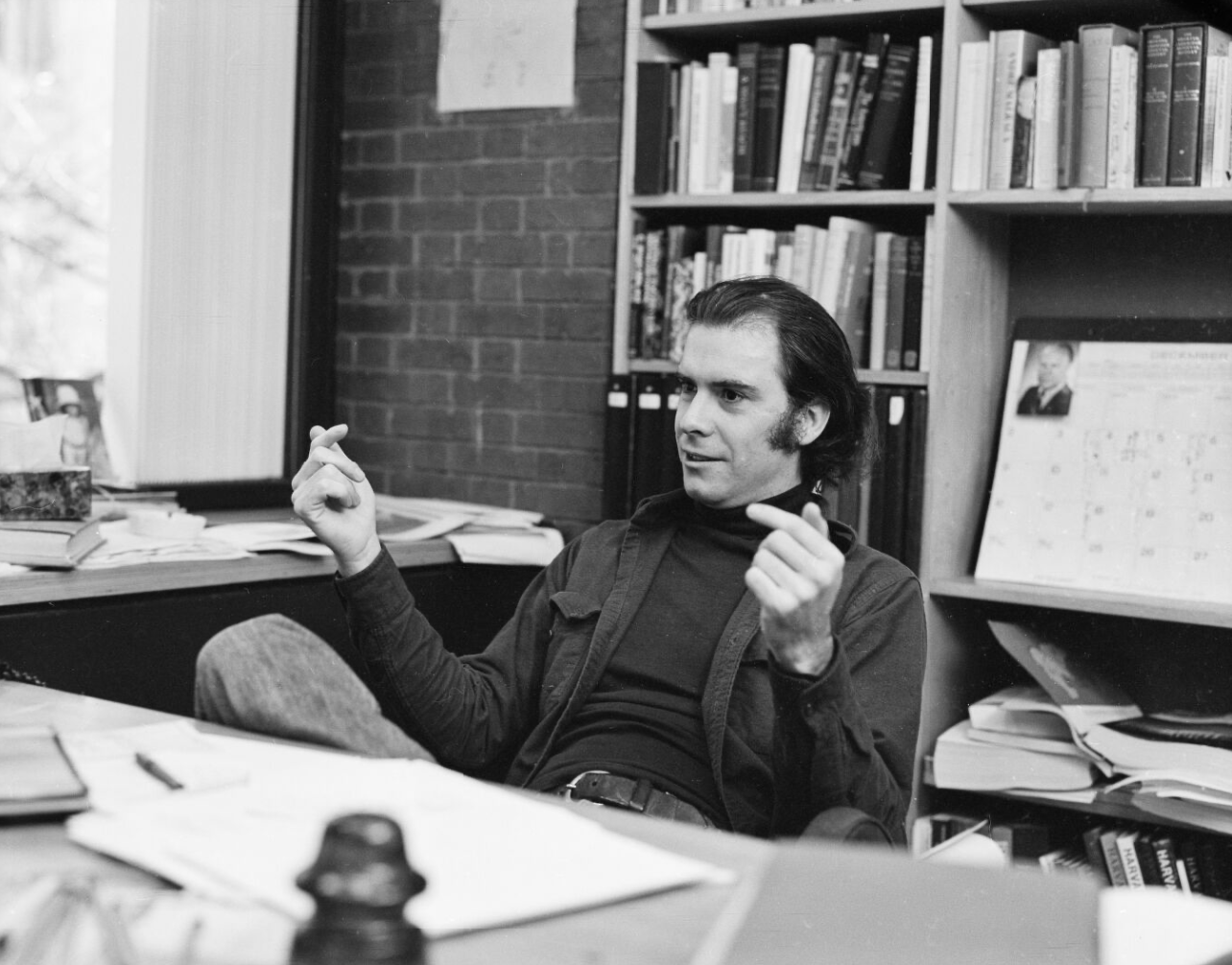
Duncan Kennedy in 1980.
Harvard file photo
Harvard Law Professor Duncan Kennedy and other early leaders saw themselves as proposing practical solutions to address inequality in the law, changing the structure of legal education to include the viewpoints of people who were not elite scholars, who were not well-to-do, who were working class and traditionally excluded from society.
They thought all law schools are doing is preaching the value of precedent and the idea that if you follow the path of the law, case by case, you’re going to achieve a just result. But in fact, so many of society’s prejudices are embedded in the law that you really need to break the mold and create a new system of justice.
In opposition to all of this, a broad coalition came together to establish the Federalist Society in 1982. What were they worried about?
The formation of the conservative legal movement was a reaction to the perceived excesses of the Warren Court combined with fear of where an even more radical left — emblemized by Critical Legal Studies — would take the law.
The biggest fear at that time was to use the courts to expand “the welfare state.” There was a feeling that the liberty protections within the Constitution, and potentially several other avenues in the law, such as property law, could be construed in a way that created a right to welfare.
There was a movement on the left that took the view that to exercise your other constitutional rights, you had to have a minimal level of subsistence, and leftist law professors believed that a court could order the government to provide subsistence to all citizens.
The court had been ordering states to provide lawyers to indigent defendants, so it didn’t seem to conservatives like it was some enormous leap for the Supreme Court to say everybody has a right to a subsistence level of income. This was a special fear for conservatives, because it seemed to them to be the epitome of judicial overreach, of judges taking on the role of legislators.
In the book, you note that from early on the Federalist Society embraced a “results, not ideas” ethos. Morton Blackwell, a top organizer for the Young Republicans, advised the society to prioritize how to make sure the right people get to be judges and how to get the right people in to study the law and promoted using college campuses as a conservative recruiting tool. Was this a political project with an academic veneer or did politics overtake what started as an intellectual undertaking?
I think it was both. People who criticized Roe v. Wade were responding to serious academic critiques from people like John Hart Ely, who taught at Harvard, Yale, and Stanford and was not a movement conservative or political conservative in any way, but who felt that the Supreme Court had seized on open-ended provisions of the Constitution and imposed its own sense of right and wrong. As an academic critique of the Warren Court, that took hold.
There was an element of intellectual integrity to the early conservative legal movement. It was a matter of deep conviction for the early conservatives to feel that they were accepting the idea that there were standards and boundaries, that legal decisions had to be made within a strict constitutional framework, whereas they felt that the liberals on the Warren Court were making it up as they were going along,
You also write about the so-called Powell memo that some have characterized as a blueprint for today’s conservative movement. Lewis Powell Jr., LL.M. ’32, issued it right before joining the Supreme Court in 1972. In it, he identifies the judiciary as potentially “the most important instrument for social, economic, and political change” and urged conservatives to create a network of think tanks, lobbying groups, and media outlets to combat what he saw as the left’s attack on free enterprise. By 1974, the Business Roundtable, the Heritage Foundation, and the Cato Institute were founded. How significant was Powell’s memo?
I think it goes a little too far to see that as a blueprint. What Lewis Powell was saying (he’s addressing the U.S. Chamber of Commerce) was that they were losing the judiciary and American freedom — in that case, business freedoms. That businesses were going to be burdened by more regulation, more court-authorized interference than they would ever believe is appropriate and that they needed to mobilize against that.
As we all know, Lewis Powell goes on the Supreme Court, and then immediately votes for Roe v. Wade.
I think the fact that you can look at Lewis Powell as a foundational figure for the conservative legal movement, alongside others like religious right leaders, shows that they did believe in the big tent.
It was truly a larger constellation of people with many different agendas, but Morton Blackwell’s role, for example, was to emphasize that they needed to have a pragmatic, practical political goal in mind, and not allow ideological perfection to be their standard.
So, in that way, they were quite different from Critical Legal Studies. Critical Legal Studies was very afraid that if they allowed moderate liberals to come in, then their movement could be rendered meaningless.
Whereas in the Federalist Society, they welcomed all comers — you’re angry about government regulation? Come on in. Angry about Roe v. Wade? Come on in. Some of the civil rights remedies like affirmative action? Come on in. It gained stature and power for being bigger and broader than the liberal movements it was countering.
Why was the Roe decision, above all others, so animating for the movement’s intellectual leaders like Antonin Scalia, LL.B. ’60, and Robert Bork?
I think it was animating for them because it was a deeply divided issue that many felt was a moral question, and that the court, presuming to come in and solve the matter on its own, seemed presumptuous to them and to go beyond the traditional judicial role.
And it was intellectually galvanizing because of feelings that Justice Blackmun’s opinion was not an airtight piece of legal craftsmanship.
I point out in the book that Ruth Bader Ginsburg, among others, wanted Roe v. Wade to be decided on pure gender equality grounds … and that if you make it an equal protection issue, it would be on very solid legal ground.
The problem was, for the men on the court at that time, seeing it purely in gender terms raised slippery slope questions that society was not comfortable with at that time, like: Could you order unisex bathrooms? Could women be ordered into combat? Would all distinctions between men and women be erased?
That was what the Roe court wanted to avoid by finding it as a matter of privacy, similar to the right to conception.