Featured series

Nation & World
‘This is not about Harvard. It is about higher education.’
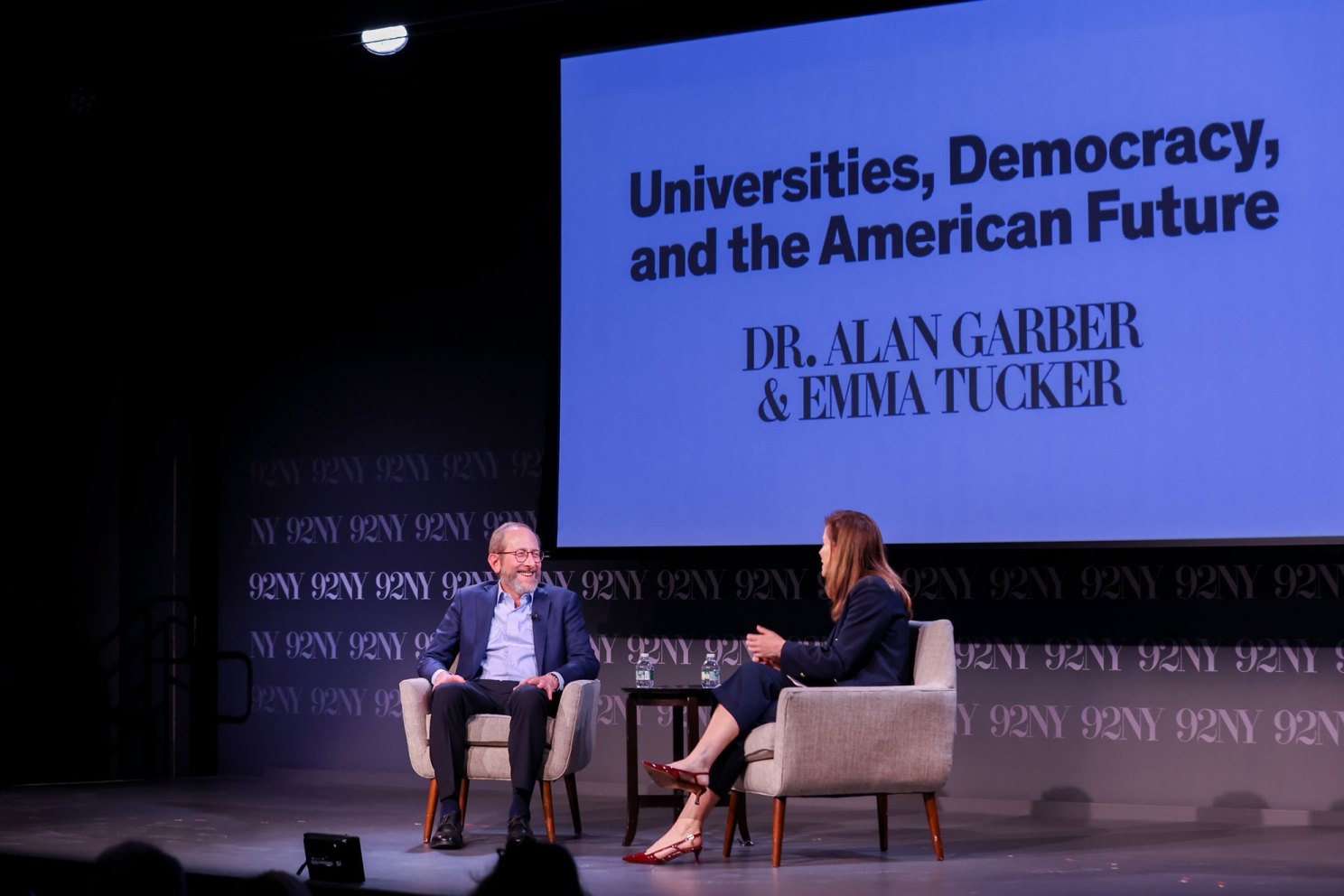
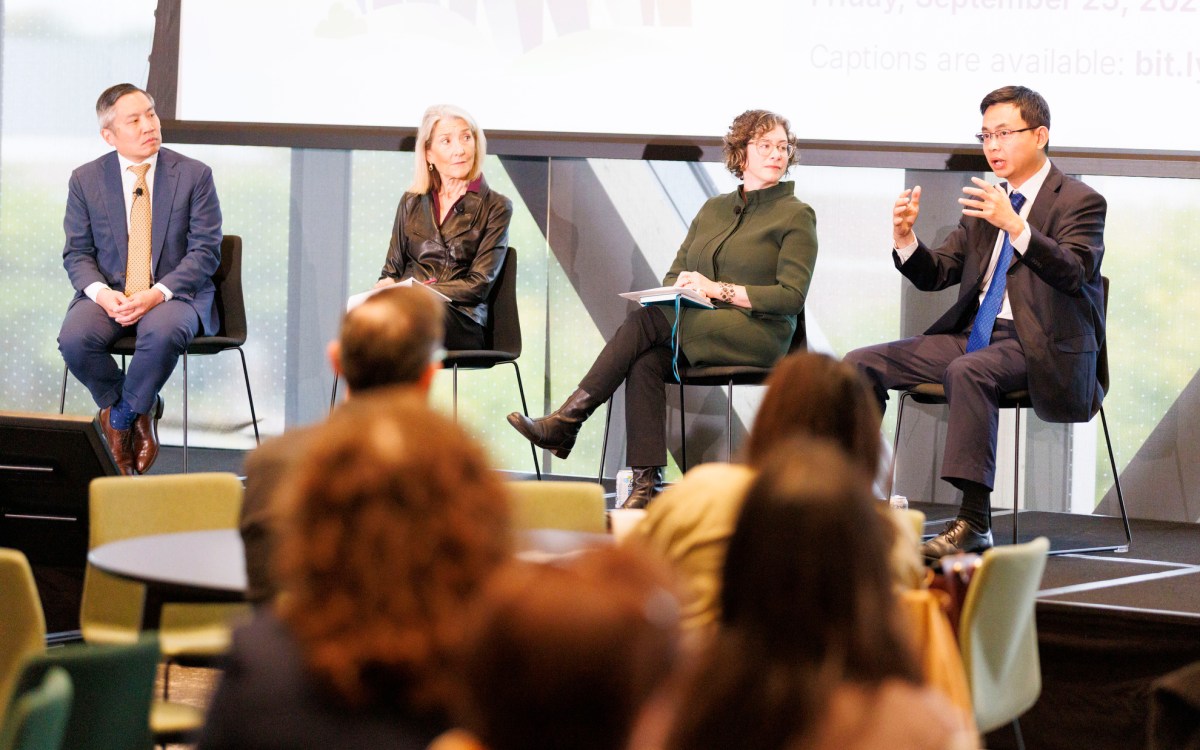
Harvard President Alan Garber and Wall Street Journal Editor-in-Chief Emma Tucker.
Photos by Josh Lobel/Michael Priest Photography
Garber discusses threat to university-government partnership, AI, fighting bias on campus in talk at 92NY
Is the 21st-century United States sliding toward its own version of post-war European brain drain?
Harvard President Alan Garber said that there are uncomfortable parallels between America today and the era of European history marked by the flight of scientists abroad, particularly to the U.S., a period that damaged the continent as a global scientific power.
Garber’s warning came Monday during a discussion with Wall Street Journal Editor-in-Chief Emma Tucker. The event, “Universities, Democracy, and the American Future,” was held at 92NY in New York and focused on what the turmoil for U.S. universities in recent months means for the nation’s future.
Before the war, Garber said, German was the “lingua franca” of science. Post-war migration to the U.S. was at least part of the reason the nation’s research and discovery leapt ahead in the ensuing decades, he said.
A second reason, he said, was the unique financial partnership that arose between universities and the U.S. government.
In that partnership, the government offered significant financial support for research. Its success put the U.S. at the forefront of global scientific advances for decades, which in turn drew the best and brightest young minds from around the world here in a virtuous cycle.
The government’s recent assault on research universities, however, threatens to unravel that partnership and reverse the flow of talent. Cuts in funding and crackdowns on immigration over the last 15 months have opened the door for other nations to woo young scholars away from U.S. institutions, Garber told an audience of about 200.
“Since World War II, the nation’s universities have been both symbols and drivers of American leadership at home and abroad, engines of discovery, economic growth, and democratic vitality,” said Ken Wallach, a member of the board of directors of 92NY, formerly known as the 92nd Street Y, who introduced the event.
Federal funding is “not a gift. It is a payment for work being conducted at the request of the federal government.”
Alan Garber
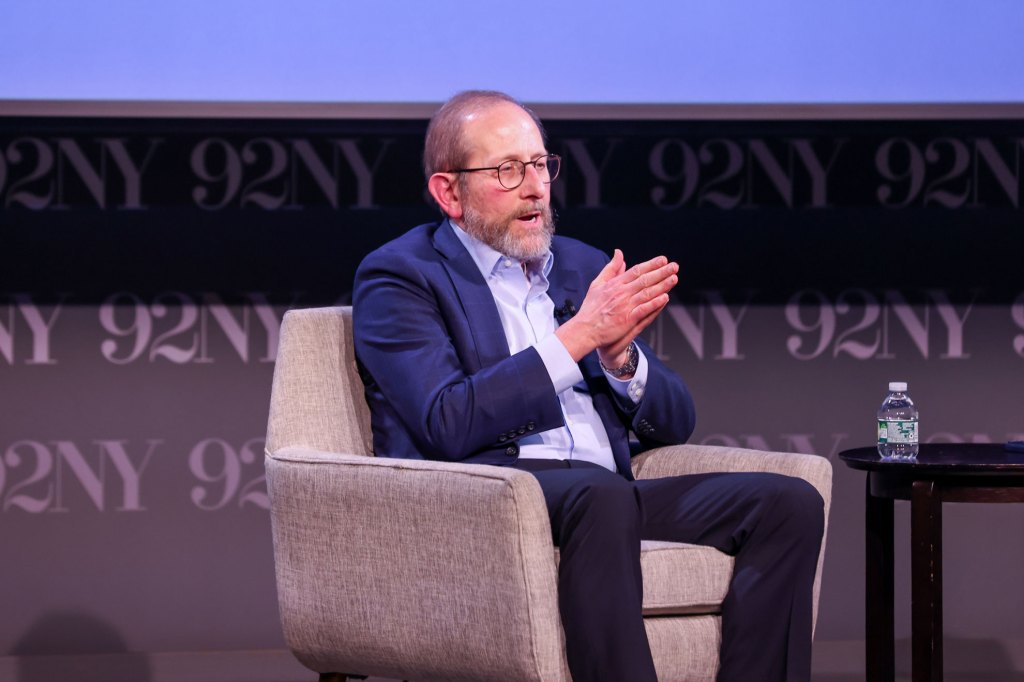
“Today, these institutions and that leadership are under real strain, facing political polarization, public skepticism, financial pressures, and technological transformation. It is indeed a moment of profound change and consequence,” he said.
Garber pointed out that other countries have taken note.
“Other nations have looked at this, and they’re seeing opportunity, just as the U.S. did in the leadup to World War II,” he said. “And there are funds in Canada and in Europe to recruit American scientists, and China is doing everything it can to ensure that its most promising scholars who are in the United States go back to China.”
With the conflict over research funding ongoing, Tucker asked whether Harvard should just go it alone and refuse to take federal money.
Garber said that ending the university-government partnership would have wide-ranging implications not just for higher ed but for the nation.
Federal funding is “not a gift. We have to be very clear about that. It is a payment for work being conducted at the request of the federal government,” Garber said. “If we were to say we are not going to conduct research, we’ll give up federal funding, arguably we might be better off financially, but it would cut out a big part of our heart. This is what research universities do. But the damage is not just to the universities, the damage is to the country.”
Garber acknowledged that not all of the criticism from the administration was unfounded.
Antisemitism on campus went unacknowledged for too long, he said, which was confirmed by a task force he appointed.
That body, and a second examining anti-Muslim and anti-Palestinian bias, both reported back on ways to address the issue, through education, including changes to student orientation, better accommodation of religious practices, and rethinking instruction about the topics.
Though the task forces expected it to take years for the reforms to effect change, Garber said they’ve seen meaningful shifts on campus after just a year.
One area with few concrete answers concerns the impact of AI on both education and the world awaiting graduates. Universities will have to keep up with the pace of change, he said, and today’s students will have to adapt as AI transforms the way we work.
Despite all the challenges facing Harvard and other U.S. universities, Garber said he is excited about promising areas of research, such as quantum computing, statistics, and the life sciences, which appear to be on the cusp of major breakthroughs.
“I think our cause is just. I’m excited about what we can accomplish,” Garber said. “This is not about Harvard. It is about higher education, it is about the future of the country. I think we can be on a good path.”
He added: “I want to do my part, and I know the entire Harvard community wants to be part of making this a stronger country and a better world. That’s what keeps me going.”