Featured series

Niles Singer/Harvard Staff Photographer
Nation & World
Call for ‘historical truth’ in our narrative of Nazi defeat
Jochen Hellbeck wants the West to acknowledge the Soviet role in stopping Hitler
On this side of the Atlantic, World War II can appear in the popular imagination as a contest between liberal democracies and totalitarian empires.
That narrative, shaped largely by Cold War enmity between Washington and Moscow, tends to overlook the unimaginable sacrifices of the Soviet Union and its people, roughly one in seven of whom died in the conflict.
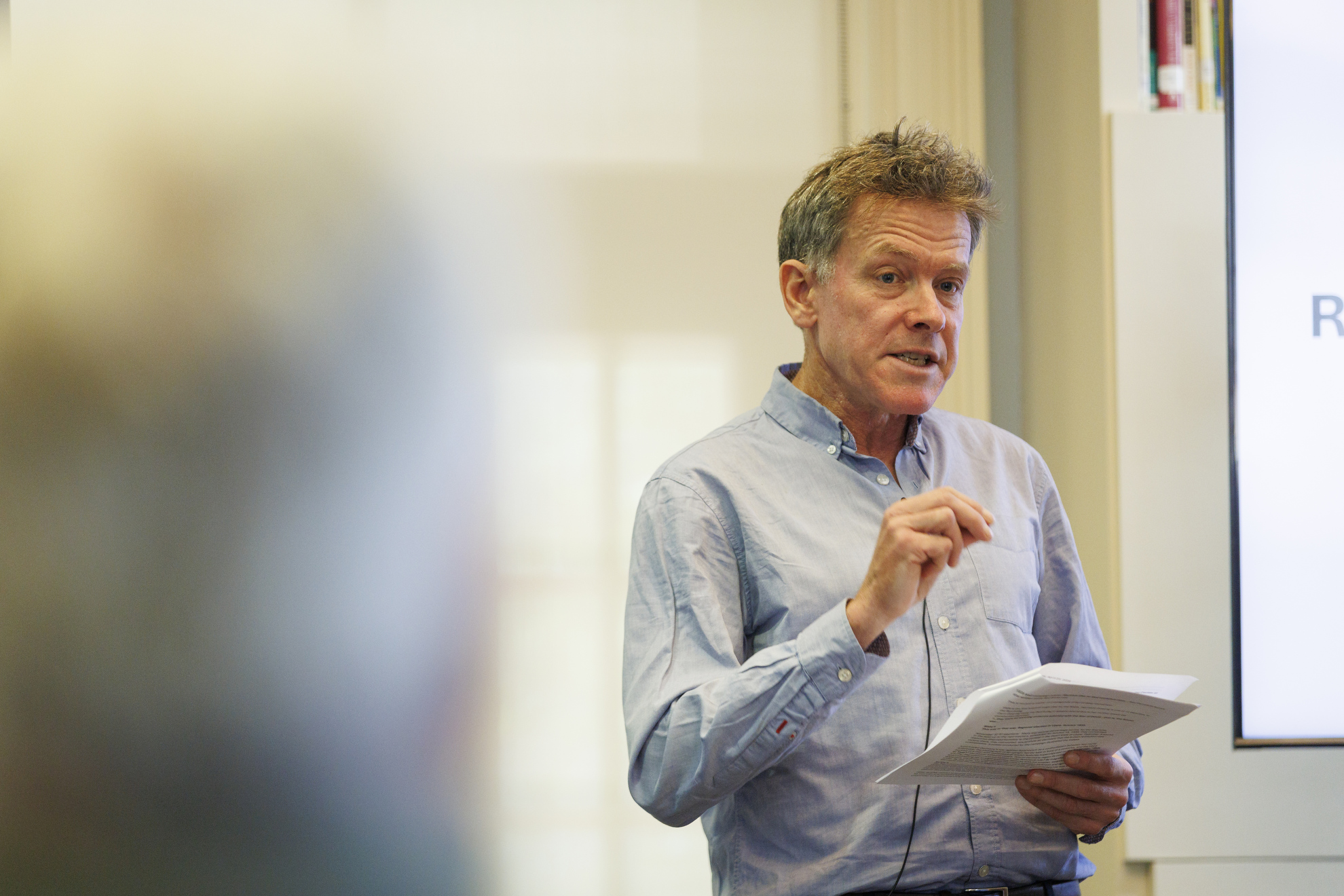
So, though it covered familiar names and dates, Jochen Hellbeck’s lecture on campus last Thursday carried an unusual charge.
Hellbeck, a German-born historian who now teaches at Rutgers University, has spent his career using archives to relocate the center of the European war to points well east of Normandy — specifically, to the collision between Nazi Germany and the Soviet Union.
By the numbers, that shouldn’t be controversial. As they invaded the U.S.S.R. in the summer of 1941, Germany and its European Axis allies opened the bloodiest theater of war in human history.
All told, the Soviets counted roughly 26 million dead — more than half of them civilians lost to starvation, siege, and several years of clockwork atrocities. Three out of four of the Third Reich’s own 5.3 million military fatalities came in the East. And the defeat at Stalingrad in February 1943 marked a turning point in the German war strategy.
Hellbeck’s latest book, “World Enemy No. 1,” goes further, arguing for the central role of anti-Soviet sentiment in what he called the “Nazi designs for mass extermination.”
To be clear, Hellbeck doesn’t dispute the Nazis’ virulent anti-Semitism. But he notes that from Hitler’s earliest days as a political figure, that hostility was often intermingled with a violent hatred of the Soviets, captured most succinctly in the party’s stock phrase: “Judeo-Bolshevism.”
“World Enemy No. 1” has proven controversial, Hellbeck acknowledged — most of all in his native land.
When an early edition of the book appeared in German, the reception was icy. Hellbeck recalls being told that “the established history of the Holocaust, as Germans understand it, must not be overturned.”
He is of two minds about that reaction. As a historian, “There’s always excitement, to see that you touched a nerve,” he said. “But then not to have a chance to discuss it, in those rooms, is disappointing.”
In any case, his revision aims not to overturn a narrative, he said, but to widen the frame around that war’s infernal final years.
“Traditionally, we have understood the Holocaust as derived purely from anti-Semitic venom — and of course, that was a very central element,” Hellbeck told his audience at the Center for Middle Eastern Studies.
“I’m just adding a political dimension to that — that is, the Nazis’ anti-Communism — and arguing that the drive to exterminate came during the conflict with a Communist enemy who was coded as Jewish.”
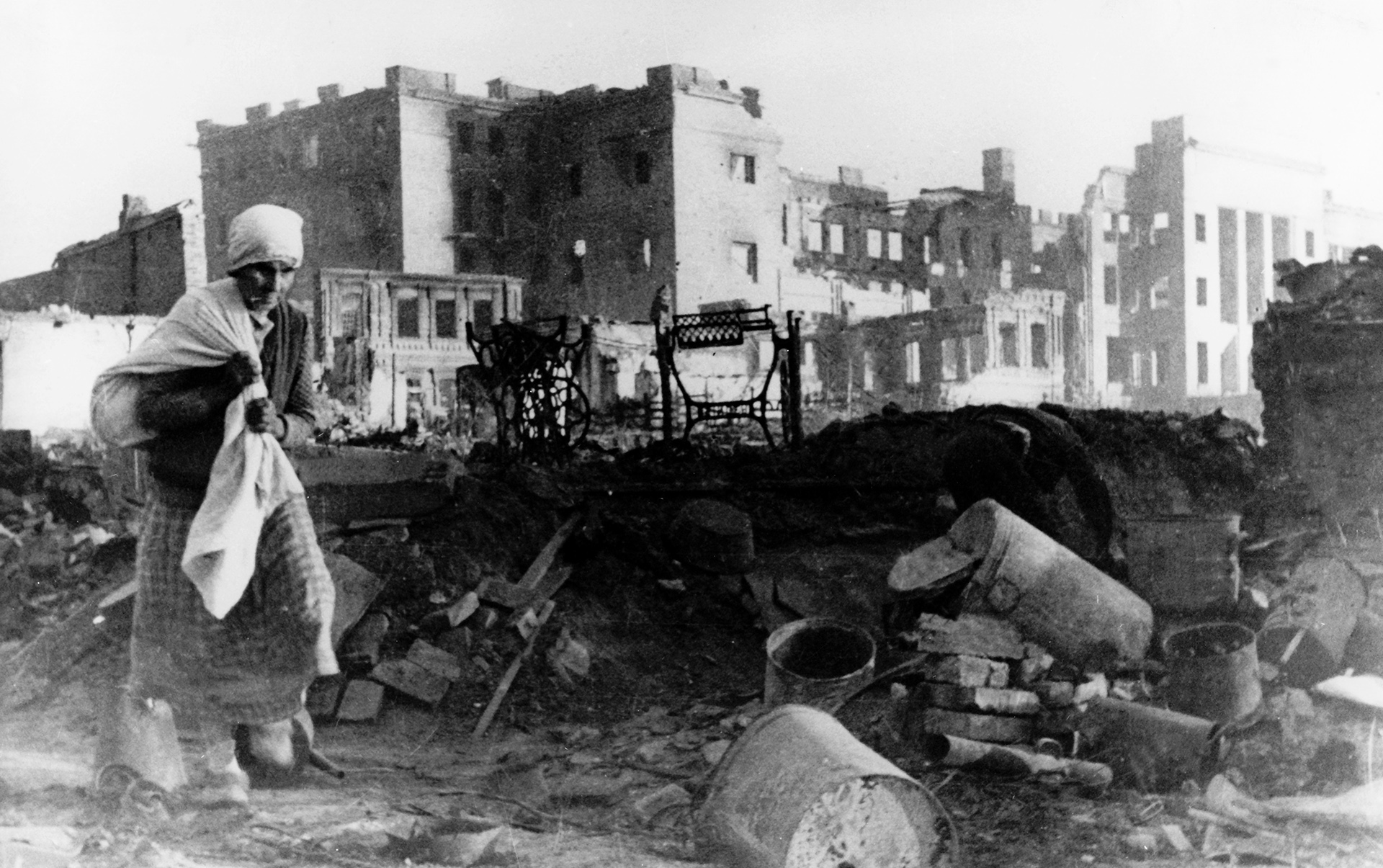
A Soviet woman searches the rubble of her home, destroyed in the 1942-1943 Battle of Stalingrad.
Photo via AP Images
Hellbeck came to Harvard to deliver the 11th annual lecture in memory of Hilda B. Silverman (Radcliffe ’60), a longtime peace activist and University affiliate, who died in 2008.
The lectures touch on issues that were near to Silverman’s heart, including the Holocaust and the ways it still shapes our politics and culture.
Sara Roy, CMES affiliate and chair of the lecture committee, said that Hellbeck clearly fits the mold. By giving voice to the human beings who lived under Stalin and helped defeat Hitler, he has “contributed greatly to a more capacious and humane understanding,” even of geopolitical adversaries.
Hellbeck spent much of his lecture resurfacing the Nazi regime’s enduring obsession with defeating Communism.
As early as 1921, Hitler, still a regional figure, alleged that “400 Soviet commissars of Jewish nationality” lived well while millions of citizens suffered in poverty.
Once the Nazis took power 12 years later, German citizens were treated to a battery of anti-Soviet propaganda and traveling shows, including the 1936 exhibition that gave Hellbeck’s book its title.
With lurid posters and slogans, “They taught Germans that Bolshevism was evil and bestial … that it was the work of Jews who are the most monstrous and menacing in their Soviet Communist incarnation,” Hellbeck told his audience. “And these shows drew millions of German spectators, including young boys who would later fight as soldiers at the Eastern Front.”
It was on that front that Nazi mass extermination began in earnest. Before death camps came the “Holocaust by bullets,” mass shootings committed by so-called Einsatzgruppen in the occupied territories of the U.S.S.R.
That campaign’s targets were described in one context as “politically and racially unacceptable elements.” It would leave millions of Jews, but also Communist party officials and Soviet intellectuals, dead in mass graves across Eastern Europe.
Images and stories — some factual, some exaggerated — of Soviet brutality were circulated in the Nazi press. And Hellbeck argues that acts of resistance by European Communists during Nazi occupation allowed the German regime to win consent for its mass killing: by redefining Jews not just as racial “others,” but as “Stalin’s auxiliaries” — enemies within.
While it might not be surprising that Nazi anti-Bolshevism was downplayed while Western countries were embarking on their own long anti-Soviet struggle, Hellbeck noted that his work is aimed at a historical “lacuna” that has endured to the present day.
“In 2019, the European Union passed a resolution … to essentially indict Nazi Germany and the Soviet Union as equivalent totalitarian powers,” he said.
He argued that that measure dishonors the memory of millions of Russians, Ukrainians, and Belarusians who, during Nazi occupation, came to see even the brutal Stalin regime as the lesser of two evils.
That made even this provocative book worth writing, Hellbeck said.
He closed his lecture with “a plea for an honest reckoning with the past.” His argument for may “run up against the desire of Western leaders to portray their countries as the leading victors … [or] appears to play into the hands of the Russian president, who invokes the Soviet contribution to victory over Nazism as a justification for his current war against Ukraine.”
“That the Soviet Union played such a central role in the Nazis’ deadly designs is an inconvenient truth in today’s world,” Hellbeck said. “But historical truth is not subject to negotiation, and historians must not yield to the political pressures of the present day. Only then can the writing of history become a basis of meaningful discussion and dialogue in tomorrow’s world.”