The Office for the Arts at Harvard (OfA) and the Council on the Arts at Harvard, a standing committee of the Faculty of Arts and Sciences, recently announced the winners of the annual undergraduate arts prizes presented in recognition of outstanding accomplishment in the arts for the 2007-08 academic year.
Instability is the reign of things erratic and unpredictable. Decomposition is the state of being as it unravels, nicely captured by a common sentiment: Things fall apart. The two words — and the frictive, unstable worlds they imply — were at the heart of a convocation of young scholars last week (April 25-26).
Chance smiled on Joe Rosenthal in late February 1945. The young Associated Press photographer was atop Mount Suribachi to cover the Allied troops’ capture of Iwo Jima when he heard that soldiers were preparing to raise an American flag. It was the second attempt of the day, for authorities had decided the first flag — placed a few hours earlier — was too small.
The Harvard University Art Museums — a leading center for research and teaching in the visual arts comprising three museums and four research centers — has changed its name to the Harvard Art Museum.
For the 16th year in a row, Arts First will color the Harvard campus next weekend (May 1-4) with more than 200 music, theater, dance, film, and visual arts events and performances.
The Office for the Arts (OfA) at Harvard and the Office of Career Services (OCS) recently announced the 2007-08 recipients of the Artist Development Fellowship.
To Hugo van der Velden, professor of history of art and architecture in the Faculty of Arts and Sciences, the Ghent Altarpiece is more than a landmark — it’s also an excellent teaching tool. The painting is the focus of Van der Velden’s History of Art and Architecture course, “Jan van Eyck and the Rise of Painting.”
If scholarship is the only reliable means of time travel, the Houghton Library offers up Harvard’s latest time machine: “Windows into Early Science,” an exhibit of scientific manuscripts, maps, and illustrated books on display through May 23.
Alex Krieger, who teaches the GSD Urban Design Proseminar as well as design studios such as last spring’s “Reconnecting City & River: Vienna, Austria & the Danube,” also leads a class in the College’s Core curriculum on the design of the American city.
On Thursday (April 17), Lilia Moritz Schwarcz joined Zephyr Frank, assistant professor of Latin American history at Stanford University, for a lunchtime conversation about race in Brazil in both the era of the slave trade and today. The event, titled “Slavery, Abolition and Race in Brazil,” was part of an ongoing series in the Brazil Studies Program of the David Rockefeller Center for Latin American Studies.
The aim was determining the truth and the technique was torture. Pain was administered in secret, under strict guidelines, often with a judge and doctor present. Once a suspect confessed, the confession would have to be repeated in court.
A Radcliffe Fellow this year, Kaufman Shelemay was co-organizer of “Cultural Creativity in the Ethiopian American Diaspora,” a conference held at Harvard this week (April 13-14).
The multigifted and much-admired musical composer Marvin Hamlisch taught a master class in the New College Theatre on “The Art of the Audition” recently (April 9) under the auspices of Learning From Performers.
Impulse, activism, and perhaps a bit of naiveté. That’s what led Jeff Silva, a teaching assistant in the Department of Visual and Environmental Studies, to make his way to war-torn Belgrade just days after the NATO bombing campaign ended in June of 1999.
Richard Delacy, preceptor in Sanskrit and Indian studies, flicks off the lights in his classroom and cues the video projector. A few students shift in their seats as the opening credits for “Khalnayak,” a renowned Bollywood film, roll across the screen.
Beginning today through Saturday (April 17-19), the Tsai Auditorium at the Center for Government and International Studies (CGIS) will host selections from the first international Iraq Short Film Festival (originally held in Baghdad in 2005).
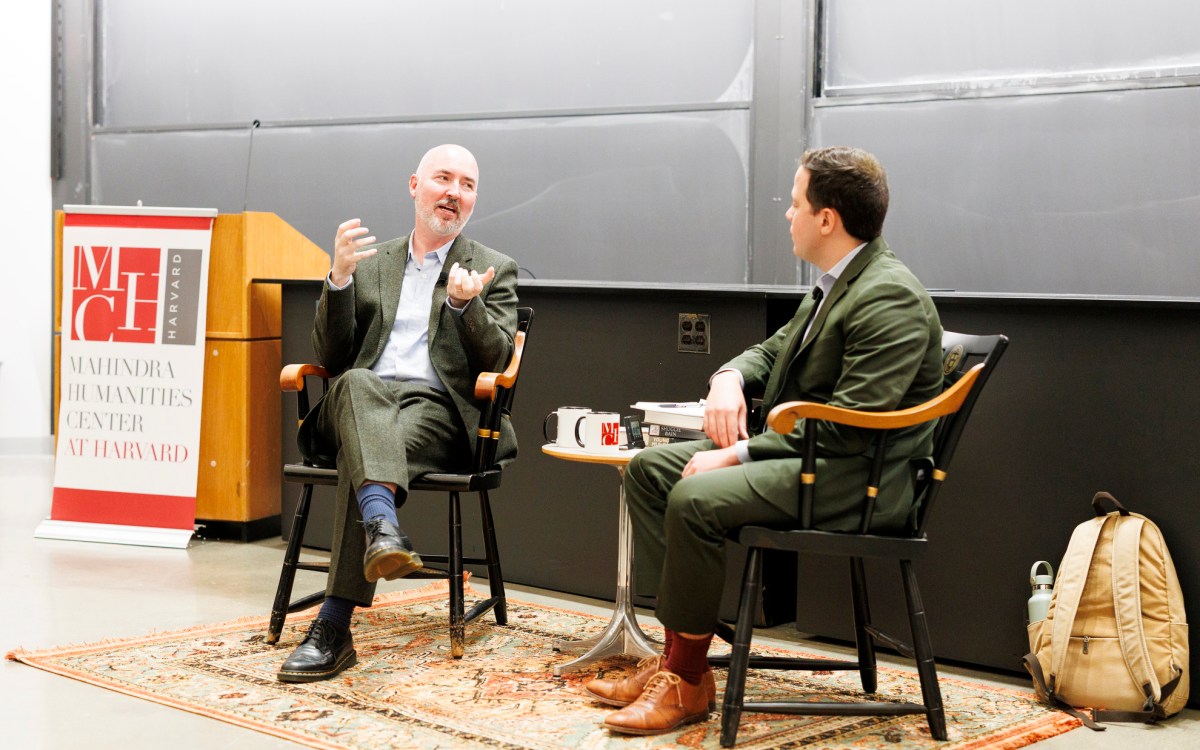
There are a thousand new HIV infections a day in South Africa, Pieter-Dirk Uys told an audience at Zero Arrow Theatre this week (April 14), during a public conversation sponsored by the Humanities Center at Harvard.
Pulitzer Prize-winning playwright Tony Kushner, author of the celebrated “Angels in America: A Gay Fantasia on National Themes,” delivered the Tanner Lectures at Harvard last week (April 9-11).
Hanging on the wall in Boylston 232, between windows overlooking the southern edge of Tercentenary Theatre, two small photographs present an intricate view of distant, colorful nebulae. Mark Schiefsky, professor of the classics, captured both images with his telescope. He has been revisiting the hobby of astrophotography as of late, an old passion from his boyhood in Michigan.
A few minutes into a conference last week at the Radcliffe Gymnasium, a building technician appeared on the balcony to open some windows. At the podium below, one of the presenters paused to say, “Air is good.”
Brown University cultural historian Robert O. Self — a Radcliffe Fellow this year — made a name for himself with his book “American Babylon” (Princeton University Press, 2003). He was the first scholar to connect the civil rights struggle with postwar white flight to the suburbs, and the tax incentives that made suburbanization possible.
An exhibition featuring the winning projects of the Aga Khan Award for Architecture will run through May 21 in the gallery at Gund Hall, Harvard Graduate School of Design (GSD). The Aga Khan Program at the GSD and the Humanities Center at Harvard University organized the exhibition, in collaboration with the Aga Khan Award for Architecture, now in its 10th cycle (2005-07). The exhibit was curated by GSD Professor Hashim Sarkis.
Shortly after unpacking his bags and setting up his easel, Antonio Martorell is ruminating on the philosophy of art. “The materials, as such, are as important as subject matter. They become subject matter themselves — they are matter and they matter.”
Controversial pop artist Jeff Koons brought his unique perspective to the Carpenter Center Thursday night (April 3), speaking about his work and philosophy to an invited audience of just over 200.
The Olympics are never just about sport. This summer’s Beijing Olympics have been emphatically about architecture, too. In preparation for the games this August, the Chinese capital is undergoing an urban transformation unprecedented in recent history.
In March 2001, Bill Saturno, a newly minted Harvard Ph.D., was in Guatemala searching for recently uncovered hieroglyphics as a research associate of the Peabody Museum. It turned out that his guides were overbooked and his planned expedition had to be canceled. As a sort of consolation prize, the company offered Saturno a three-hour Land Rover ride to San Bartolo in the Peten jungle, an area unexplored by archaeologists, to take a look at a Maya pyramid. Three hours turned into an overnight stay, then an arduous eight-hour hike in 100-degree heat to the pyramid.
Women in Design, a student group at the Harvard Graduate School of Design (GSD) that aims to increase the visibility of women in the field, kicked off its four-part spring symposium, “Progress in Process,” Thursday night (March 13) with a panel discussion on where women in architecture are now and where they are headed. Department of Architecture Chair Toshiko Mori moderated the event, which was held in Gund Hall’s Piper Auditorium and attracted a crowd of about 150 people — mostly, it was noted by panelists, women.
Manhattan composer Lisa Bielawa is a Radcliffe Fellow this year. Her tiny studio on Concord Avenue is spartan: white walls, a piano, a violin, two chairs, a table strewn with music staff paper. On one side is the glow of a computer. On the other is a single window, with a blur of trees beyond. But the little studio, as Shakespeare wrote of art, is such stuff that dreams are made on. The dream that Bielawa made at Radcliffe this year is “Double Violin Concerto,” a 24-minute composition that premieres in Boston next week (March 29). It pays homage to music’s past by reviving an old form. (Double concertos were last popular in Antonio Vivaldi’s 18th century.)

 Featured series
 Audio
Audio