Behind a large white tent in front of the Science Center, Harvard University Dining Services staff members worked over sizzling grills, cooking hot dogs and hamburgers to feed a large crowd of staff, students, and Greater Cambridge residents.
Aided by a wheel chair, his slight frame bent in part by a curvature of the spine since birth, in part by the passage of time, a man who endured unspeakable cruelty 70 years ago told his story of survival to a Harvard audience.
In stone, bronze, iron and oils the artistic and architectural details on campus boast a dizzying array of fine craftsmanship – both ornamental and functional – ranging over the centuries.
On an abnormally sweltering spring day, one would expect to see patches of Harvard students sunbathing in the Yard, not reading poetry inside Lamont Library. But a throng of students, faculty, and staff gathered inside the modest-sized Woodberry Poetry Room on a sultry Tuesday (April 28) evening to celebrate the release of Poetry@Harvard, a new Web site dedicated to all things poetry.
For the seventh year in its eight-year history, Harvard Review has had contributors selected for inclusion in the highly selective “Best American” series and have been nominated for a prestigious Pushcart Prize.
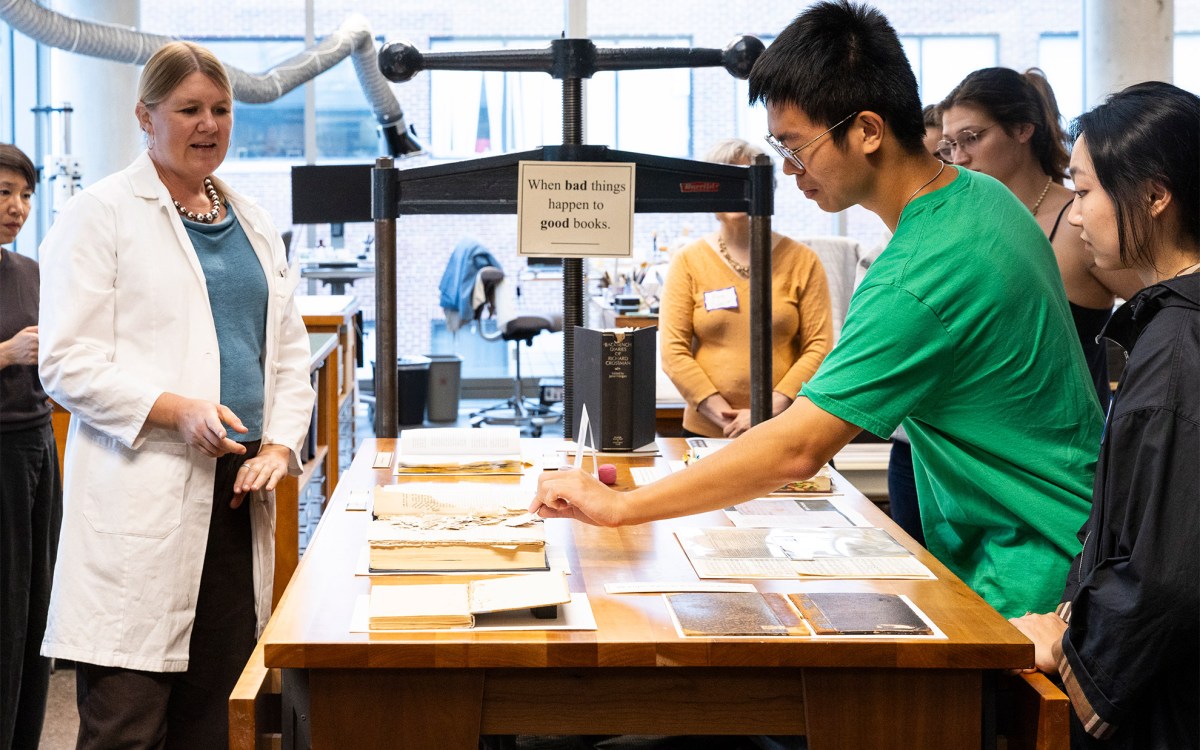
When Jane Cheng ’09 arrived at Harvard four years ago, her interest in book conservation led to a job at the Weissman Preservation Center, and it was that job that led her to the medieval text that would become the subject of both her senior thesis and a new exhibition organized by Cheng at Houghton Library.
A new exhibition, “‘Ever Westward’: Sir Arthur Conan Doyle and American Culture,” opening May 5 at Houghton Library, hopes to paint a fuller picture of Sir Arthur Conan Doyle’s contributions to world literature, which range from historical fiction to personal memoir to science fiction and beyond.
The Adams House Pool Theatre sits in the heart of Westmorly Court, one of the several “Gold Coast” dormitories that now make up Adams House. Originally built as a pool, the space has become home to unconventional, spirited productions and has gained a reputation as an alternative venue on campus.
Even on Earth Day — an April celebration of the environment since 1970 — humor traditionally has had little place. There’s always more oh-oh than ho-ho.
The Harvard Museum of Natural History’s galleries rang with music Tuesday evening (April 28) as the facility’s fossils made room for musicians performing seven original classical pieces written in honor of the 150th anniversary of the publication of Charles Darwin’s “The Origin of Species.”
English political philosopher John Locke died nearly a century before the American Revolution, and in his time parliamentary democracy was in its infancy. But his Enlightenment ideas — including the right to life, liberty, and property — went on to inspire American revolutionaries.
“Arriving this morning we made our way to our home for the next six nights, the floating hotel boat, The Merlijn,” wrote Martin Zogran, assistant professor of urban design in Harvard’s Graduate School of Design (GSD), in his blog that highlighted details of the Harvard-Netherlands Project: Climate Change, Water, Land Development, and Adaptation.
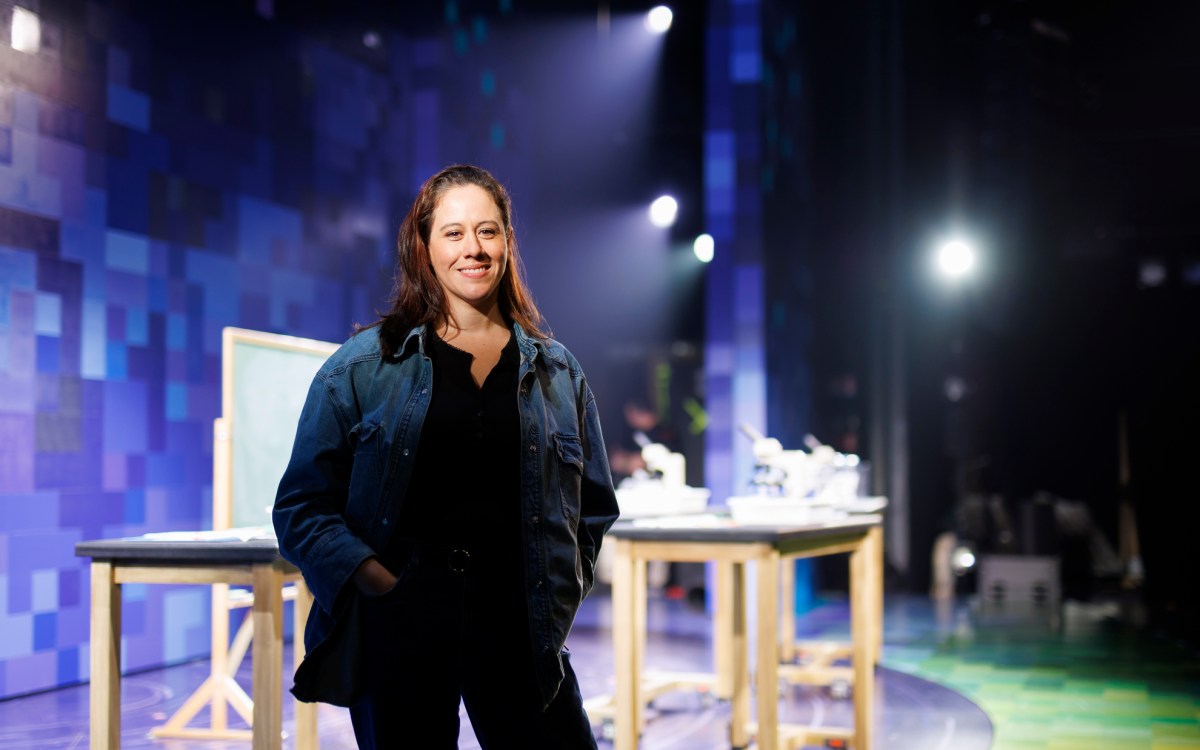
Clad in black and white, her brown hair loose about her shoulders, her green eyes intense, Diane Paulus sits in her office and smiles. Against the window rests a stolen treasure from her days as a Harvard freshman, a poster of the American Repertory Theater’s (A.R.T.) production of Samuel Beckett’s “Endgame.”
The Harvard University Choir and the Harvard Baroque Chamber Orchestra will present Handel’s magnificent oratorio “Saul” on April 26. The performance is dedicated to the memory of John Raymond Ferris, University organist and choirmaster from 1958-1990, who passed away last summer.
Harvard-Radcliffe Orchestra (HRO) members Catherine Buzney ’09 and Christine Barron ’09 have been named recipients of the Rachel Mellinger Memorial Award.
A recent symposium about the prehistory of Australia and the Americas brought together scholars from 10,000 miles apart. But that’s nothing compared to the journey early humans made to populate Australia and the Americas tens of thousands of years ago.
A graphic in an undergraduate geology textbook serendipitously led to the 2004 discovery of the missing link between fish and land animals far in the Canadian Arctic, one of the creature’s discoverers said during an April 16 lecture at Harvard.
The 100th anniversary of the discovery of the North Pole was marked this year on April 6. For more than 20 years, Harvard Foundation Director S. Allen Counter has made it a mission to bring to light the work of Matthew Henson, the African-American Arctic aide of Robert Peary, the sole explorer credited for reaching the North Pole in 1909.
Four women keep a meticulous diary of their stay on Great Brewster Island in July of 1891. The diary, which is filled with illustrations and photographs, was purchased by the Schlesinger Library in 1999.
Eleven undergraduate playwrights will present staged readings of their plays as part of the inaugural Harvard Playwrights’ Festival, held April 23-26 in New College Theatre. The plays will be performed with the collaboration of professional directors, graduate actors, and dramaturges from the Institute for Advanced Theatre Training.
Chris Gummerson ’12 was driving past the headquarters of a scrapple factory in a small town when an idea for a musical came to her. What if the town’s livelihood depended on the factory, and what if a USDA official made a surprise visit that culminated in a product-recall panic, and what if the meat-eating son of the factory’s owner fell in love with the vegan-artist daughter of the USDA official, and they had to set aside their dietary differences to save the town?
On the hot day of July 15, 1891, four women set off for the adventure of a lifetime in Boston Harbor. For nearly two weeks the quartet — well-educated, upper-class women from the Lowell area — “roughed it” in a quaint yet ramshackle cottage on remote Great Brewster Island, a place they considered “an enchanted isle.”
With music filling his ears, the Harvard-Radcliffe Orchestra (HRO) Conductor James Yannatos will retire after 45 years by giving his final concert on April 17.
Clicking keyboards provide a soundtrack to the semester’s end, as students put finishing touches on term papers, theses, dissertations, and the like. But amid the flurry of traditional writing assignments, there are other projects afoot. Short stories, for example. Screenplays. Fiction manuscripts. Personal essays.
In 1991 the Baseball Hall of Fame in Cooperstown, N.Y., paid homage to players from the Negro Leagues, an artifact of segregated America that had faded away three decades earlier.

 Featured series



 Video
Video