Kang-Kuen Ni, Theodore William Richards Professor of Chemistry and Professor of Physics, has been named to the 2026 class of Brown Investigators, a cohort of midcareer faculty recognized for bold, curiosity-driven research in physics and chemistry. Each investigator will receive significant, flexible funding over five years to pursue high-risk, high-reward basic science.
The Brown Science Foundation supports bold ideas for curiosity-driven basic research, focusing on tenured faculty at leading U.S. universities whose most daring projects are often difficult to fund through traditional government sources. Administered by the Brown Institute for Basic Sciences at Caltech, the program backs investigators in atomic and condensed matter physics and fundamental areas of chemistry with few funding restrictions and limited reporting requirements, enabling them to pursue new phenomena, novel measurement techniques and original strategies for analyzing complex data.
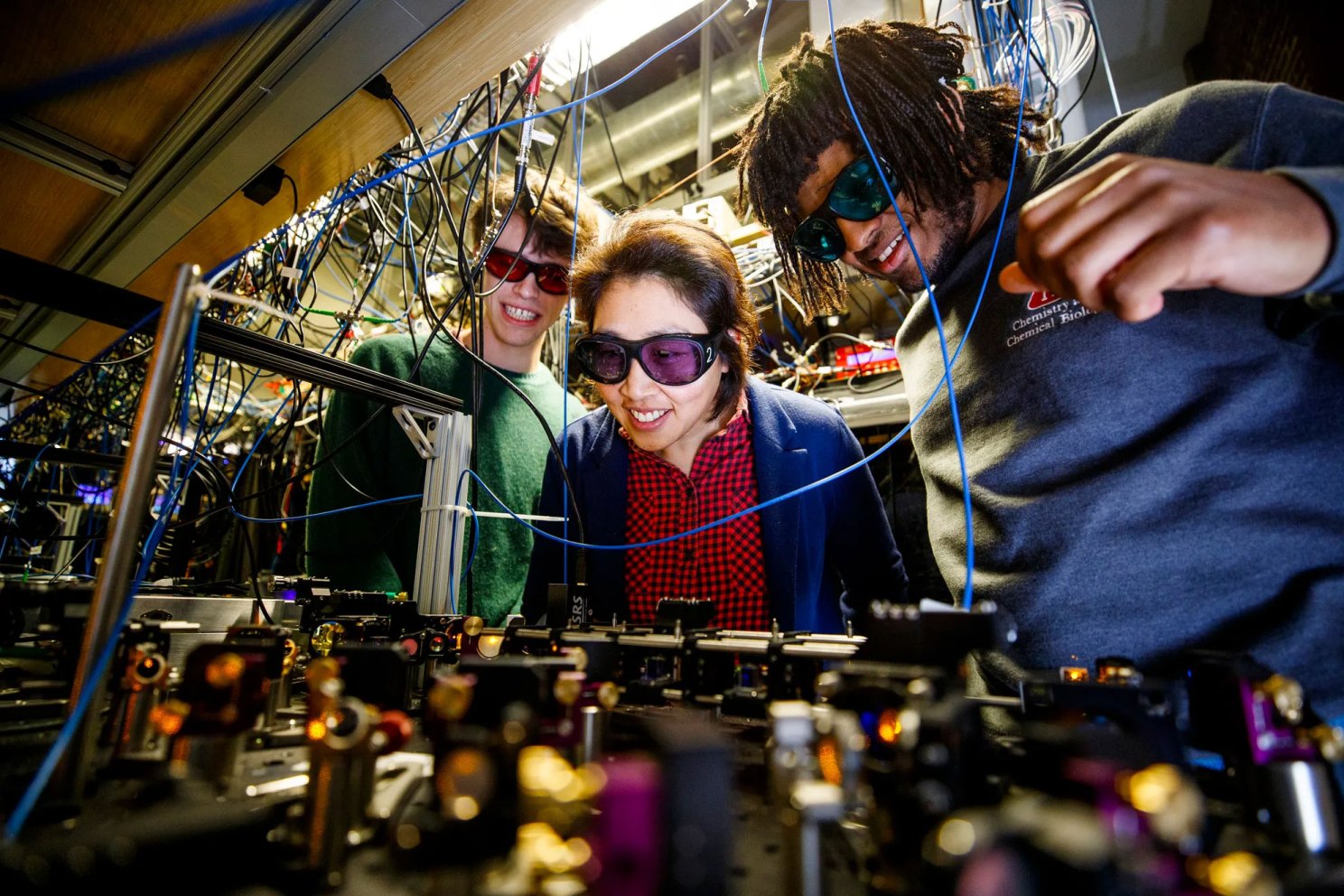
For Ni, whose work sits at the interface of chemistry and physics, the award comes at a pivotal moment. Her group has spent years developing a platform in which a single molecule can function as a quantum bit and a pair of them can interact to perform quantum logic gate — a fundamental operation for quantum information science.
“We’re pushing on a technology that we have been invested in for a while,” Ni said. “We had a good proof-of-principle demonstration demonstrating that we can use single molecules for quantum logic gates, something that we wanted to do for a long time.”
Logic gates enable information processing in quantum computers just as they do in traditional computers. But while classical gates manipulate binary bits (0s and 1s), quantum gates operate on qubits. That means quantum computers can do things that would be impossible for traditional machines.
Although the result has already attracted attention, Ni emphasizes that the underlying technology remains in its early stages.
“The technology is not mature so there’s a lot of room for advancement, and there are some serious bottlenecks that I want to solve to enable us to do a wider range of science,” Ni said.
Ni said the Brown Investigator award is especially meaningful because of the flexibility it provides.
“It’s hard work, but I think the award will enable us to do a lot of really exciting science down the road, for example to exploring exotic phases of matter such as quantum spin liquids and supersolidity,” she said. “Funding is very hard to come by, and flexible funding is extremely difficult and extremely valuable.”
Without the award, she added, the research would have continued but under far more constrained conditions.
Ni also sees the award as an affirmation of basic research and its often unpredictable impact.
“Often the real breakthroughs come from serendipitous discovery,” she said, “which sometimes allows us to make real leaps, as opposed to incremental progress.”
Because her work spans physics and chemistry, Ni said the focus of the Brown Investigator program feels like a good match.
“I feel like I am a natural fit for this award, because I’m at the interface between chemistry and physics,” Ni said. “I am excited for what we can achieve in the future.”

 Featured series