Featured series



Photo by Elena Seibert
Arts & Culture
‘She took those kids and left before he got home from work.’
Jayne Anne Phillips recalls childhood visits to beauty shop in rural West Virginia hometown in new memoir
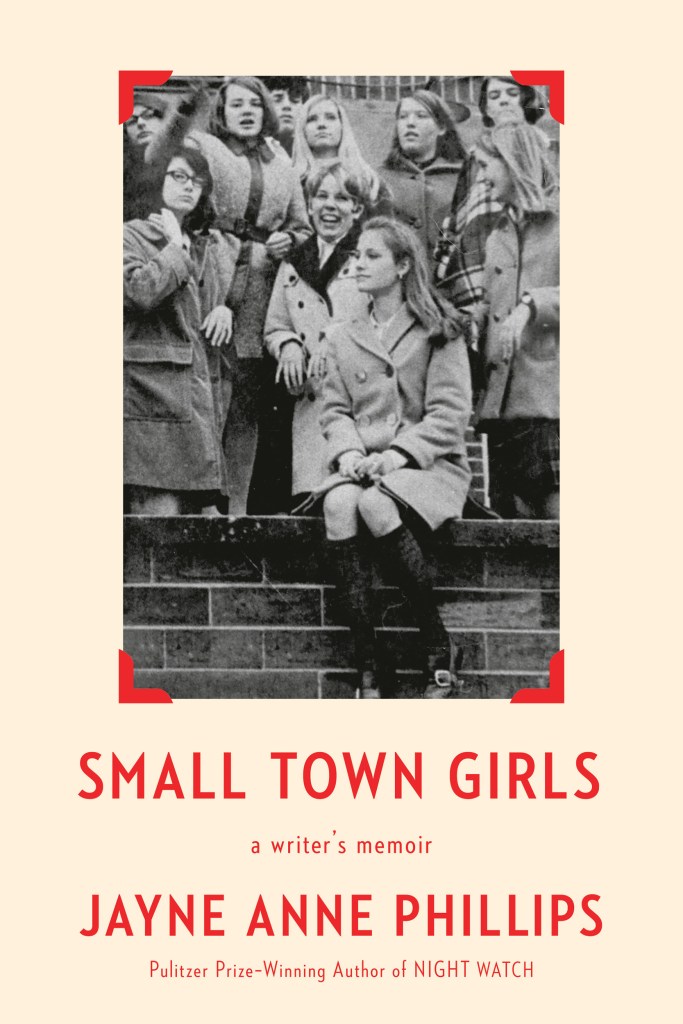
Excerpted from “Small Town Girls: A Writer’s Memoir” by Jayne Anne Phillips, Bunting Fellow (now called Radcliffe Fellows) ’80-’81, by permission of Alfred A. Knopf, a division of Penguin Random House LLC.
Who first tells us what is beautiful? Definitions of beauty are handed down, like stories and myths, absorbed as expressions of a specific time and place. In writing a particular novel, I found myself setting several scenes in a small town beauty shop, similar to one I remember from my own childhood. Beauty shops of that era predated use of the word salon, and there were definitely no male hairdressers. The shops were women-owned and women-operated sanctums in which there were no males of any stripe, unless they were babies, or the loutish teenage sons of the female owners, who walked through purely to rifle the cash register.
Girls need sanctums. It’s probably no accident that a few of the girl characters in my fiction are 11-, 12-, 13-years-old — about the same age I was when my mother began taking me along to her weekly hair appointments. My incursions into the world of beauty were part of my mother’s campaign to get me to cut my long (in her view) scraggly hair, a prospect I continued to view with suspicion, but I grew fascinated with the beauty shop itself. I was invisible there, privy to conversations not usually conducted in my hearing. Lulled by the sounds of the machines, I feasted on trash magazines my mother would never have allowed me to peruse. All around me, women were submitting, being serviced and done to. They engaged in truly archetypal gossip, touching on their own deepest fears and desires, trotting out other people’s stories as parable and warning. Later they got washed. Quiet now, they lay back in their chairs, heads swallowed up by the deep, slotted sinks. I noticed how their legs fell slightly apart. Their hands relaxed. Uniformed girls massaged their scalps with careless efficiency, and the women closed their eyes. Their faces took on a somnolent wistfulness that almost scared me, and I looked away. I’d witnessed attitudes of such surrender only at the movies, in love scenes between men and women, and those, of course, weren’t real.
Women went to the beauty shop to be with other women, to engage in private rituals that supposedly had to do with men, yet the men were wholly absent. They were sometimes discussed, but never as objects of desire, not as the heroes or princes my friends and I expected to encounter, out there somewhere, far beyond the adolescent boys with whom we were forced to contend. Conversations between women here skipped all that and presupposed a middle passage I resisted contemplating. Nowhere in the talk could I detect the dark pulse of promise sex had already acquired for me, a pilgrim at the gates. Women at the beauty shop didn’t talk about sex or refer to their own hopes or traumas. They did talk about instances of seduction, other women who had strayed, but it was always wholly the woman’s story, as though the man and the smell and feel of him were incidental. There were stories of triumph: She finally told him to hit the road. or, I looked him right in the eye and said, ‘There are laws to protect me from men like you.’
Women who came weekly to this shop ranged in age into their 80s, but my mother and her friends must have been in their late 30s. Far younger than I am now, they’d been parents for close to 15 or 20 years and were veterans of what seemed generations of marriage. They referred often to their grandmothers, who seemed to have known one another, too. They knew the stories of those partnerships and misalliances, the childbirths and early deaths, the wayward siblings and how they grew, the musings about those who went away and didn’t come back: They never heard from him again, or, She took those kids and left before he got home from work. The stories presupposed years of friendship between women, nurtured in the shelter of church groups and odd clubs, each with its memberships and little gold pins, its small books of rules, its ceremonies. The society of the shop seemed to me a more egalitarian, less severe adult variation on the theme of girls’ secrets. What happened there became a grown-up version of my first understanding of secrecy — those moments when a favored child of my early life crooked a finger in my direction, whispered, I’ll tell you a secret, and put her mouth to my ear. The words might be indistinguishable from breath itself, from the sweaty hand on my neck, but it didn’t matter. Those secrets bore the scent of our coltish bodies, of weeds and bushes, an earthy smell. In the beauty shop, words did matter, and the smell was chemical. Women didn’t speak in whispers here — they didn’t have to; the story was communal.
Still, beauty shops were a double-edged sanctuary. Here we were initiated into womankind as it existed in our town, but we were also made to understand what hard work it was to be beautiful, or even presentable. How it never came naturally. I remember finally sitting in the chair that pumped up and down with a foot pedal, staring at myself in the mirror. May, the proprietor of the shop, stood on my right, and my mother stood on my left. They debated what to do with me.
Look how short her eyelashes are, May said.
Yes, mused my mother, I’m afraid she’ll always be a plain Jane.
How about a short cut? May said. It’ll help her hair thicken.
And so I emerged, ashamed, my long hair chopped off nearly above my ears, with a haircut called a pixie.
. . .
The painful thing about adolescence is that everything seems absolute, and the painful thing about adulthood is that nothing does. My mother identified with our hometown in every way: comfortable in groups, a housewife who raised three kids while teaching elementary school and taking graduate classes one at a time. Twice, she went to New York with women from her bridge club and saw two or three Broadway shows each trip: “My Fair Lady,” “Brigadoon,” “South Pacific.” She kept all her Playbills and played vinyl albums of show tunes, early in my childhood, on our upright cabinet Victrola, singing along: “I’m gonna wash that man right outa my hair …” She went to Europe with women friends from her church, to Oberammergau, for the German passion play held in a Bavarian town outside Munich. “It’s performed once every 10 years,” she said. “I’d better go now, while I’m healthy.” In her early 20s, she’d nursed her mother through a cancer death. My grandmother died at home, and my mother was so traumatized that she never expected to live a long life.
She was right. The year after my mother died, the college in our hometown, her alma mater, presented me with an honorary doctorate of arts. I’m sure the honor was instigated by my mother’s friends, in her memory, in recognition of my attempt to care for her in those years. Her friends knew how she’d struggled, that she’d lived with me the last year and died far from home. She’d accumulated enough credit hours for a doctorate but never wrote her dissertation. Accepting the degree, I hoped I was completing, in a way, one of several important tasks she’d had to leave undone. Her friends all attended the commencement ceremonies. Many were the same women I had known from years before, when their children were growing up and they met at the beauty shop. I don’t remember any of them bringing their daughters to wait for the hour-plus it took to get their hair done, but my mother was a bit of a pioneer then; in 1970, she became one of the first “respectable” divorced women in the town. Some of the other women in her circle had worked outside the home; most had not. Some were the wives of doctors or dentists or professors, women whose lives she perhaps considered easier than hers in some respects, yet she knew them all well enough to know their sorrows; they were all girlhood friends who had struggled side by side through some of the calamities of their adult lives. That struggle and bond are surely the beauty of women, and every detail is remembered. All the rest is fascinating dross.
Can we forgive women for thinking about beauty? Can we forgive our mothers for hoping we’ll be beautiful? Can we forgive one another for fanning out the hand of cards dealt us by our families, our hometowns, by the cultures in which we all exist? All the suppositions about ideals, about what looks good, about what we’re supposed to do, who we can be?
The summer I was 26, during the painful breakup of a love affair, I went home, fled home, actually, to see my mother. Her only sister was visiting her at the time. My aunt Peg was ill, and seeing her was part of my excuse for leaving the man in question. I’d been driving for 10 hours; I was sweaty and tired, wearing a black leotard and (still) jeans.
Did I tell you? my mother asked my aunt. Someone’s going to publish her book.
No kidding, my aunt mused. As I struggled in and out with my suitcase and bags of books, she asked me, Why is your stomach so flat?
I don’t know, I said.
I do, said my mother. You won’t be asking her that question after she’s had a few babies.
Well, my aunt answered, she looks wonderful. They ought to put her on television right now — it’s all downhill from here.
Thanks, Aunt Peg, I said.
Mark my words, she responded.
And so it was, and wasn’t. The beauty of a beginning is always easiest to appreciate: the start of emotion, the unlined face, the unsullied field of snow. The middle passage — the deepening, the acknowledgment of age, change, banality, and heartbreak — is another matter. These combined to become the atmosphere I remember, the rituals I didn’t understand, those Saturday afternoons in the beauty shop. Silent observer, I watched the women who were trimmed and permed and crimped. Were they there to be beautiful? To fail in some dream of themselves? I think they were there to be together. One afternoon a week in their buffeted lives, someone took care of them.
© 2026 by Jayne Anne Phillips. All rights reserved. No part of this excerpt may be reproduced or reprinted without permission in writing from the publisher.