Featured series




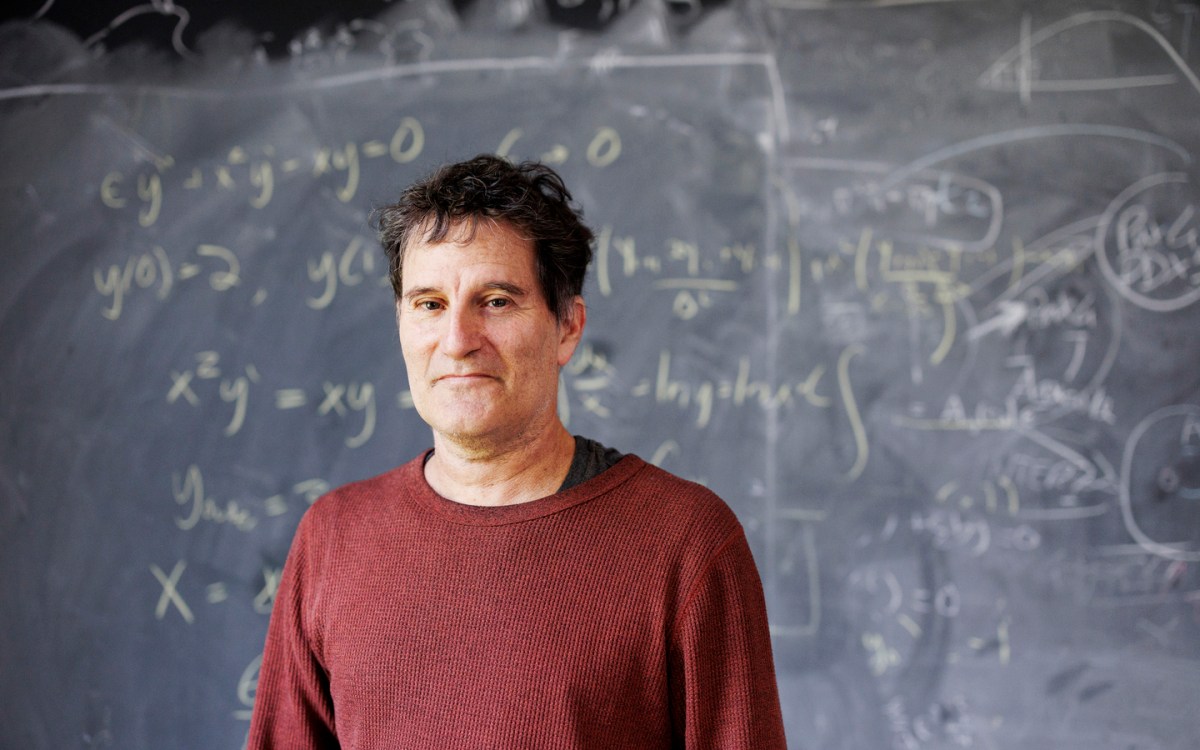
Natasha Singer.
Bella Wang Photography
Science & Tech
Should parents be wary of Silicon Valley’s influence in schools?
Times reporter says students need ‘tech civics’ to understand value, drawbacks amid breakneck advance of tools like AI
Things move quickly in Silicon Valley. Its now-familiar mantra — “move fast, break stuff” — can suggest either daring or recklessness, depending on where you stand.
It is an attitude that might be expected to sit uneasily in the deliberate, bureaucratic, complex world of public schools.
And yet, leading technologists and executives have been drawn to classrooms in recent decades as laboratories, market opportunities, and above all, problems waiting to be solved — whether with computers, software, or AI chatbots, according to Natasha Singer.
Since 2013, Singer has watched those efforts closely as a New York Times tech reporter. She found them at best quixotic or naive and at worst insidious, threatening to deprive young Americans of their ability to think critically about some of the world’s largest companies.
In her just published book, “Coding Kids,” she presents a panoramic view of a series of campaigns starting in the 1980s to shape the nation’s students into future coders, founders, and technologists.
The daughter of an MIT professor, Singer returns to Greater Boston this week to discuss the book, including in a conversation with Cathy O’Neill, Ph.D. ’99, author of “Weapons of Math Destruction: How Big Data Increases Inequality and Threatens Democracy,” Wednesday night at 6 p.m. at the Science Center.
In this edited conversation, Singer describes how tech companies became decisive players in public education — and why parents and teachers should be wary.
Gazette: One phrase that jumps out from your book is “tech exceptionalism.” When it comes to schools, you argue, we don’t rush to deploy even new cleaning chemicals or sodas. And yet we have done that with new digital technologies, for decades: from the first desktop computers to Chromebooks to AI. Why does tech have that unique level of access?
Natasha Singer: Big tech companies have more power in schools than any other industry partly by virtue of the fact that they now provide the infrastructure that schools run on. Apple and Microsoft provide iPads or Surface tablets; Google provides Chromebooks — and then the operating systems those things run on.
They also provide other kinds of infrastructure — cloud computing, data analytics, and things that kids and teachers use on a daily basis.
For instance, millions of kids use Gmail in school and come to class, and the teacher says, “Open your Chromebooks to Google Classroom,” which is an app that Google made where teachers can make assignments and kids can see them.
If they’re asked to write an essay, they do it in Google Docs; for a presentation, they’ll do it in Microsoft PowerPoint or Google Slides. So these companies are entrenched, the backbone on which schools rely to operate — and essentially utilities.
But then you detail a further step, where the companies that provide these utilities come, in many ways, to shape teaching and learning.
Right. These companies now have an end-to-end influence over nearly every step in the education supply chain that we do not see in other subjects or other industries.
Some train teachers directly or provide funding to third-party nonprofits that do. Some have also gone from state to state, lobbying to get laws passed or to promote subjects that are important to their industry — like AI or computer science.
And some companies have had a seat on state committees that decide what education standards are going to be for a subject like computer science.
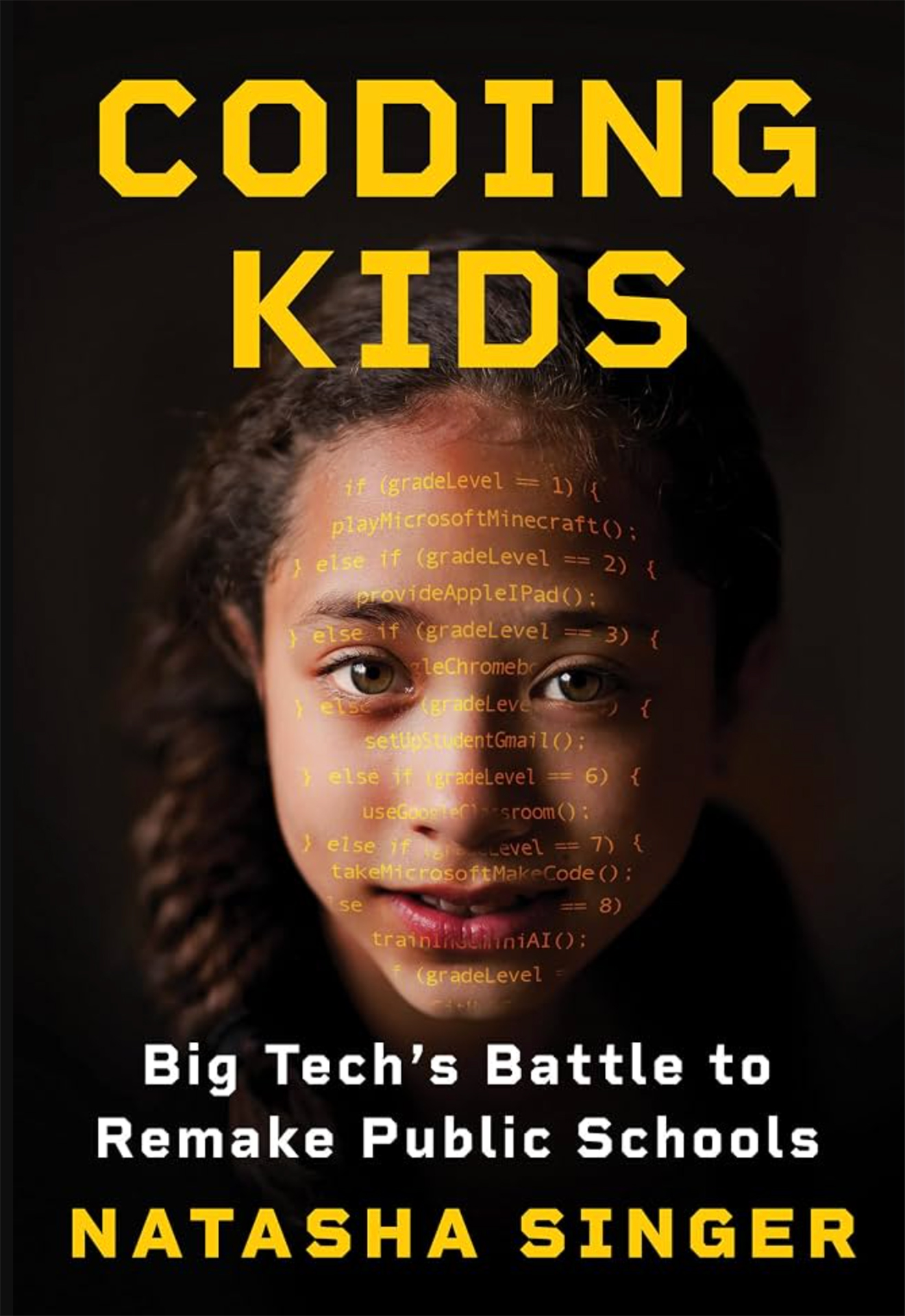
One example I give in the book is that when the College Board was trying to expand AP computer science, they decided to approve company-sponsored, branded curriculum.
So there is an AP computer science course that is Apple-branded, that teaches kids to code in Swift, Apple’s programming language for iOS. And there’s another one from Microsoft that uses Minecraft, their popular game, to teach computing.
By comparison, we do not have AP Pfizer Biology, or AP ExxonMobil Environmental Science. And if we did, there would be parents, teachers, and students who thought we shouldn’t let an oil and gas company shape what environmental science looks like.
Speaking of which, you came to the tech beat after years covering big pharmaceutical companies like Pfizer. And in the book you see parallels between the kind of hard and soft influence on industry professionals that the two industries have pursued.
Yes. For decades, the big drug companies have gone into big academic hospitals and brought lunch. Doctors are busy, so are run-down medical students, and they’d bring salad or sandwiches or pizza, and the doctors would sit for 15 minutes and have the industry rep tell them about the latest drug and its benefits.
When bioethics researchers studied these practices, they discovered that doctors who took even one lunch, worth less than $20, were more likely to prescribe the drug that had been pitched to them.
So in medicine, researchers routinely study that kind of influence, and doctors who speak at conferences have to disclose their conflicts of interest. But in public schools, we don’t even ask the question — like it’s impolite.
There is, of course, a cultural or an economic argument behind adding tech to schools. From the first desktop computers to AI, tech executives have argued that making digital tools available in school both introduces young people to the magic of engineering and better prepares the future workforce. And many public officials have agreed.
That’s right. And generally I take the position that most people were well-intentioned — there’s no big conspiracy. The executives I interviewed all thought their ideas would make stuff better.
I do think tech entrepreneurs like to look ahead, though: History isn’t something that many of them love, because it bogs you down. And I do think the framing of education as a solvable problem, when it is so complex, is one big issue here.
I really admire Larry Cuban, now an emeritus professor at the education school at Stanford. He wrote a book in the 1990s, right as computers were being introduced in schools, called “Oversold and Underused.” And he found that teachers didn’t know how to teach with them and that kids weren’t really using them.
Part of his argument was that schools’ most serious underlying problems — like kids who’ve come in without having eaten breakfast or dinner, or the roof is leaking, or there’s no air conditioning — are not going to be solved by technology.
You spoke with many teachers who are trying to navigate this moment, and they emerge as kind of the heroes of your book, trying to mediate between the good and the bad in the digital age.
That’s one of the things that gives me hope: this new generation of teachers with a vision for a broader kind of tech education. On top of using tech and making tech, they say kids need to be able to understand tech, interrogate tech.
There’s all kinds of names for that new approach, but I call it “tech civics.” We already teach government civics, and it’s a discipline about power.
The book ends in Revere High School, in the computer-science class of a teacher named Lisa Black. You watch her class, and she’s showing her students those robotic dogs that can carry weapons, and she’s asking them: “What are the risks of AI?” Or: “Who has your data?” The students said, “Mark Zuckerberg and the bald dude from Amazon” — they couldn’t remember Jeff Bezos’ name.
Now, Lisa Black told me she is grateful for the tools that the tech industry offers her — that she needs these resources. And she’s got a Google poster in one corner of her classroom, and an Amazon poster in another corner.
But she also said that the resources come with costs, and kids need to understand what’s under the hood, and, “As a teacher, it’s my duty to teach them that.”
The book is timely in the sense that communities are starting to raise the alarm about Big Tech. There’s the growing resistance to data centers behind AI models, and some large school districts are moving to ban or restrict AI use.
Earlier this year in Los Angeles, more than 1,000 parents petitioned the schools to stop providing iPads and Chromebooks in pre-K to first grade, and to block YouTube and other things — and the district agreed. New York just introduced some similar restrictions.
The book hopes to explain how we got here, by tracking this cycle: overpromotion of tech in schools, and then a failure to live up to the hype. That’s what parents are now pushing back against.