Featured series


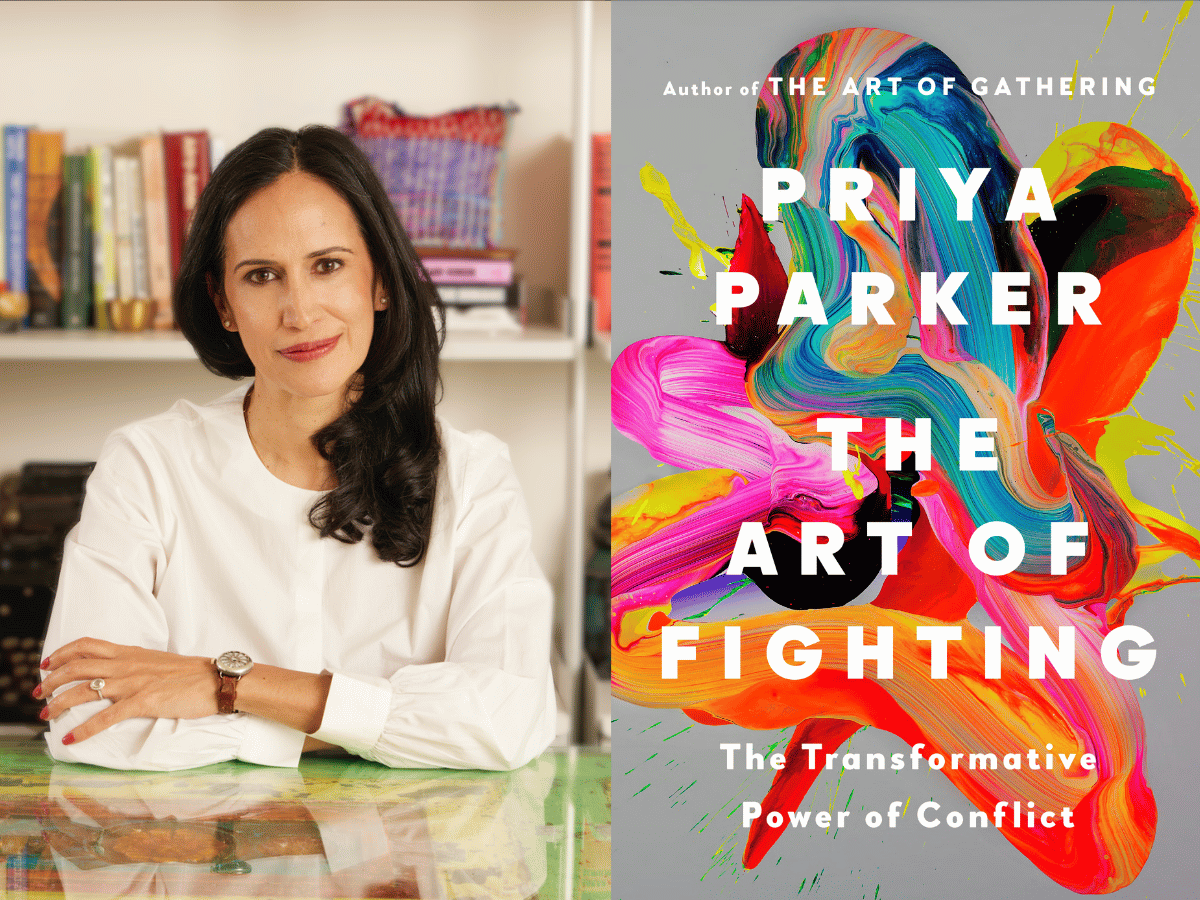
Priya Parker.
Photo by Fernando Palafox.
Arts & Culture
Why a fight might be just what your group needs
Priya Parker says sometimes reckoning with buried tensions can help reconnect group to values, identity — and one another
Excerpted from “The Art of Fighting: The Transformative Power of Conflict” by Priya Parker, M.P.P. ’12, published on Sept. 8 by Riverhead Books, an imprint of Penguin Publishing Group, a division of Penguin Random House LLC. Parker is a specialist in conflict resolution who works with organizations, communities, and leaders.
When people in conflict first call me, they tend to say some version of: “Make this go away.”
I get it. Conflict is not fun. They are concerned, worried. A group of people they care about, or rely on, or live among, is in crisis.
Make this go away.
What I have learned from years of fielding these calls is that most people, including people very savvy in other areas of life, have an unhelpful mental model of what group conflict is. Perhaps they think of it as a court case, and they’re calling me, their lawyer. Make this go away. Or they think of their fight as a story about to break in the media, and they’re calling me, their crisis communications whiz. Make this go away. Perhaps they think their conflict is just troublemaking by some members or employees or parishioners, and they’re calling me, a heavy, a tough guy who is going to find the complainers and ask ominously if they’ve got a problem. Make this go away.
I try not to judge this impulse. I get it. But I also inform my callers: I don’t make things go away.
I have a different perspective. To me, “How can I make this go away?” is the wrong question to ask, because trying to stave off a fight is not always what best serves a group. Thinking of conflict as something to bury or put back in the bottle or disappear is common among group amateurs. The artful fighter knows better. Some tears in group life should indeed be quickly sewn up and forgotten about. But others are the beginning of a big, revealing, and necessary reckoning, of a struggle that will force a group to face fundamental, half-buried questions about who they are, what they are for, and how they operate. These conflicts are unlikely to go away and will keep coming up again and again if left unaddressed.
So when people ask me to make a fight go away, I tell them it’s time to stop being afraid and start becoming curious. Why is this happening? Why is this happening to us? Why is this happening now? Why am I feeling so bad?
“When people ask me to make a fight go away, I tell them it’s time to stop being afraid and start becoming curious.”
Rebekah called me when she realized her family Passover ritual was broken. Her extended family had been gathering for the seder for some 30 years. Her grandmother, a Holocaust survivor and the family matriarch, always insisted that the family stick together. They were, as Rebekah put it, “desperate to cling to each other” and Passover Seder was the “big central thing for the whole family.” The ritual is a more-than-2,000-year-old tradition of remembering and telling the story of the Jews leaving Egypt and finding their freedom. For Rebekah’s family, “there was a lot of symbolism about slavery and redemption that for the Holocaust survivors was a really important way to express their grief,” she explained. It was often the only moment when family stories of survival were brought up at all. When she was young, Rebekah cherished the ritual and the gathering. It shaped her and so much of her family deeply.
Year after year, the whole family would witness the youngest among them ask the famous four questions of the seder. It was where family members shared important news — like a cousin who one year came out at the table. (During one hymn, the family would always joke and rhyme and make up new passages. That year, during the refrain “El bneh, el bneh,” Rebekah’s cousin Alex blurted out, “I am gay!” and without missing a beat, another family member retorted, “El bneh, el bneh, and that’s OK!”) It was where all the cousins would introduce their partners to the rest of the clan. When a niece’s chair broke under her and her new fiancé didn’t instinctively rush to catch her, the family knew the relationship was over. It was where Rebekah herself announced a pregnancy, one that she later lost.
But Passover was also where she started feeling the suffocating pressure and judgment around having kids. It was where she got stuck in the role of cooking for weeks ahead of time and throughout the festivities. And then once she finally had kids, she started to notice how sick they would all become after the late nights and frenzied days of family time. She started to feel the consequences of taking off days of work to prepare for the holiday, and then more precious days off to stay home with sick kids after the fact. It was becoming unsustainable. Like at many family holiday tables, ideological differences were also becoming more apparent. An uncle would regularly hit “reply all” to the family welcome email thread and send “long political right-wing rants,” which he would then bring to the dinner table. Then COVID‑19 hit, and the family couldn’t gather at all.
Until that moment on our Zoom call, Rebekah had been very matter‑of‑fact — almost clinical — in describing the situation. And then she got quiet. I saw that she was softly crying. When she heard the clacking of my typing stop, she looked up. “I’m so sorry,” she said. I said gently what I say on many calls: “Please don’t apologize.” And she just cried. “I don’t want to feel like this. I wish I didn’t care so much,” she said. She was articulating an unspoken assumption shared by so many people on these calls: If only she could just sidestep this part of the process. If she wasn’t bogged down by feeling so sad, she could act!
“Feelings aren’t just OK here,” I told her. “They’re crucial. They’re not an inconvenience. They’re information. They’re a natural resource. They’re energy.” As Rebekah was rationally plotting her exit from her family’s celebrations, she viscerally remembered how deeply she cared for these people.
Feelings, no matter how painful, are not bad. They are grist. You may not be able to solve what’s in front of you if you can’t be bothered to cry. Tears are the lubricant of group conflict resolution. “No More Tears” may be a great formula for kids’ shampoo, but it’s a disastrous approach to adult fights.
Rebekah was experiencing anticipatory grief trying to figure out what she should do with this messy group that she loved but where the formation was no longer working for her (and, she suspected, for others as well). In a study conducted for the National Institutes of Health, researchers found that our brains process turmoil in relationships and perceived isolation with the same pain receptors as physical attack. Often, people don’t know what to do with these feelings.
Your feelings about a group conflict are valid and normal. But they’re more than that. They’re useful and informative. In fact, when a group feels really stuck, feelings are a signal of possibility.
When you find yourself feeling fragile or hurt in the aftermath of some kind of rupture, it may be that you are experiencing something that the conflict resolution specialist Sethu Nair calls “relational longing.” It is one of the most important superpowers you can tap into when seeking to resolve and transform a conflict.
Nair is a veteran group dialogue facilitator who works at the Center for Creative Conflict Resolution in New York City. She’s the kind of facilitator who gets a call when a “flag war” breaks out in the offices of a local government agency — Black Lives Matter signs on some desks, American flags or Blue Lives Matter ones on others. Would she be willing to come in and help the staff confront the divisions within?
Nair is not intimidated by garden-variety conflict. She’s a founding member of Hidden Water, an organization that developed trauma-informed circles for individuals and families impacted by child sexual abuse who wanted to heal with others.
In explaining how she begins to approach a conflict, Nair says that she must find the “relational longing” at the center of the fight. This relational longing, she says, is “the only avenue of possibility” through the fight, and she believes it exists everywhere. Relational longing is the residual desire within us to connect to someone or something, even when we’re hurt or mad. “We wouldn’t even have conflict if we weren’t trying so hard to be heard,” Nair told me. “I love finding that, and it’s not so hard to find if you really listen for what people are longing for.”
We don’t fight within our groups because we hate each other and want nothing to do with each other anymore. We fight because we are yearning to be in relationship with each other still, perhaps just not in the form of relationship we are currently in. (When that’s no longer true, we don’t fight; we leave.)
Where there are strong feelings, there is energy, and energy is easier to work with than apathy. There’s a there there. Where there is some beating pulse of relationship left, even a badly arrhythmic one, there remains a possibility of transforming the bond.
The inverse is also true. If a rupture stirs no feelings in you, that is useful to know. You may have a problem in the group, but no longing to solve it.
By the end of the calls I get, if I’ve done my job well, the person feels better. Nothing may have changed in the situation, but they have begun to learn what the artful fighter knows: that when faced with the first flushes of a conflict, they must steel themselves and refuse to sweep back what is peeking out from under the rug. They must push themselves to be curious — about why they’re feeling what they are, about what areas of heat are causing their group to fracture, about what they may have failed to notice before, and about why all this may be happening now.
Once the laments recede and the real questions arise, the artful fighter is well on their way. What awaits them now is trying to figure out, through all this questioning, what they have on their hands.
Copyright © 2026 by Priya Parker