Featured series
Arts & Culture
‘Design is not a single thing,’ and these projects prove it
Complexity a common theme in GSD students’ option studios
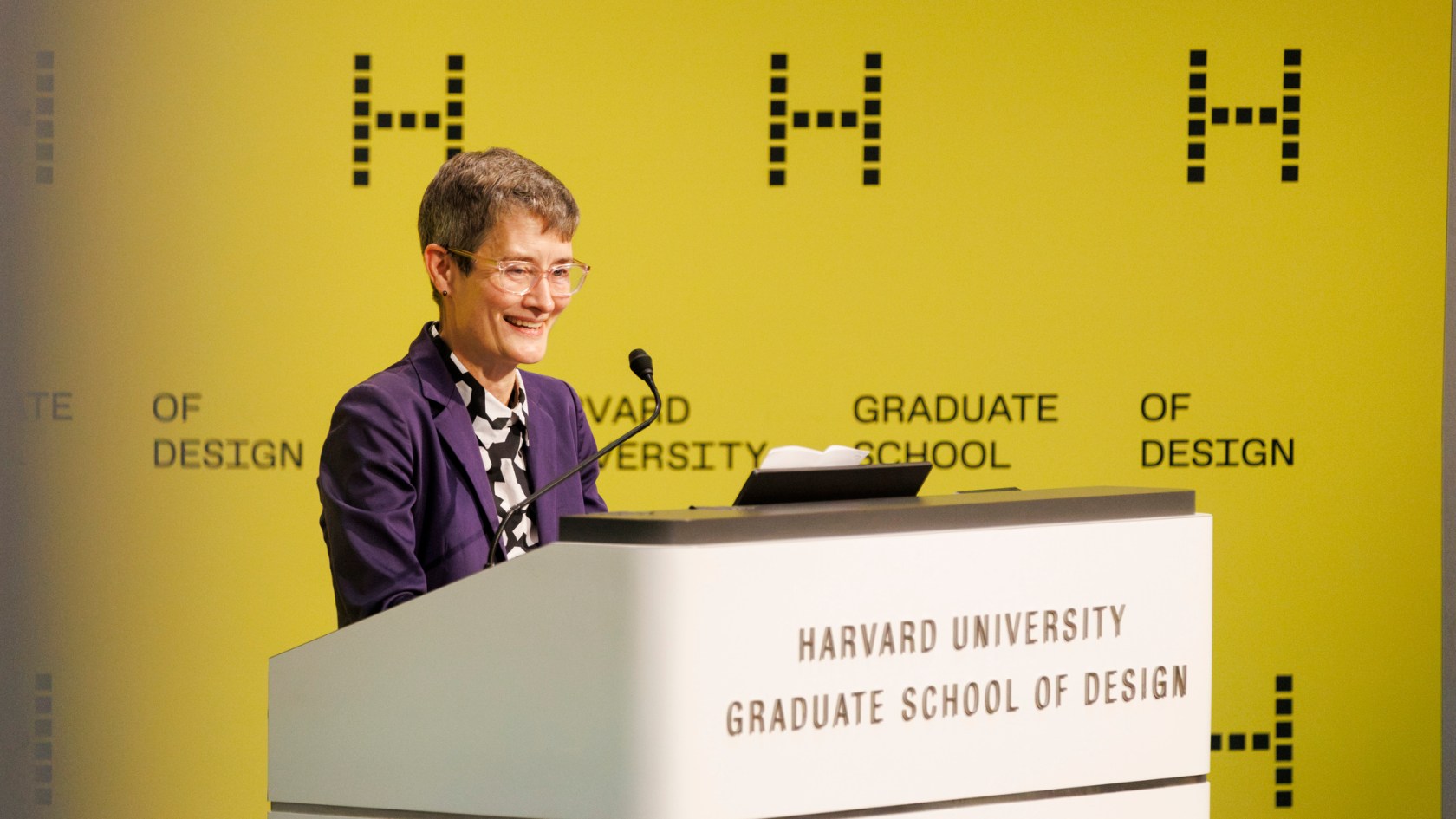
Sarah Whiting.
Niles Singer/Harvard Staff Photographer
Students at Harvard’s Graduate School of Design don’t just apply their knowledge in the classroom. They tackle real-world challenges facing communities across the world, including in advanced “option studios,” where innovations in architecture, landscape architecture, and urban planning and design are among this year’s projects.
“Design is not a single thing,” said Dean Sarah Whiting during a kickoff event this month. “It’s not a single technique. It’s not a single geography or even a single discipline. Each option studio, like any design commission out there in the real world, is like a mini-GSD because design studios draw from all the School’s disciplines. They are impacted by policies and codes, history, site conditions, climate, structures, typologies, morphologies, materials, social, financial, and political considerations.”
The breadth of this year’s 23 projects, she added, is “simply breathtaking.”
Below, a sampling. Read more about this year’s option studios here.
From rust to must: Reimagining McKeesport
Deep into the 20th century, industry boomed in the steel towns of Western Pennsylvania. But in the 1970s, foreign competition began to take a serious toll on U.S. steel, depriving once-bustling communities of crucial revenue and leading to a period of decay and disrepair.
“Can major shifts in lifestyles, productivity, and the environment be tapped, and through design, induce economic development and community renewal?”
Ignacio Bunster-Ossa
This semester, students in Ignacio Bunster-Ossa’s open studio will explore how to revive these communities, looking specifically at McKeesport, a town outside Pittsburgh blighted by hollowed-out factories.
“Can major shifts in lifestyles, productivity, and the environment be tapped, and through design, induce economic development and community renewal?” Bunster-Ossa asked. “I suspect that students will be challenged to address every condition of an urban environment, from public space to development to buildings to infrastructure to see if there’s a solution here.”
Before the master plan: Architecture as cultural hypothesis for Shinagawa Ura, Tokyo
Ever travel only to feel that your surroundings haven’t much changed? According to Elizabeth Bowie Christoforetti, this might be because cities are all starting to look the same.
Christoforetti’s course will explore homogenization among 21st-century post-industrial landscapes, and how designers and planners might find a way to introduce some variety.
Students will examine “the changing relationship between water, land, and building, as well as the shifting dynamic between human and nonhuman systems in an era of new nature,” Christofretti said.
The main case study will be the Shinagawa Ura waterfront in Tokyo — currently undergoing a redevelopment by Nippon Steel.
“We will work directly with Nippon Steel to explore alternatives to the replication of sameness in a real-world application,” she said. “We’re asking questions about buildings and places, about how buildings and places become what they are, and what the invisible forces are shaping their visible form and disposition.”
Diversions: Minor public works of the continental divide
It’s easy to miss the massive water infrastructure that runs through the landscape of Rocky Mountain National Park. But if you look closely, there are clues — a tunnel opening or outlet pipe peeking out from the grass or stone.
In her studio, Danielle Choi will explore how this hidden infrastructure may shape Colorado’s continued need for freshwater transport as well as new recreational amenities popping up across the state. According to Choi, droughts and diminished snowpack are shifting the state’s resource access, while at the same time tourism at national parks and their surrounding areas is affecting the natural landscape.
Choi’s students will look at how these needs might work together, and how they might attempt to blend into the natural world, including utilizing or rejecting the idea of visitors enjoying nature at a distance — or as a panoramic view.
“We’ll be looking programmatically at the 20th-century legacy of the National Park Service visitor infrastructure and how we might rethink these kinds of encounters and thresholds with the built and natural landscape,” she said. “At the same time, we’ll be drawing upon the work of Herbert Bayer — Bauhaus designer, graphic designer, exhibition designer, and landscape designer — thinking through his work on the hydrologic cycle to investigate different precedents that engage water, and thinking through mapping for students to form a programmatic or relational agenda among the different sites.”